Sit inside a movement-disorder waiting room in Boston, Seattle, or Phoenix and you can spot the exact inflection point when oral Parkinson’s pharmacology stops holding the line. For the first five or six years after diagnosis, immediate-release carbidopa-levodopa smooths out resting tremor and bradykinesia reliably. By year eight or nine, however, striatal dopamine buffering narrows into a punishing roller coaster: forty-five minutes of violent peak-dose choreiform dyskinesia followed abruptly by “off-state” gait freezing in grocery store aisles, painful dystonic toe curling at 4:00 AM, and pill-burden alarms ringing six times a day. Functional neurosurgeons know that bilateral Deep Brain Stimulation (DBS) acts as an electronic clutch—flattening motor fluctuations and trimming daily levodopa equivalents by 40% to 60%—yet financial clearance inside the United States routinely stalls families for a year or more.
For pre-Medicare Americans aged fifty-two to sixty-four carrying self-funded ACA bronze plans, narrow-network Medicare Advantage enrollees denied out-of-state academic referrals, or patients whose domestic insurer refuses to cover a 15-year rechargeable Implantable Pulse Generator (IPG) over a cheaper non-rechargeable battery, hospital billing statements run between $110,000 and $155,000. Nearly two-thirds of that invoice reflects US hospital implant markup rather than neurosurgical operating time.
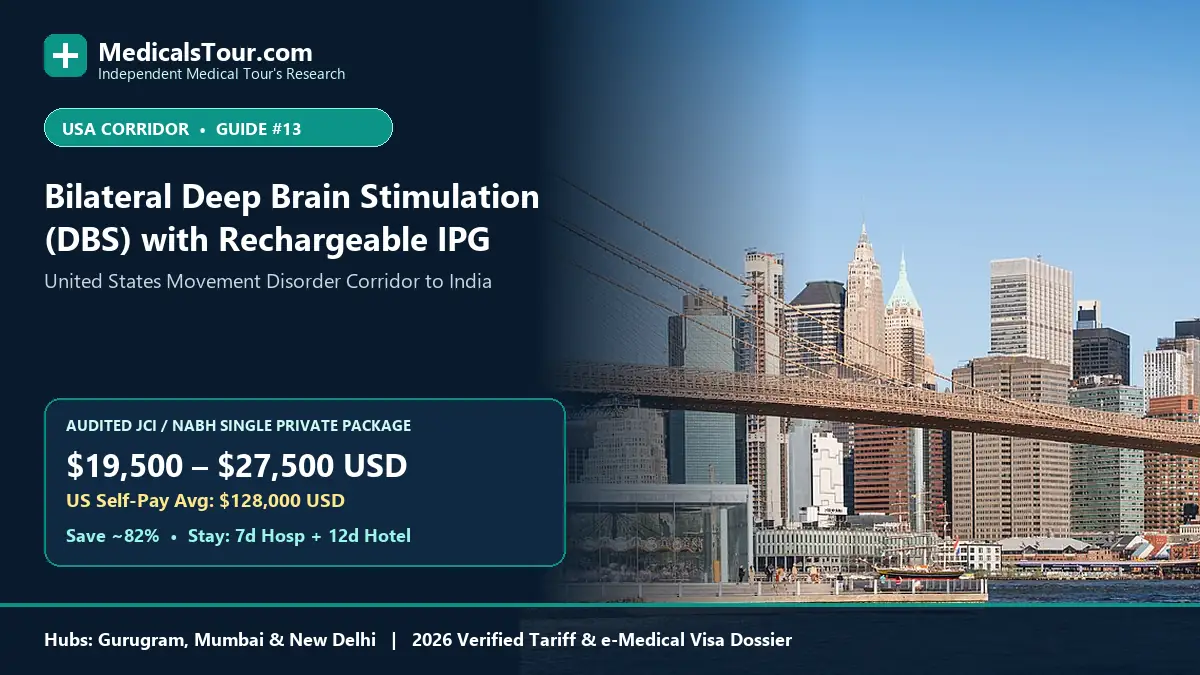
Across Medical Tour’s 2026 functional neurosurgery audit in Gurugram, Mumbai, and New Delhi, we examined itemized hardware invoices, stereotactic targeting workflows, and cross-border remote programming setups. At India’s flagship JCI hospitals, complete bilateral DBS implantation using the exact same FDA-approved Medtronic, Abbott, or Boston Scientific directional leads and rechargeable generators bills between $19,500 and $27,500—including seven inpatient nights and initial monopolar contact mapping before flying home.
When Levodopa Windows Narrow and US Hospital Device Markup Hits Six Figures
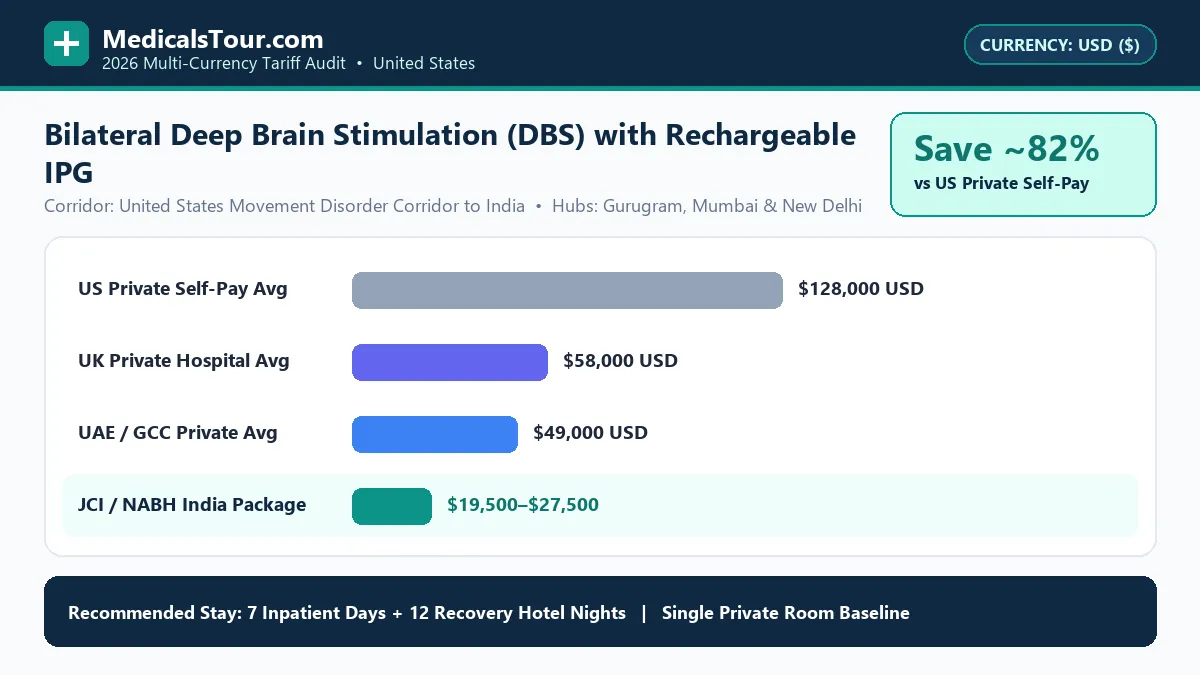
Understanding why bilateral Deep Brain Stimulation costs $25,000 in Gurugram versus $128,000 in Cleveland or San Francisco starts with medical-device supply-chain economics. Three American manufacturers—Medtronic, Abbott Neuromodulation, and Boston Scientific—supply virtually 100% of the Western world’s directional brain leads, cranial burr-hole locking caps, tunneled extension cables, and subclavicular pulse generators. Inside India, national medical-device price-transparency rules and direct institutional procurement compress the landed price of a rechargeable dual-channel neurostimulator kit to roughly $13,500–$17,500, whereas US hospital chargemasters routinely mark up that identical serial-numbered titanium box to $58,000–$75,000 before adding stereotactic operating room minutes.
Clinical volume reinforces that cost advantage. Leading movement-disorder teams in Delhi NCR and Mumbai implant 80 to 140 bilateral DBS systems annually—spanning idiopathic Parkinson’s disease, generalized DYT1 and cervical dystonia, medication-refractory essential tremor, and Tourette syndrome. Unlike low-volume community hospitals performing one DBS case a month, dedicated Indian functional neurosurgery programs staff full-time movement-disorder neurologists, neuropsychologists, and electrophysiologists inside the operating theater to interpret real-time microelectrode neuronal firing signatures.
Patients already researching cranial and spinal navigation standards across Indian tertiary centers can compare intraoperative imaging infrastructure in our US-to-India O-Arm Navigation Spine & Neurosurgery Guide as well as our itemized Neurosurgical & Spine Procedure Cost Benchmarks. Beyond idiopathic Parkinson’s disease, North American families also utilize this corridor for refractory essential tremor targeting the Ventral Intermediate Nucleus (VIM) of the thalamus—where bilateral stimulation routinely restores handwriting, soup-spoon steadiness, and water-cup control within seconds of intraoperative test activation—and pediatric or young-adult generalized dystonia where high-amplitude GPi pacing prevents permanent orthopedic spinal contractures.
2026 Bilateral DBS Package Breakdown: Medtronic, Abbott & Boston Scientific IPG Tiers
In Indian corporate hospital billing, DBS quotes split cleanly into two parts: the Surgical & Hospitalization Bundle ($6,500 – $8,800) and the Imported Implant Hardware Kit ($12,800 – $19,200) billed at transparent MRP sticker price. You can combine these package tiers with companion flights and twelve hotel nights in our Medical Trip Budget Planner.
| Bilateral DBS Hardware Configuration | US Self-Pay / Out-of-Network Avg | India All-In Package (USD) | Battery Lifespan & Programming Ecosystem |
|---|---|---|---|
| Non-Rechargeable Primary Cell Dual-Channel IPG (Medtronic Percept PC / Abbott Infinity) |
$105,000 – $128,000 | $19,500 – $22,400 | 3.5–5 year battery life depending on voltage; zero weekly charging chore, ideal for older patients with mild dexterity limits. |
| 15-Year Rechargeable Directional System (Medtronic Percept RC with BrainSense) |
$125,000 – $152,000 | $24,500 – $27,500 | 15+ year longevity, rapid 45-minute wireless chest-pad recharge, records beta-band Local Field Potentials (LFPs) for adaptive tuning. |
| Remote Tele-Programming Rechargeable System (Abbott Liberta RC + NeuroSphere Virtual Clinic) |
$122,000 – $148,000 | $23,800 – $26,900 | Encrypted cloud programming allows your neurologist to adjust amplitude, pulse width & directional steering over Wi-Fi back in the US. |
| 8-Contact Directional Current-Steered System (Boston Scientific Vercise Genus R16) |
$120,000 – $145,000 | $23,500 – $26,800 | Multiple independent current control (MICC) steers stimulation away from internal capsule fibers to prevent slurred speech. |
| Chest IPG Battery Replacement Only (Existing Leads) | $38,000 – $54,000 | $11,500 – $15,800 | 45-minute subclavicular pocket swap under local/monitored sedation; 1–2 inpatient nights & impedance verification. |
Why Most Traveling US Patients Choose Rechargeable Directional Hardware
When flying 8,000 miles for functional neurosurgery, spending an extra $4,200 up front for a 15-year rechargeable generator (Percept RC, Liberta RC, or Vercise Genus R16) pays enormous clinical dividends. High-energy targets such as the Globus Pallidus Internus (GPi) in generalized dystonia or advanced dyskinesia can drain a fixed primary-cell battery in thirty-six months—forcing a $42,000 chest-pocket replacement surgery back in the States. Rechargeable titanium generators are thinner on lean chests, carry full-body 1.5T/3T MRI conditional clearance when switched into MRI mode via the patient controller handset, and include universal 100V–240V inductive charging collars compatible with US wall outlets.
Just as important as battery longevity is segmented directional lead geometry (1-3-3-1 contact rings). Older cylindrical ring electrodes radiated current symmetrically in a 360-degree sphere—meaning if a lead sat 1.2 millimeters close to the internal capsule corticospinal tract, turning up voltage to stop hand tremor triggered lip pulling or slurred dysarthria. Modern segmented directional leads allow your neurologist to steer electrical fields medially or dorsally toward pure motor subthalamic fibers while shielding adjacent sensory and speech tracts. Confirm before admission that your hospital Proforma Invoice specifies 8-contact directional leads rather than legacy 4-contact cylindrical leads, and budget $450 to $850 extra for Day-1 outpatient pre-anesthesia echocardiograms, non-frame 3T volumetric MRI sequences, and discharge oral medications.
Candidate Screening: The UPDRS On/Off Levodopa Challenge & Neurocognitive Clearance
Ethical Indian movement-disorder programs turn away roughly 20% of international inquiries before a visa letter is ever issued—and that selectivity should reassure your family. Deep Brain Stimulation works miracles for idiopathic Parkinson’s symptoms that still respond to levodopa (resting tremor, rigidity, bradykinesia, motor fluctuations, and levodopa-induced dyskinesia), plus levodopa-resistant Parkinsonian tremor. Conversely, it will not reverse atypical parkinsonism—such as Progressive Supranuclear Palsy (PSP), Multiple System Atrophy (MSA), or Corticobasal Degeneration—nor will it cure late-stage postural instability falls or dementia.
Clinical timing matters too: following landmark EARLYSTIM trial evidence, movement-disorder boards no longer treat DBS as a last-ditch hospice salvage after fifteen years of wheelchaired decline. Ideal American travelers typically sit four to eleven years post-diagnosis (Hoehn and Yahr Stages 2.5 to 3.5 in the OFF state)—still cognitively sharp and eager to keep working, traveling, or playing golf, yet trapped by unpredictable oral wearing-off spells or violent dyskinesias that oral entacapone, rasagiline, and amantadine can no longer smooth out.
Before booking flights, Indian centers request three specific pre-travel items over encrypted video and cloud upload:
- Standardized UPDRS Part III “OFF vs ON” Video Protocol: Recorded at home or with your local neurologist—first in the morning after withholding dopaminergic medication for 12 hours (“practically defined OFF state”), and again 60 minutes after a suprathreshold levodopa dose (“best ON state”). A ≥ 30% motor score improvement confirms robust surgical candidacy (with tremor-dominant Parkinson’s granted an exception even when oral response is modest).
- Recent Non-Contrast 3-Tesla Brain MRI: Uploaded in raw DICOM slices to rule out severe microvascular white-matter ischemia, hydrocephalus, or structural basal ganglia atrophy along the planned frontal trajectory.
- Neuropsychological & Psychiatric Screening: Verifying intact executive cognition (MoCA / Mattis Dementia Rating Scale) and controlled mood, which helps the team choose between targeting the Subthalamic Nucleus (STN)—superior for cutting medication pill burden—and the Globus Pallidus Internus (GPi), often favored for patients over sixty-eight or those needing gentle cognitive and speech preservation.
Genetic subtyping occasionally refines that target choice even further. Younger-onset American patients carrying LRRK2 or Parkin (PRKN) mutations generally exhibit sustained, crisp STN responsiveness for well over a decade, whereas patients with certain glucocerebrosidase (GBA) variants face steeper long-term cortical cognitive vulnerability—prompting experienced Gurugram and Mumbai multidisciplinary boards to favor pallidal GPi stimulation over aggressive subthalamic pill reduction.
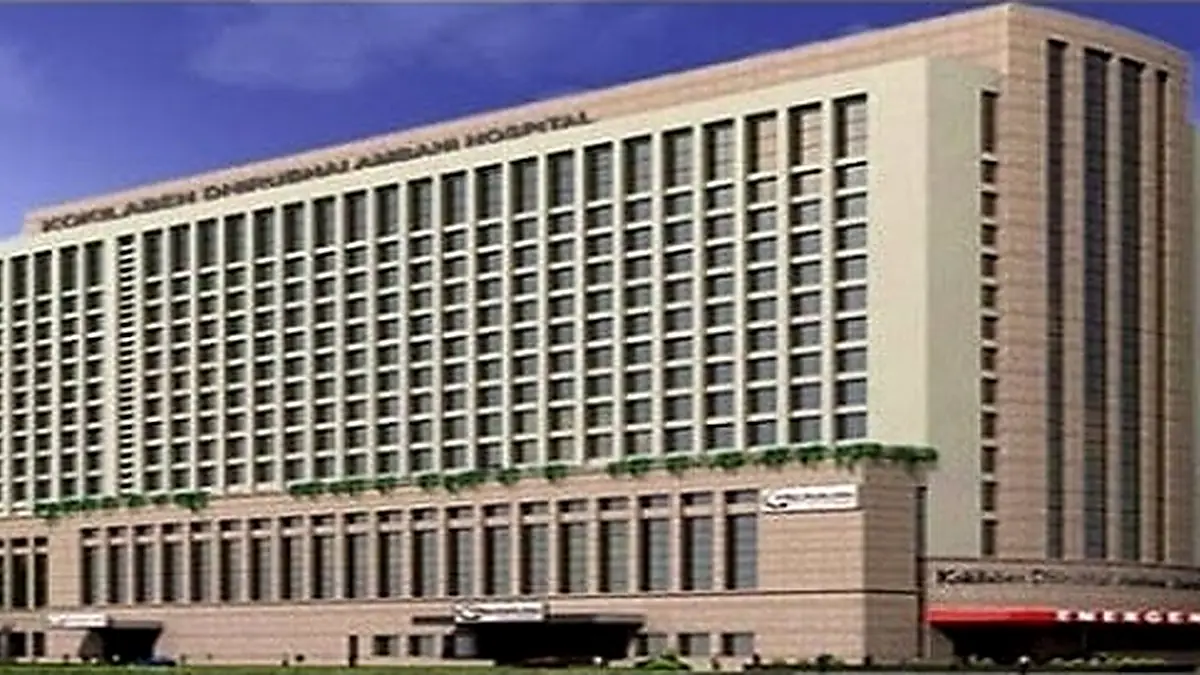
Inside the Stereotactic Suite at Medanta Gurugram and Kokilaben Mumbai
Two quaternary JCI campuses anchor North American movement-disorder referrals. Thirty minutes southwest of New Delhi’s IGI Terminal 3 via NH-48, Medanta – The Medicity in Sector 38, Gurugram operates an Institute of Neurosciences equipped with intraoperative 3T MRI Suites, Medtronic O-Arm 3D stereotactic verification, and Leksell Vantage carbon-fiber frames that eliminate metallic CT artifact. On India’s western coast, Kokilaben Dhirubhai Ambani Hospital in Four Bungalows, Andheri West, Mumbai houses a dedicated Centre for Movement Disorders featuring high-density 5-channel Microelectrode Recording (MER) and ROSA robotic stereotactic assistance.
Understanding how Stage 1 and Stage 2 unfold calms pre-op anxiety for both patient and spouse. On surgery morning (after an overnight 12-hour medication hold), local lidocaine numbs four cranial pin sites to secure the Leksell frame, followed by thin-slice stereotactic CT fused digitally onto preoperative 3T SWI/FGATIR MRI tractography maps showing the dorsolateral sensorimotor zone of the STN down to 0.5-millimeter accuracy.
During Stage 1 (Awake Cranial Lead Placement, ~3 hours), the patient rests comfortably awake—because the brain parenchyma itself has zero pain receptors—while hair-thin microelectrodes listen to characteristic high-frequency STN burst firing. The movement-disorder neurologist stands right beside the drape testing wrist cogwheel rigidity, finger taps, and counting speech aloud at 1.0 mA to 4.0 mA test currents, confirming wide therapeutic windows without capsular pulling or diplopia. Once locked into twin burr-hole caps and verified by intraoperative O-arm CT, the anesthesiologist induces brief general anesthesia (~60 minutes) for Stage 2, tunneling subcutaneous extensions behind the ear to implant the pulse generator beneath the collarbone.
Infection control inside a neuro-prosthetic theater tolerates zero shortcuts, because a colonized subclavicular pocket can force hardware explantation. Both Medanta and Kokilaben enforce laminar ISO Class 5 positive-pressure airflow, double-gloved implant handling, vancomycin-gentamicin antibiotic pocket irrigation, and strict preoperative nasal mupirocin plus chlorhexidine body washes for 48 hours prior to skin incision—holding hardware infection rates around 1.1%, squarely in line with leading North American academic registries.
19-Day Surgical & Initial Monopolar Programming Schedule Before Flying Home
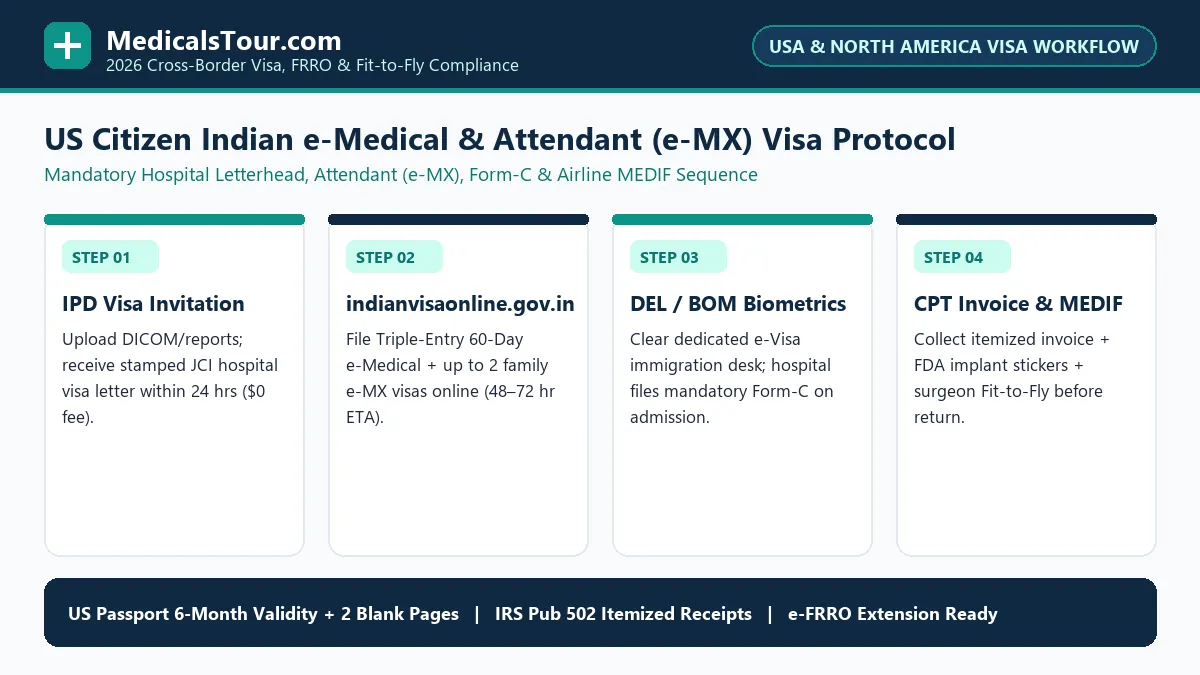
Never trust an overseas medical facilitator claiming you can fly back to Chicago five days after DBS surgery. Freshly placed brain electrodes create a temporary microscopic edema halo around the subthalamic target—known clinically as the “micro-lesioning” or honeymoon effect—alongside tiny pockets of subdural air (pneumocephalus) introduced through the burr holes. Both distort electrical impedance for the first week and create cabin-pressure risk if flown too early. Plan a disciplined 18-to-20-day stay in India (7 inpatient hospital nights + 11–12 nearby hotel nights) and secure your travel visa ahead of time via our US Citizen India e-Medical Visa Guide.
| Corridor Days | Clinical & Neuromodulation Milestone | Patient & Caregiver Setting |
|---|---|---|
| Days 1–2 | Arrive DEL or BOM; formal OFF/ON UPDRS scoring, neuropsychometry, anesthesia echo & Volumetric 3T MRI under light sedation if tremor causes motion blur. | Nearby 4/5-Star Hotel (Gurugram Sec 38 / Andheri) |
| Day 3 | Inpatient admission; evening scalp prep, prophylactic IV cefazolin planning & midnight dopaminergic medication hold. | Single Private Neuro Ward |
| Day 4 | Bilateral stereotactic lead implantation + Stage 2 chest IPG placement; overnight observation in dedicated Neuro-ICU with fusion CT scan. | Neuro-ICU (1–2 Nights) |
| Days 5–9 | Step-down ward mobilization, gait physiotherapy, resume baseline oral levodopa while IPG stays OFF (or ultra-low 0.5V) as micro-lesion edema settles. | Single Private Neuro Ward |
| Days 10–13 | Discharge to hotel; cranial & chest suture inspection; Session 1 Monopolar Review—testing all 8 directional contacts per hemisphere for tremor/rigidity thresholds. | Hotel + Outpatient Neuromodulation Clinic |
| Days 14–18 | Suture/staple removal; Sessions 2 & 3 Fine-Tuning—gradual 25%–40% oral levodopa reduction, dyskinesia check, caregiver charger training & repeat head CT confirming zero residual pneumocephalus. | Hotel + Fit-to-Fly Clearance |
| Day 19 | Airport wheelchair escort & nonstop/one-stop flight home carrying patient programmer handset and Implant ID Card. | Outbound Return Flight |
During that hotel step-down week in Sector 38 Gurugram or Andheri West Mumbai, daily LSVT-BIG inspired stride physiotherapy and speech articulation drills accelerate motor recalibration. Patients who previously shuffled through hotel lobbies with festinating steps routinely walk out to dinner with steady arm swing once their segmented directional contacts are activated at 130 Hz and 60 microseconds pulse width.
Remote Tele-Programming & Handing Device Management to a US Movement Disorder Neurologist
Because brain tissue impedance continues maturing over the first three to six months post-surgery, initial programming in Gurugram or Mumbai delivers roughly 70% to 80% of your ultimate motor gain, with two or three minor outpatient voltage tweaks needed at Weeks 6, 12, and 24. Two parallel mechanisms make US continuity straightforward when arranged properly before travel.
First, Medtronic, Abbott, and Boston Scientific hardware implanted in JCI Indian hospitals uses identical global wireless telemetry protocols (`Clinician Programmer` tablets) found in every movement-disorder center from Mass General and NYU Langone to UCSF and Mayo Clinic. Prior to departure, book a routine post-op establishment visit with a US movement-disorder neurologist, informing their nurse coordinator upfront that you are having FDA-identical Medtronic Percept or Abbott Liberta hardware placed abroad and bringing full lead coordinates (`X, Y, Z` AC-PC stereotactic offsets), intraoperative CT-MRI fusion files showing exact contact positions inside the STN/GPi, and initial monopolar threshold charts.
Second, if you select Abbott’s NeuroSphere Virtual Clinic or pre-configured Medtronic patient-therapy groups (Groups A, B, and C with safe ±0.3 mA ceiling/floor rails loaded onto your Samsung/iPod patient controller), your Indian movement-disorder specialist can supervise interim stimulation adjustments over encrypted video during your first ninety days back home while oral carbidopa-levodopa doses step down smoothly. Medtronic Percept platforms add one additional telemetry advantage for long-distance travelers: chronic BrainSense Local Field Potential (`LFP`) beta-band (13–30 Hz) sensing records objective basal-ganglia beta power peaks right inside your subthalamic leads while you walk around your hometown in Ohio or Oregon, giving your US programming neurologist a crisp graphical readout of afternoon wearing-off windows without guesswork. Never cut oral dopamine agonists or carbidopa-levodopa abruptly to zero on your own after successful STN activation; overly rapid dopaminergic withdrawal can trigger apathy or restless legs even when tremor and rigidity look completely controlled.
Airport Millimeter-Wave Scanners, MRI Conditional Modes & Caregiver Logistics
Traveling across international aviation hubs with a newly implanted neurostimulator requires calm familiarity with airport security and electromagnetic rules. Before discharging from Medanta or Kokilaben, verify that your coordinator hands you both the temporary hospital implant certificate and registers your serial numbers for the manufacturer’s permanent wallet Medical Device Identification Card, alongside a signed surgical clearance letter aligned with our Post-Surgical Fit-to-Fly Certificate Guide.
At Delhi IGI, Mumbai T2, European transit hubs, and US TSA checkpoints, show your DBS Implant ID card to the screening officer and request a manual pat-down instead of walking through high-field magnetic metal-detector archways or holding handheld security wands directly over your collarbone generator. Strong walk-through magnetic fields can occasionally trigger transient uncomfortable stimulation surges or toggle older generators; keep your wireless patient handset powered on in your carry-on bag (never checked luggage, along with your inductive lithium recharger) so you can verify “Therapy ON” status at the departure gate in ten seconds.
Also alert future dentists, orthopedic surgeons, and physical therapists back in the United States about three permanent post-DBS precautions: surgical monopolar electrocautery requires bipolar forceps or a grounding dispersive pad placed far from the chest IPG; therapeutic ultrasound diathermy is strictly contraindicated anywhere on the body due to lead-heating risk; and baseline electrocardiograms (ECGs) will show harmless high-frequency electrical artifact unless your stimulator is briefly paused for thirty seconds during the tracing.
In Medical Tour’s post-travel family debriefs, caregivers consistently highlight one final practical tip: never travel solo for DBS surgery. Having a spouse or adult child present during Days 10 through 18 to practice strapping on the chest charging collar and toggling Therapy Group presets guarantees confidence once you touch down at home. Explore additional neurological and quaternary care routes in our Global Medical Travel Corridors hub.