Ask an Emirati grandmother from Al Ain, a Saudi mother from Qassim, or a Kuwaiti teacher from Hawalli why she postponed robotic fibroid surgery, breast lump excision, or bilateral knee replacement in Munich or Boston, and the answer rarely involves surgical hardware. It comes down to dignity, modesty (khusoosiya), and clear communication at her most vulnerable hour: waking up shivering in a mixed-gender post-anesthesia bay without her headscarf, trying to explain pelvic pain through a male nephew because no professional female Arabic interpreter was on shift, or staring at dry hospital meals uncertain whether the kitchen handles halal slaughter separately.
Over three decades of caring for families from all six GCC states, Iraq, Jordan, Yemen, and North Africa, flagship JCI-accredited hospitals across New Delhi, Gurugram, Mumbai, and Chennai have woven Arab cultural privacy directly into inpatient clinical architecture rather than treating it as an afterthought. Salaried Arabic medical translators staff inpatient floors around the clock, dedicated all-female surgical and nursing rosters handle gynecology, breast oncology, urogynecology, and maternity admissions, and bathroom plumbing across India naturally features handheld water bidets (shattaf) alongside dedicated Musalla prayer rooms.
Yet Medical Tour’s 2026 patient-advocacy audits highlight two costly traps Gulf families still stumble into: hiring freelance street translators who inflate hospital bills by 25%, and upgrading blindly into Presidential Suites without understanding India’s room-multiplier billing math. Here is how to lock in cultural privacy, female-led clinical teams, and transparent VIP hospitality in writing before you fly.
Locking In an All-Female Clinical Roster for OB-GYN, Breast & Pelvic Surgery
In Western academic hospitals, requesting an exclusively female operating room and inpatient care team is frequently brushed aside as logistically impossible under standard union shift rotations. Across India, by contrast, women make up the overwhelming majority of senior consultants in Obstetrics & Gynecology, Reproductive Medicine (IVF), Breast Oncoplastic Surgery, Female Urology/Pelvic Floor Reconstruction, and Perinatal Anesthesia—supported by predominantly female inpatient nursing and ultrasound cadres.
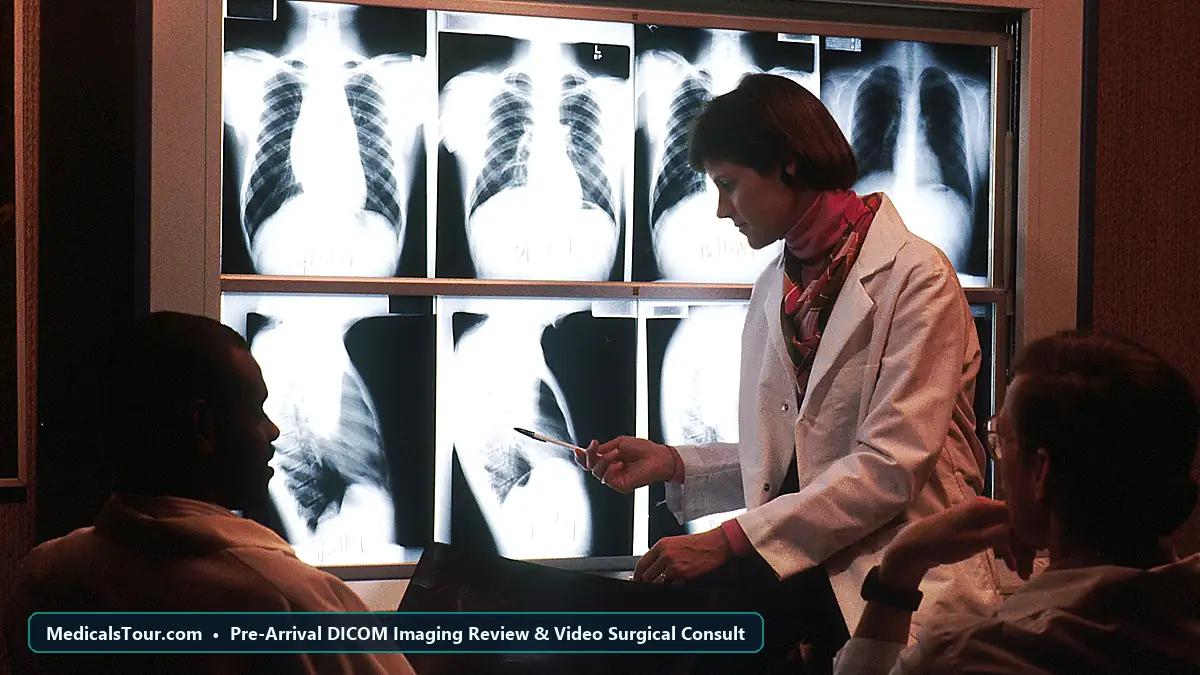
At international referral flagships such as Max Hospital in Sushant Lok, Gurugram and MIOT International in Manapakkam, Chennai (as well as Apollo, Fortis, Medanta, Kokilaben, and Reliance), Arab women traveling for robotic endometriosis excision, Da Vinci multi-fibroid myomectomy, prolapse sacrocolpopexy, breast conservation surgery, or fertility egg retrieval can request a documented All-Female Clinical Protocol during pre-admission booking:
- Female Lead Surgeon & First Assistant: Confirm your primary consultant and scrub registrar by name and medical council registration on your Visa Invitation Letter.
- Female Consultant Anesthesiologist & Female PACU Recovery Nurses: Ensures airway management, spinal/epidural placement, urinary Foley catheterization, and post-anesthesia awakening take place strictly with female clinicians, with a clean cotton head-covering cap or scarf replaced immediately before wheeling out of the theatre complex.
- Female Diagnostic Sonographers & MRI Technologists: Under Indian PNDT and hospital chaperone rules, transvaginal pelvic scans, breast mammography/sonomammography, and 3T breast MRI positioning are staffed by female radiologists and female technologists inside locked, curtained suites.
- Door-Sign Knocking & Female Physiotherapy Protocol: Inpatient private rooms carry bilingual Arabic/English “Knock & Wait 15 Seconds — Female Patient Privacy” door placards, and post-operative knee, spine, or pelvic rehabilitation is assigned exclusively to female physiotherapists. Review female fertility package baselines in our IVF & Fertility Package Cost Guide and joint rehab standards in our Robotic Knee Replacement Cost Guide.
Female proctology and colorectal pelvic care deserve special mention here. Thousands of women across Saudi Arabia, Oman, Kuwait, and the UAE suffer silently for years from post-partum grade-III hemorrhoids, anal fissures, rectoceles, or stress urinary incontinence solely because local surgical clinics staff predominantly male general surgeons. Requesting a dedicated female colorectal and urogynecology specialist in Gurugram, Chennai, or Mumbai allows laser hemorrhoidoplasty or mid-urethral sling repair in 24-hour day-care privacy with zero male clinical contact.

Salaried Hospital Arabic Interpreters vs The Freelance ‘Translator’ Kickback Trap
Accurate medical Arabic is a clinical safety requirement, not a concierge perk. Mistranslating warfarin dosing intervals, confusing “fasting including water” (sawm ‘an al-akl wal-maa) before general anesthesia with Ramadan-style reflection, or softening a neurosurgeon’s 4% facial-nerve palsy risk during informed consent creates real medical danger. Beyond formal Modern Standard Arabic, everyday spoken dialects differ sharply when patients describe physical symptoms—an Iraqi elder describing chest tightness, an Omani mother explaining infant colic, and a Saudi patient detailing neuropathic burning use distinct regional idioms.
Every major JCI hospital in Delhi NCR, Mumbai, and Chennai employs full-time, salaried Arabic medical interpreters—including female interpreters specifically assigned to OB-GYN, IVF, and breast clinics—at zero additional charge when you register directly with the hospital’s official International Patient Desk prior to departure.
Why You Must Never Hire an Unaffiliated Airport or Hotel ‘Translator’
Outside Baghdad, Muscat, Riyadh, and Cairo visa offices—and near hospital gates in Gurugram, South Delhi, and Mumbai—freelance Arabic-speaking middlemen approach arriving families offering “free airport rides and personal hospital translation for $20 a day.” In reality, that driver or freelance translator rushes ahead to the hospital’s facilitator desk and registers your passport under their commercial agency code. Under broker referral contracts, the hospital or sub-agent pads your surgical, pharmacy, or diagnostic package by 18% to 30% ($1,500 to $5,000+ USD) to pay the middleman’s kickback—and worse, unethical touts routinely steer families away from JCI hospitals toward unaccredited strip clinics paying even higher 40% commissions! Verify genuine hospital quality credentials first inside our JCI vs NABH Hospital Accreditation Guide.
If an unsolicited driver ever claims your booked hospital “is full today” or insists on accompanying you to the registration counter, politely decline, walk directly inside the guarded main lobby to the uniformed International Patient Lounge reception, and present your pre-arrival email confirmation and passport yourself.
Halal Inpatient Kitchens, Qibla Prayer Suites & Bathroom Shattaf Standards
Hospital nutrition and ritual cleanliness shape how fast an elderly parent regains appetite and strength after cardiac bypass, spinal fusion, or joint replacement. Unlike European or North American hospitals—where halal meals arrive as frozen airline-style foil trays heated in a shared microwave and inpatient bathrooms lack water sprayers—Indian tertiary hospitals operate in a cultural environment where halal meat sourcing and water-based hygiene are everyday operational norms.
- Certified Halal Hospital Meat Supply & Clinical Dietetics: Non-vegetarian poultry, lamb, and fish prepared inside JCI hospital kitchens in New Delhi, Gurugram, Mumbai, and Chennai are sourced exclusively from FSSAI-licensed, certified halal suppliers, with zero pork or alcohol-based culinary extracts anywhere on inpatient menus. Arabic lounge dietitians customize low-sodium cardiac broths, diabetic grilled fish/chicken platters, soft post-dental purees, and warm lentil soups (shorbat adas) calibrated to your exact post-op electrolyte orders.
- Dedicated Musalla Prayer Rooms & Wudu Ablution Stations: International wings feature quiet, carpeted gender-segregated prayer rooms (Musalla) marked with accurate Qibla compass indicators, copies of the Holy Quran, prayer mats, and adjacent seated Wudu foot-washing stations—while every private inpatient room displays a ceiling or drawer Qibla arrow for bedside prayer.
- Universal Handheld Bidet (Shattaf) & Roll-In Grab Bars: Every single private, deluxe, and suite bathroom across accredited Indian hospitals comes plumbed standard with a warm/ambient handheld water bidet sprayer beside Western-height commodes, fold-down shower seats, and emergency nurse-call pull cords.
- Ramadan Clinical Medication Timing: For stable accompanying relatives or outpatient rehabilitation guests visiting during Ramadan, Arabic coordinators arrange pre-dawn Suhoor meal trays and sunset Iftar dates/soup while clinical pharmacists adjust twice-daily oral medications safely around fasting hours whenever medically permissible.
Note how strict infection-control policies interact with Arab family hospitality: while Gulf relatives naturally wish to bring home-cooked kabsa, harees, fresh dates, or Arabic qahwa flasks onto surgical wards, hospital security guards restrict outside cooked food inside cardiac, oncology, and transplant floors to prevent foodborne gastroenteritis. Unsealed home dishes are enjoyed comfortably inside ground-floor family lounges or serviced apartments, while inpatient Arabic tea and dietary meals come straight from the audited hospital kitchen.
VIP & Presidential Hospital Suites: How the 20%–40% Room Billing Multiplier Works
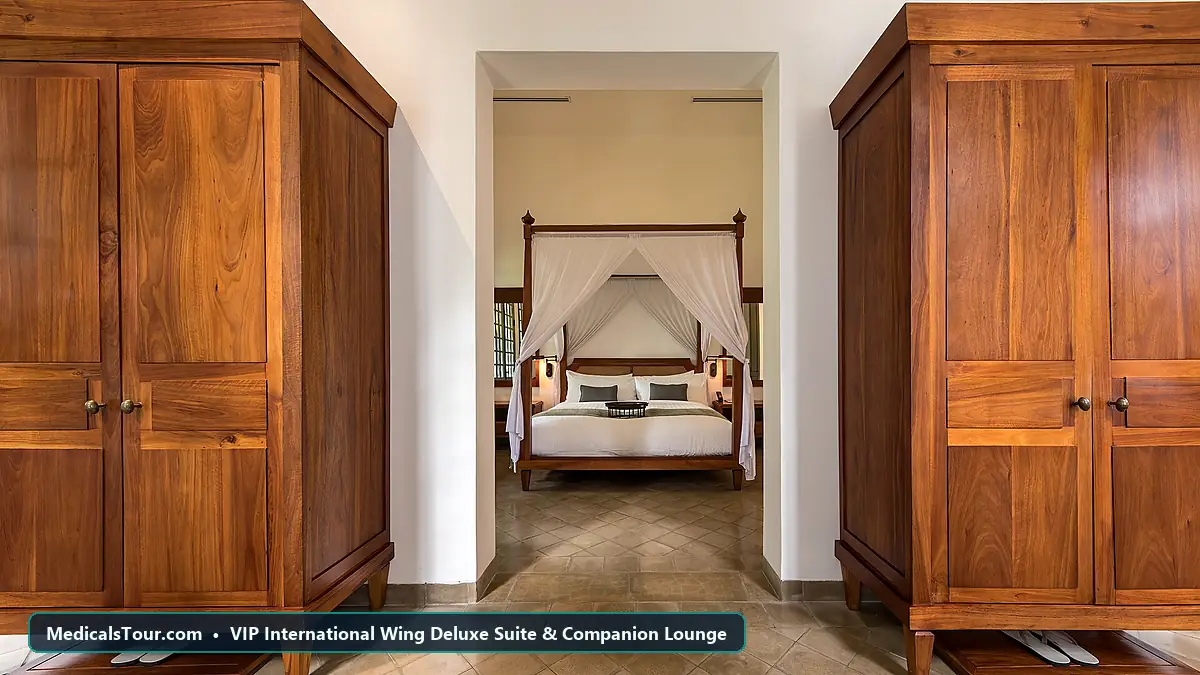
Families from Doha, Riyadh, Abu Dhabi, and Kuwait City accustomed to generous royal or corporate VIP hospital wings often request a two-room Presidential Suite or Maharaja / Executive Suite upon admission so multiple relatives can visit comfortably in an adjacent majlis-style living lounge. Indian flagship hospitals offer genuinely palatial suites—complete with separate attendant bedrooms, kitchenette pantries, dining tables, and dedicated butler nursing—but every self-pay or capped-insurance family must understand how Indian hospital software prices them before signing admission forms!
| Inpatient Room Tier | Typical Nightly Room Rent (USD / AED / SAR) | Overnight Attendant & Lounge Space | Impact on Total Surgery & Doctor Bill |
|---|---|---|---|
| Standard Single Private Room | $140 – $210 / night (515–770 AED / 525–790 SAR) | Private room + private shattaf bath + 1 sofa-bed for 1 adult companion. | 1.0x Base Package Rate (100% of quoted Proforma Invoice). |
| Executive Deluxe Room | $230 – $310 / night (845–1,140 AED / 860–1,160 SAR) | Larger floorplan, mini-fridge, recliner + sofa-bed for 1 attendant. | +18% to +25% Multiplier across surgeon, anesthesia, OR & lab fees. |
| Two-Room Suite / Royal VIP Suite | $360 – $520 / night (1,320–1,910 AED / 1,350–1,950 SAR) | Patient bedroom + separate family sitting/majlis salon + 2 bathrooms; 2 attendants. | +30% to +35% Multiplier across all non-implant clinical charges. |
| Presidential Suite | $600 – $950 / night (2,200–3,490 AED / 2,250–3,560 SAR) | 1,000+ sq ft wing, private pantry, dining area, butler & VIP security foyer. | +35% to +45% Multiplier on surgical, ICU-retention & consultant lines. |
Look closely at that fourth column: upgrading a $7,000 robotic knee or cardiac surgery from a Standard Single Private Room to a Presidential Suite does not merely add $500 × 5 nights ($2,500)—it scales surgeon, anesthesiologist, operating room, and daily consultant fees upward by 35%–45%, raising a $7,000 bill closer to $11,500–$12,500 USD (plus 5% Indian GST levied on hospital room rents exceeding ₹5,000/day). Notice too that clinical sterilisation, FDA-cleared titanium or ceramic implant hardware, nursing infection protocols, and senior consultant surgical hands remain 100% identical across all four room categories.

The Smart Gulf Alternative: Single Private Hospital Room + Adjacent 5-Star Majlis Suite
Once families understand the room-multiplier rule, a practical hospitality strategy immediately stands out whenever three or four relatives accompany an Emirati, Saudi, or Kuwaiti patient. For the 4 to 6 acute inpatient surgical nights (two of which the patient may spend inside a sterile ICU where suites sit empty anyway unless you pay double “room retention” rent!), admit the patient into a clean, quiet Standard Single Private Room with one devoted same-gender attendant (wife, daughter, sister, or son) sleeping on the in-room couch-bed.
Simultaneously, book a Two-Bedroom Luxury Residence or Club Suite at an adjacent five-star hotel five minutes from the hospital gates—such as Sheraton New Delhi right opposite Max Saket, Taj City Centre or The Westin five minutes from Max Sushant Lok in Gurugram, ITC Grand Chola / Feathers A Radha Hotel ten minutes from MIOT International in Chennai, or JW Marriott Juhu fifteen minutes from Kokilaben Mumbai ($180–$340/night). Accompanying relatives enjoy full luxury dining, swimming pools, laundry, and spacious family reception areas while keeping your inpatient surgical bill locked at the 1.0x Single Private tariff—saving $3,000 to $6,000 USD on surgery alone!
Of course, if an embassy Health Attaché Letter of Guarantee covers VIP suite category explicitly—or if your family gladly budgets the extra 35% for unified inpatient togetherness inside a two-room hospital suite—ask the International Patient Desk to issue a Suite-Category Fixed Proforma Invoice upfront before admission so the exact multiplier is locked in writing with zero checkout surprises.
Patients sponsored by the UAE Armed Forces Medical Services, Saudi Ministry of Health Medical Attaché, Kuwait Health Office, Qatari Medical Committee, or Royal Court Diwan delegations in New Delhi and Mumbai have dedicated embassy liaison desks right inside major JCI lobbies. Those desks manage direct Letter-of-Guarantee room-tier authorizations, weekly Arabic clinical progress reports back to the home ministry, and diplomatic chauffeur coordination without charging a single dirham or riyal to the patient.
Family Companion Rules, Chaperone Visas & Gulf Neighborhood Halal Dining Hubs
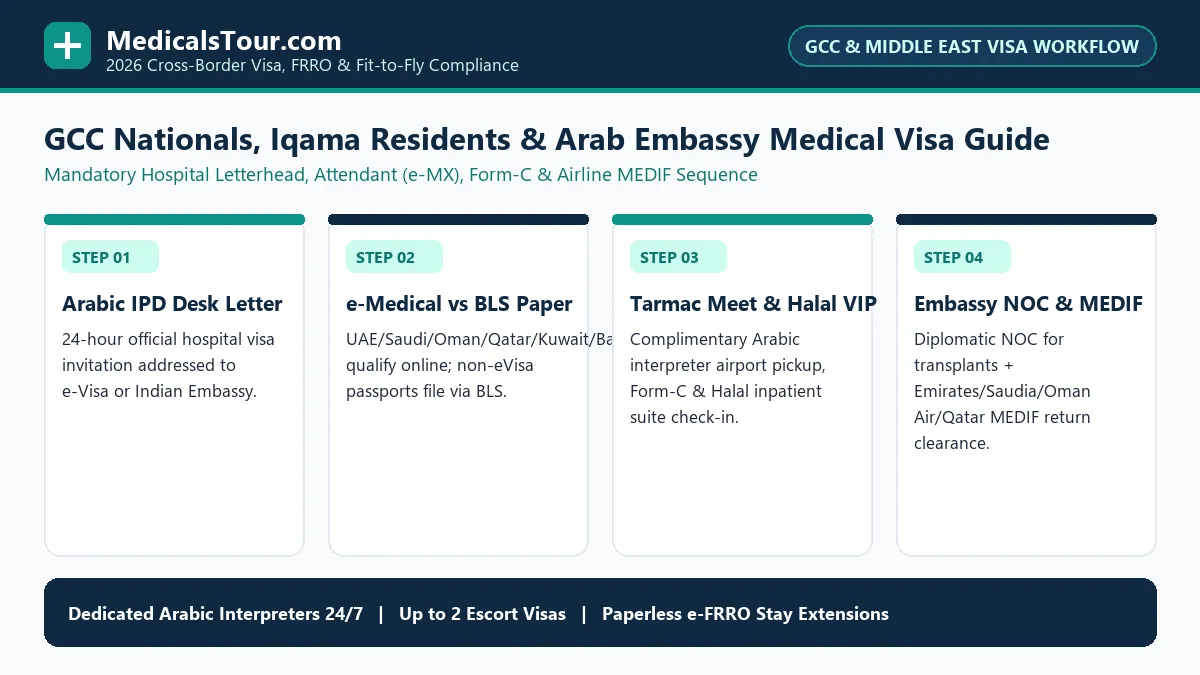
Traveling as an extended Arab household requires coordinating visa allocations and ward visitor passes smoothly before departure. Under Government of India rules, each primary Medical Visa supports up to two Medical Attendant Visas (`e-Medical Attendant` or `MED-X`). What if an elderly mother from Riyadh or Muscat is accompanied by her husband, two daughters, and an adult son? Two relatives travel on linked Medical Attendant Visas (granting inpatient overnight attendant pass eligibility and matching FRRO extension rights), while additional visiting family members from GCC states can apply for standard 30-day or 1-year Indian e-Tourist Visas to visit during daytime hospital hours (typically 11:00 AM–1:00 PM and 5:00 PM–7:00 PM). Check exact kinship documents in our Medical Attendant Visa Checklist and compare short-stay Gulf fertility/dental logistics in our UAE & Saudi to Delhi Dental & IVF Travel Guide.
| Indian Medical Hub | Top Arab Family Dining, Grocery & Mosque Micro-Pockets | Distance from Flagship JCI Campuses |
|---|---|---|
| South Delhi & Gurugram | New Friends Colony, Nizamuddin East, Saket Malls & Gurugram Sector 29 / Sector 38–51 | 5–15 mins from Apollo, Fortis Escorts, Max Saket, Max Sushant Lok, Medanta & Artemis. |
| Mumbai (South & Western Suburbs) | Colaba / Mohammed Ali Road, Bandra West Hill Road, Juhu & Andheri Lokhandwala | 5–18 mins from Reliance Foundation, Lilavati Bandra, Nanavati-Max & Kokilaben. |
| Chennai (Greams Road, Manapakkam & OMR) | Thousand Lights (next to Apollo Greams Rd), Nungambakkam, Guindy & OMR Perungudi | 2–15 mins from Apollo Greams Rd, MGM Healthcare, MIOT Manapakkam & Gleneagles. |
Female travelers from conservative Gulf households also appreciate how safe and family-oriented upscale medical corridors in Sushant Lok (Gurugram), Saket (South Delhi), Bandra/Andheri (Mumbai), and Nungambakkam/Manapakkam (Chennai) feel after sunset. Five-star aparthotels and luxury malls employ female security guards at dedicated ladies’ entrances, modest abaya and hijab attire is commonplace across international hospital lobbies, and hotel concierges arrange vetted, GPS-tracked hospital sedans with uniformed drivers for evening pharmacy or clinic runs.
Bilingual Arabic-English Discharge Summaries & Post-Return Tele-Consult Continuity
Language support should not vanish the moment the inpatient cashier prints your receipt. When returning to a family physician or Ministry of Health clinic in Kuwait, Oman, Bahrain, Saudi Arabia, or the UAE, patients need two distinct document sets: official English ICD-10 / CPT clinical discharge summaries, operative notes, and pathology reports (since clinical medical records inside GCC hospitals operate in English!), paired with a clear Arabic patient-facing medication and wound-care chart so an elderly parent at home never confuses morning blood-thinners with evening gastric protectors.
Before leaving the hospital’s Arabic Lounge on your final outpatient review day, verify four wrap-up details:
- Written Arabic Medication Grid: Morning (Sabahan), afternoon (Zuhran), and bedtime (Masa’an) pill boxes labeled clearly onto sealed manufacturer cartons.
- Female Doctor Direct WhatsApp / Tele-Follow-Up Slot: For OB-GYN, IVF early-pregnancy progesterone titration, or breast surgical drain recovery, schedule a Day-14 post-return video review directly with your female consultant accompanied by the same female Arabic interpreter who attended your inpatient stay.
- Wheelchair & Female Security Screening Assist at Departure: Indian airports (`DEL`, `BOM`, `MAA`) provide dedicated enclosed private curtained booths operated strictly by female CISF security officers for every female passenger during pat-down screening, preserving complete hijab and niqab privacy from curb to boarding bridge.
Families traveling with post-operative surgical drains, external orthopedic braces, or stoma appliances can also request a stamped bilingual airport security medical letter from the hospital’s International Patient Lounge 24 hours prior to flight check-in. Presenting that clinical note at the terminal entrance allows private medical-room inspection by same-gender officers without awkward public explanation.
Maternity and high-risk fetal-medicine patients arriving from Oman, the UAE, Bahrain, or Saudi Arabia for cervical cerclage, fetal laser surgery, or NICU delivery should additionally budget 10 to 14 post-delivery administrative days so the municipal birth certificate, embassy newborn passport, and online Indian FRRO newborn exit permit are processed calmly before flying home.
Based on Medical Tour’s Gulf family satisfaction surveys, confirming your all-female clinical roster and room-tier multiplier in writing 72 hours before departure eliminates 95% of cultural and billing friction. Explore all regional guides on our Medical Corridors Hub and map out suite upgrades, companion apartments, and airfare inside our Medical Trip Budget Planner.