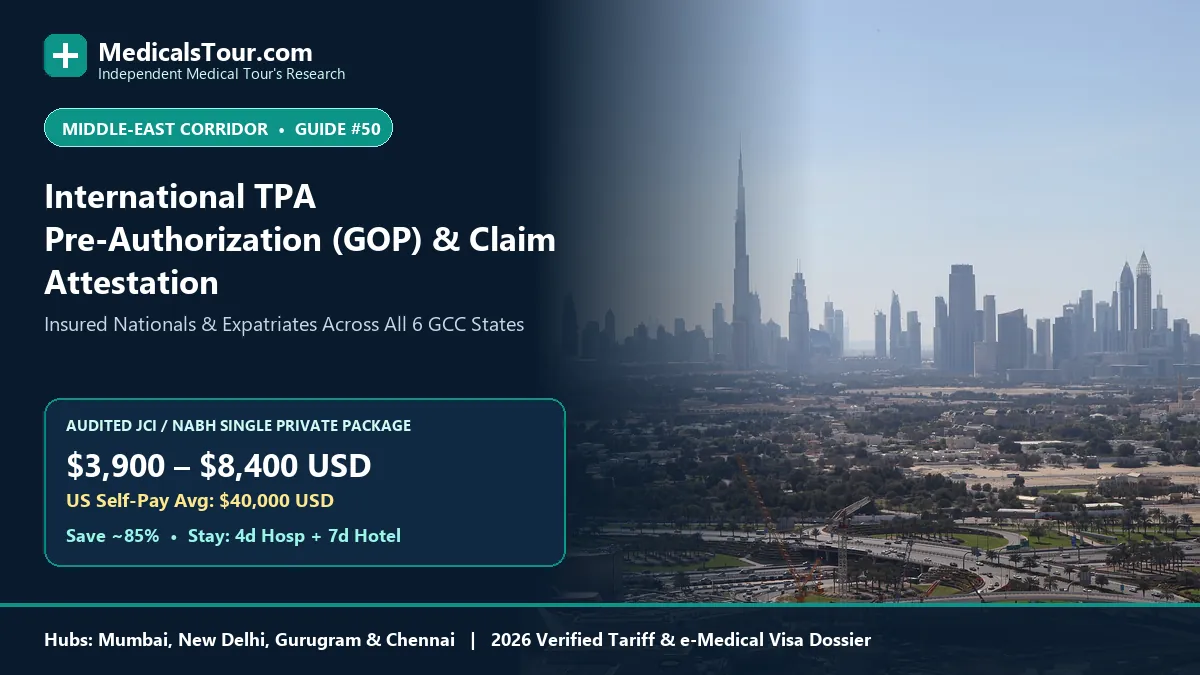
Open the digital insurance wallet of almost any corporate manager, engineer, banker, or citizen household across Dubai, Abu Dhabi, Riyadh, Muscat, Doha, Kuwait City, or Manama, and you will find a gold or platinum card issued by Bupa Global, Cigna Healthcare Middle East, Allianz Care, Daman (Thiqa / Enhanced), GIG Gulf (formerly AXA Gulf), Sukoon (Oman Insurance), Tawuniya, Medgulf, or QLM—often paired with a third-party administrator (TPA) logo such as NextCare, NAS/Neuron, GlobeMed, or MedNet. What remarkably few policyholders realize until a surgeon in Dubai quotes a 20% co-pay on a 140,000 AED spinal fusion is that millions of Gulf policies explicitly include India inside their Direct-Billing or Elective Worldwide Excluding-USA Area of Cover—and many regional insurers actively waive your inpatient co-payment and deductible when you choose an accredited JCI hospital in Mumbai, New Delhi, Gurugram, or Chennai!
The catch? Cross-border insurance approval operates nothing like tapping your Emirates ID or Saudi CCHI card at a neighborhood polyclinic for a sore throat. Show up unannounced on Monday morning at a Mumbai hospital reception desk expecting Tuesday morning cashless robotic surgery without a pre-issued Guarantee of Payment (GOP), and you will end up swiping your personal Visa card for a $7,000 security deposit while international claims adjusters trade queries across time zones.
Compiled from Medical Tour’s 2026 audits of international insurance desks across India’s top twenty hospitals, this step-by-step guide explains how to verify your policy’s South Asia network tier, trigger cashless GOP approval 7 to 10 business days before flying, avoid discharge-day non-medical exclusions, and assemble an unrejectable Pay-and-Claim reimbursement packet.
Reading Your GCC Insurance Table of Benefits: Area of Cover & South Asia Co-Pay Waivers
Before emailing medical reports to any hospital in India, spend five minutes inspecting four exact lines on your annual Table of Benefits (TOB) PDF or mobile app (Cigna Envoy, Bupa MembersWorld, MyAllianz, Daman App, or GIG Gulf portal). Every international claim decision hinges on how your employer’s HR broker structured territorial coverage:
- 1. Area of Cover (Geographic Scope): Policies labeled “Worldwide”, “Worldwide Excluding USA”, “GCC + MENA + South Asia / Indian Subcontinent”, or “Home Country Elective Cover” cover planned inpatient surgeries in India by contract. Conversely, basic mandatory compliance plans (such as Dubai Essential Benefits Plan EBP or entry-level KSA CCHI tiers restricted strictly to “UAE / KSA Only — Emergency Only Outside Territory”) cover zero planned elective surgery abroad unless upgraded.
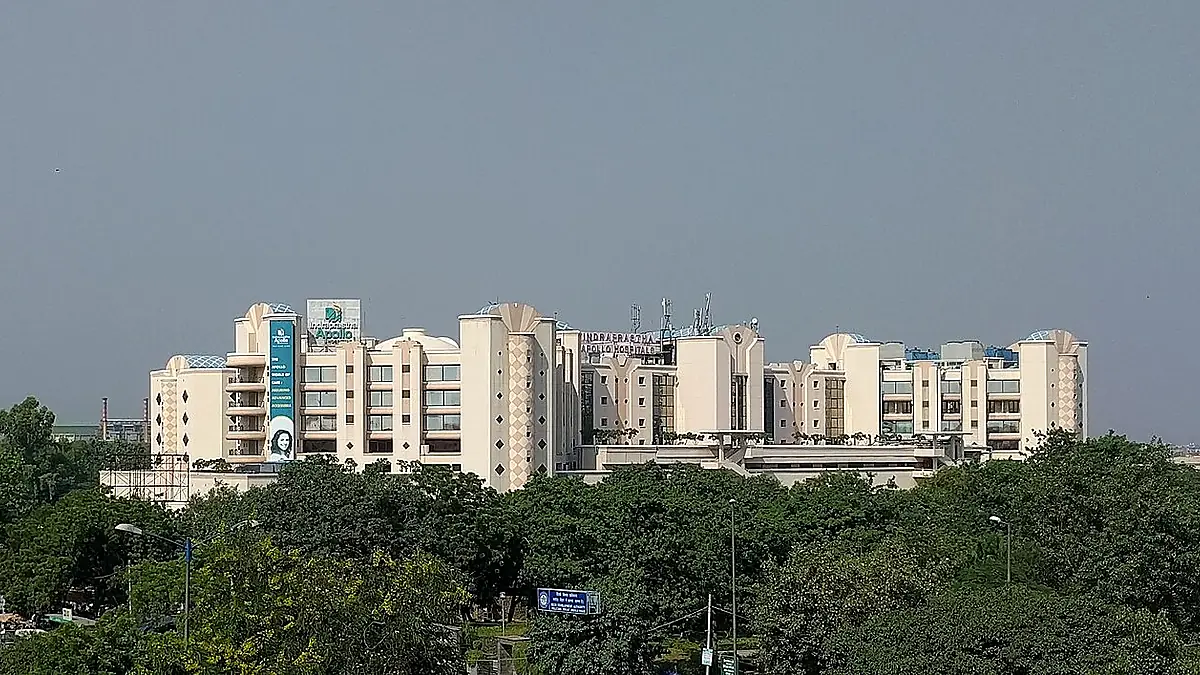
- 2. Direct Billing Network vs Out-of-Network Reimbursement: Global insurers like Bupa Global, Cigna Global, and Allianz Care maintain direct cashless settlement agreements (directly or via Indian partner TPAs like Vidal Health, Paramount, East West Assist, or International SOS) with flagship JCI hospitals including Kokilaben Dhirubhai Ambani Hospital in Mumbai and Indraprastha Apollo Hospital in New Delhi. Regional Gulf policies under NextCare, NAS, Neuron, Daman, or Sukoon frequently offer cashless GOP at contracted Indian network flagships—or reimburse 80% to 100% of Reasonable & Customary tariffs on a Pay-and-Claim basis!
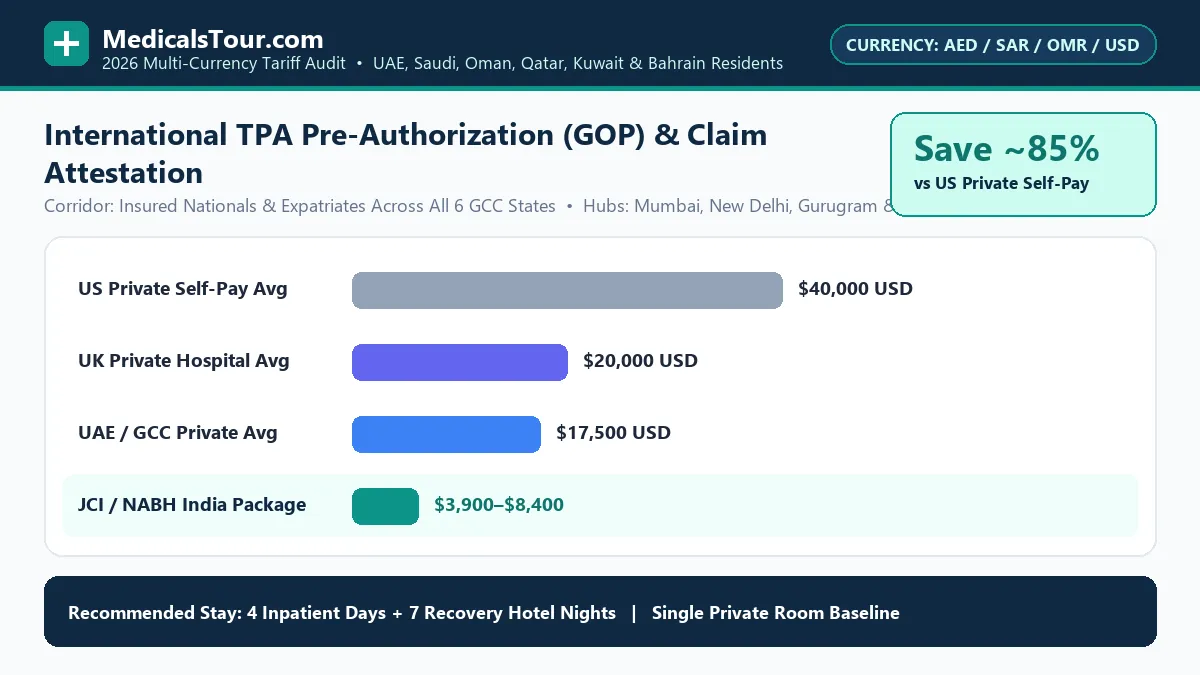
- 3. Elective South Asia Co-Pay & Deductible Waivers: Because a robotic knee replacement in Mumbai costs $5,800 USD instead of $24,000 USD at a tier-1 Dubai private hospital, several UAE, Omani, and Bahraini corporate policies explicitly reduce a 10%–20% inpatient co-pay down to 0% co-pay (and even reimburse Economy round-trip airfare for the patient!) when elective surgery is performed in India.
- 4. Inpatient Room-Limit Cap: Check whether your card caps inpatient accommodation at “Standard Single Private Room” (or a fixed $200/day ceiling). Selecting a VIP Suite above your policy’s room cap leaves you paying not only the extra nightly suite rent, but also the 25%–35% proportionate surgeon/OR room-multiplier differential!

Pathway A — Cashless Direct Billing: The 7-to-10-Day Pre-Authorization (GOP) Loop
In international hospital finance, an insurance plastic card or mobile QR code is merely proof of identity—it is never financial authorization. Cashless admission happens only when your insurer emails a signed, dollar-capped Initial Guarantee of Payment (GOP) directly to the Indian hospital’s International Insurance Desk.
How to Secure Your Cashless GOP Before Buying Flights
- Remote Specialist Tele-Consult & Clinical Justification Note (Day -12): Share your Gulf MRI, CT, angiogram, or biopsy reports with your chosen Indian JCI hospital and complete a brief video consult ($35–$65) so the senior Indian surgeon writes a formal clinical note detailing symptom duration (crucial for proving the condition is not an undeclared pre-existing exclusion during a waiting period!), failed conservative therapy, exact ICD-10-CM diagnosis codes, and CPT surgical procedure codes.
- Itemized Hospital Proforma Estimate (Day -10): Ask the hospital’s International Insurance Desk—not the general self-pay desk—to prepare a TPA-formatted Pre-Authorization Request specifying proposed admission date, expected length of stay (e.g., 5 nights Single Private), implant manufacturer cost, and bundled surgical tariff. Compare realistic self-pay vs insured rates inside our Robotic Knee Replacement Cost Guide and PET-CT & Oncology Cost Guide.
- Insurer Medical Underwriting Review (Days -9 to -3): Both you (via your Bupa/Cigna/Allianz/GIG member portal) and the hospital insurance coordinator upload the pre-authorization packet. Insurer medical reviewers occasionally issue one clinical query (for example, requesting the actual raw knee X-ray showing Kellgren-Lawrence Grade 4 bone-on-bone joint space loss, or raw HbA1c/lipid labs).
- Written Initial GOP Issuance (Day -2): Once cleared, the insurer issues a written GOP valid for a specific 14-to-30-day admission window stating covered ceiling, room entitlement, policy deductible/co-pay, and exclusions. Only now do you fly for cashless admission!
What happens if intraoperative findings extend your stay—for instance, a laparoscopic endometriosis or gallbladder surgery requires two extra High-Dependency Unit observation nights, or an oncology resection requires blood transfusion? The hospital’s insurance desk submits an Interim GOP Enhancement Request accompanied by daily ICU progress sheets 24 hours before your initial authorized ceiling runs out, ensuring continuous cashless protection through discharge.
Emergency admissions while visiting Mumbai, Delhi, or Chennai on business or leisure follow a parallel 24-hour notification rule: your companion presents your passport and digital Bupa, Cigna, Allianz, or Daman card at the emergency casualty desk immediately upon arrival so the hospital triggers an acute Emergency GOP within the insurer’s mandatory 24-to-48-hour emergency reporting window.
2026 GCC Insurer & TPA Matrix at Indian JCI Hospitals: Direct GOP vs Reimbursement
Different Gulf insurers route Indian hospital claims through distinct international settlement rails. Use the operational matrix below to know exactly which desk handles your card before you travel.
| GCC Insurer / Administrator | Typical Indian JCI Settlement Mode | Pre-Approval Lead Time & Critical Policy Rule |
|---|---|---|
| Bupa Global (UAE / KSA / Oman / Qatar) | Direct Cashless GOP at major JCI flagships | 5–7 business days; pre-authorization mandatory for all inpatient, MRI/PET-CT & oncology care. |
| Cigna Global & Cigna ME (Neuron / NAS) | Direct Cashless GOP (Global) / Network or Pay-Claim (Regional) | 5–8 business days; check whether Neuron/NAS card carries ‘South Asia Direct’ or ‘Elective Reimbursement’ rider. |
| Allianz Care / Allianz Partners | Direct Cashless GOP via international desk | 5–7 business days; requires itemized CPT/ICD-10 form signed by Indian treating consultant; 20% penalty if un-notified! |
| Daman (Thiqa / Enhanced — Abu Dhabi) | Selected Network Direct GOP or Pre-Approved Reimbursement | 7–10 business days; strict prior approval required before flying for elective overseas care outside emergency cases. |
| GIG Gulf (ex-AXA) & Sukoon (Oman Ins.) | Direct GOP via partner TPA or 80%–100% Reimbursement | 6–9 business days; several regional plans waive UAE 15%–20% co-pay for elective surgery in India! |
| NextCare / GlobeMed / MedNet / QLM / Tawuniya | Primarily Pre-Authorized Pay-and-Claim (Direct on VIP tiers) | 7–10 business days; obtain written pre-approval reference number first, settle via SWIFT/card, and claim within 60–90 days. |
Note why accreditation status is non-negotiable for every insurer listed above: almost all Gulf international policies restrict elective overseas settlement strictly to hospitals holding active Joint Commission International (JCI) or full NABH accreditation. Verify hospital credentials before booking inside our JCI vs NABH Hospital Accreditation Guide.
Why Cashless Discharge Takes 6–10 Hours (And What ‘Non-Medical Consumables’ Still Cost You)
Even with a rock-solid cashless GOP from Bupa Global, Cigna, or Allianz in your file, families who book a 4:00 PM flight out of Mumbai or Delhi on the afternoon of hospital discharge guarantee themselves a missed plane. Understanding the back-office mechanics of an international Final Discharge GOP saves hours of hallway frustration.
When your surgeon signs clinical discharge at 9:30 AM on Day 5, your Initial GOP does not automatically close the ledger. First, ward nurses return unused pharmacy ampoules; second, medical coders compile the final itemized invoice alongside the signed typed Discharge Summary, Operative Notes, and Implant Stickers; third, the hospital emails that complete final packet to your insurer’s international claims team in Dubai, Dublin, Cairo, or Kuala Lumpur (whose business day starts 1.5 to 4.5 hours behind Indian Standard Time!).
Claims adjusters then audit every single line item over 4 to 8 hours before faxing/emailing the Final Settlement Authorization, routinely carving out $120 to $380 USD in “Non-Payable / Non-Medical Consumables” that the patient must settle personally at the IPD cashier before receiving the gate pass:
- Routine Non-Medical Exclusions: Patient admission registration fees, digital thermometers, crepe bandages, spirometer balls, surgical hand-scrub/gloves/gowns billed separately, sterile wipes, diapers/underpads, companion extra meal trays, and take-home discharge medications beyond 7 to 14 days.
- Refundable Security Deposit Buffer: Even on 100% cashless GOP admissions, Indian hospitals routinely collect a refundable ₹25,000 to ₹50,000 INR ($300–$600 USD) credit-card pre-authorization or deposit at check-in specifically to cover those non-medical consumables and any policy co-pay at checkout.
Pathway B — Bulletproof ‘Pay-and-Claim’ Reimbursement: The 10-Document Packet
Suppose your Saudi Tawuniya, UAE NAS/NextCare, Omani GIG, or Kuwaiti QLM corporate policy covers worldwide elective surgery on a Reimbursement (Pay-and-Claim) basis—or you need surgery within 72 hours and cannot wait eight business days for a direct-billing GOP. Paying the Indian hospital directly at self-pay package rates (which are often 12% to 20% lower than insurer rack-rate tariffs!) and claiming 80%–100% reimbursement back in the Gulf works smoothly only if you walk out of the hospital holding all ten mandatory claim documents.
Missing even one item below triggers dreaded “Claim Pending Additional Information” limbo weeks after you are already back in Riyadh or Dubai:
- Pre-Authorization Approval Email / Reference Number: Even on reimbursement plans, most GCC insurers impose a 20%–50% penalty (or outright denial) if elective inpatient surgery was not pre-notified before admission!
- Completed Insurer Claim Form Signed & Stamped by the Treating Surgeon: Print your specific Cigna/Daman/GIG/NextCare PDF claim form before leaving home and have the senior Indian consultant sign and affix their official Medical Council registration stamp on Part B before discharge!
- Original Stamped Final Summary Bill + Detailed Line-by-Line Itemized Breakup Bill: Insurers reject single-page lump-sum package invoices unless accompanied by the full multi-page itemized ledger showing room dates, OR charges, doctor fees, lab codes, and pharmacy batch lines.
- Official Zero-Balance Paid Receipt + SWIFT MT103 / Card Charge Slips: Must prove payment came from the insured policyholder (never pay via an unrelated friend’s card!). Review clean wire documentation in our Hospital Forex & SWIFT Wire Billing Guide.
- Signed Typed Discharge Summary & Detailed Operative Note: Stating admission/discharge timestamps, symptom onset history, exact procedure performed, and discharge medications.
- Original Implant Barcode / Lot Stickers (Crucial for Ortho, Spine & Cardiac!): Peel-off manufacturer lot stickers for Stryker/Zimmer knee implants, Medtronic spinal cages, intraocular lenses, or Abbott coronary stents pasted onto an official Hospital Implant Certificate.
- All Diagnostic Reports Supporting Medical Necessity: Pre-op MRI/CT/angiogram text reports, NABL blood panels, and final Histopathology Report (mandatory for any tumor, gallbladder, fibroid, or appendix excision—insurers hold oncology/gynecology claims until benign/malignant pathology is submitted!).
- Itemized Pharmacy Tax Invoices Matched to Signed Prescriptions: Every billed outpatient medicine strip must match a dated doctor’s prescription line.
- Passport Copy + Entry/Exit Immigration Stamps (or e-Visa Boarding Passes): Proves exact travel dates inside India to validate overseas territorial rules.
- Medical Superintendent Stamp & Attestation (When Required Above Thresholds): For high-value Gulf reimbursement claims (often >50,000 AED / SAR) or government ministry funds, obtain the Hospital Medical Superintendent counter-stamp—and verify whether your TPA requires Indian Ministry of External Affairs / UAE or Saudi Embassy attestation before leaving New Delhi or Mumbai.

Pre-Existing Condition Traps, Waiting Periods & Why ‘Package vs Tariff’ Rates Differ
Two insider hospital-billing nuances frequently surprise savvy GCC policyholders. First, watch how symptom duration is recorded by junior casualty or ward doctors during your admission history! Suppose you upgraded onto a new private individual Cigna or Bupa plan eight months ago carrying a 12-to-24-month waiting period on undeclared pre-existing conditions, and you developed acute sciatica from a fresh L4–L5 disc herniation six weeks ago after lifting luggage. If a rushed junior resident casually writes “Patient c/o off-and-on lower back ache x 3 years” in your initial nursing intake sheet without listening carefully, the insurer’s medical auditor will flag that single line and deny the entire $6,800 surgery as an undeclared pre-existing condition! Always review history notes accurately with the senior consultant during Day-1 admission.
Second, do not accuse an Indian hospital of fraud if their Insurance GOP Estimate ($7,400) reads 15% higher than the Cash Self-Pay Promotional Package ($6,300) quoted on a cash brochure. Cash promotional packages require 100% upfront advance payment before admission with zero administrative overhead, whereas international insurance direct billing requires dedicated coding teams, multi-round clinical queries, 45-to-90-day receivables float, and itemized tariff billing rather than discounted cash bundles. If your policy carries a high 20% co-pay or tight annual sub-limit, do the math upfront: sometimes paying the lower Cash Self-Pay Package directly via credit card and submitting for reimbursement nets a smaller out-of-pocket balance than using direct billing!
| Elective Procedure (Single Private Tier) | Gulf Private Hospital Bill (20% Co-Pay = Your Cost) | India Cash Self-Pay Package | India Direct GOP / 0%-Co-Pay Net Patient Outlay |
|---|---|---|---|
| Unilateral Robotic Knee Replacement | $22,000 ($4,400 Co-Pay / 16,160 AED) | $4,800 – $5,800 | $0 Co-Pay (+ $180–$290 non-medical items) |
| 1-Level O-Arm Lumbar Spinal Fusion (TLIF) | $28,500 ($5,700 Co-Pay / 20,935 AED) | $5,800 – $7,400 | $0 Co-Pay (+ $210–$340 non-medical items) |
| Off-Pump Coronary Bypass (CABG) | $34,000 ($6,800 Co-Pay / 24,975 AED) | $5,600 – $7,600 | $0 Co-Pay (+ $250–$380 non-medical items) |
| Da Vinci Robotic Hysterectomy / Myomectomy | $18,500 ($3,700 Co-Pay / 13,590 AED) | $4,600 – $6,500 | $0 Co-Pay (+ $150–$260 non-medical items) |
Study that comparison closely: when a Dubai, Abu Dhabi, Muscat, or Riyadh corporate policy imposes a 20% inpatient co-pay locally ($4,400 to $6,800 USD out of your own pocket!)—or caps annual orthopedic/maternity/dental sub-limits—flying three hours to Mumbai or New Delhi under a South Asia 0%-co-pay incentive saves you thousands of dollars personally even when you already hold comprehensive Gulf insurance.
Filing Within the 60–90 Day Window & Protecting Continuation Coverage Back Home
Once you land back in Dubai, Abu Dhabi, Riyadh, Muscat, Doha, or Kuwait City, treat your reimbursement claim deadline like a tax filing. Most GCC insurers and TPAs enforce a strict 60-day or 90-day post-discharge submission cutoff (check your exact policy wording—some regional TPAs tighten overseas claim filing to 30 or 45 days from discharge date!). Scan every single page of your 10-document hospital folder into high-resolution colour PDFs before handing original paper receipts over to HR or courier desks, keeping one complete notarized duplicate binder in your home safe.
When submitting via digital portals (Cigna Envoy, Bupa MembersWorld, MyAllianz, Daman, or NextCare mobile apps), list expenses in the exact currency printed on the Indian hospital invoice (INR ₹, accompanied by your credit-card statement or bank SWIFT debit advice showing the exact AED/SAR/OMR/USD conversion rate debited by your Gulf bank) so claims processors do not apply an unfavorable arbitrary exchange rate.
If your treatment in India initiates ongoing high-cost outpatient maintenance back in the Gulf—such as post-stent dual antiplatelet therapy, post-oncology targeted oral tablets, or biological injections—upload your Indian JCI Discharge Summary and Histopathology Report into your UAE NABIDH / Malaffi or Saudi NPHIES/Sehhaty digital health record through your local network specialist within two weeks of returning home so monthly GCC pharmacy refills clear domestic TPA pre-approvals without interruption.
Drawing on Medical Tour’s cross-border insurance desk reviews, GCC families who initiate GOP pre-authorization 10 full business days ahead of travel—and verify implant barcode stickers plus histopathology sign-offs before leaving India—achieve >96% first-pass claim settlement without appeals. Compare all 2026 surgical pathways on our Medical Corridors Hub and model co-pays, non-payable consumables, flights, and companion hotels inside our Medical Trip Budget Planner.