At 2:00 AM inside an acute stroke unit in Muscat, a trauma ward in Riyadh, or a coronary care unit in Dubai, families suddenly face a transport puzzle nobody teaches you how to solve until an emergency strikes: how do you move a bedbound parent or injured sibling across 2,000 kilometers of Arabian Sea into a quaternary surgical or neuro-rehabilitation bed in Mumbai or New Delhi without endangering their life—or spending $28,000 USD on a private medical jet when a $6,800 commercial airline stretcher rig was completely safe? Conversely, families sometimes buy a $2,400 lie-flat Business Class ticket assuming a fractured-pelvis or hypoxic patient can stay horizontal throughout the flight, only to be offloaded at the departure gate because aviation law requires upright seatbacks during takeoff and landing.
Three-to-four-hour widebody corridors linking Dubai (`DXB`), Abu Dhabi (`AUH`), Muscat (`MCT`), Riyadh (`RUH`), Jeddah (`JED`), Doha (`DOH`), Kuwait (`KWI`), and Bahrain (`BAH`) into Mumbai (`BOM`), New Delhi (`DEL`), and Chennai (`MAA`) represent one of the world’s best-equipped aeromedical networks—provided you match the patient’s airway, oxygen liter flow, hemoglobin, and spinal stability to the exact aviation tier required by airline medical desks.
Informed by Medical Tour’s 2026 review of aeromedical transfers into Mumbai and Delhi NCR, this operational manual breaks down Business-Class MEDIF clearances, 6-to-9-seat commercial economy stretcher installations on Gulf flag carriers, dedicated Learjet/Hawker/Challenger bed-to-bed ICU air ambulances, and tarmac high-loader apron transfers.
The Three Aeromedical Tiers Between the Gulf and India: Matching Acuity to Cost
Every medical transfer out of the GCC falls into one of three distinct aviation categories. Picking the right tier starts with four clinical vital signs recorded on your treating doctor’s morning chart: airway independence (breathing spontaneously vs endotracheal tube/tracheostomy ventilator), oxygen requirement (room air vs 2–5 L/min nasal cannula vs high-flow/FiO2 >40%), hemodynamic stability (normal blood pressure vs continuous intravenous norepinephrine/milrinone syringe pumps), and sitting tolerance (able to sit at a 35–45° angle for 20 minutes vs strictly supine spinal/pelvic precautions).
| Aeromedical Transport Tier | All-In Gulf-to-India Cost (USD / AED / SAR) | Lead Time to Mobilize | Clinical Eligibility & Mandatory Escort Rules |
|---|---|---|---|
| Tier 1: Business-Class Lie-Flat + IATA MEDIF + Wheelchair (WCHC) | $1,850 – $3,900 (6,795–14,325 AED / 6,940–14,625 SAR) | 48 – 72 Hours | Clinically stable; sits upright for taxi/takeoff/landing; optional FAA-approved Portable Oxygen Concentrator or ≤4 L/min airline O2 + family attendant or flight nurse. |
| Tier 2: Commercial Airline Economy Stretcher + Flight Medic | $5,400 – $10,200 (19,830–37,460 AED / 20,250–38,250 SAR) | 48 – 96 Hours | Strictly supine (stroke hemiplegia, femur/spine fracture, post-op); spontaneous breathing (no ventilator); ACLS doctor or ICU flight nurse mandatory beside stretcher. |
| Tier 3: Dedicated Bed-to-Bed Fixed-Wing ICU Air Ambulance | $17,500 – $29,500 (64,270–108,350 AED / 65,625–110,625 SAR) | 6 – 18 Hours | Intubated/ventilated, vasoactive IV drips, neonatal PGE1 incubator, post-craniotomy sea-level cabin requirement, or acute multi-organ ICU instability. |
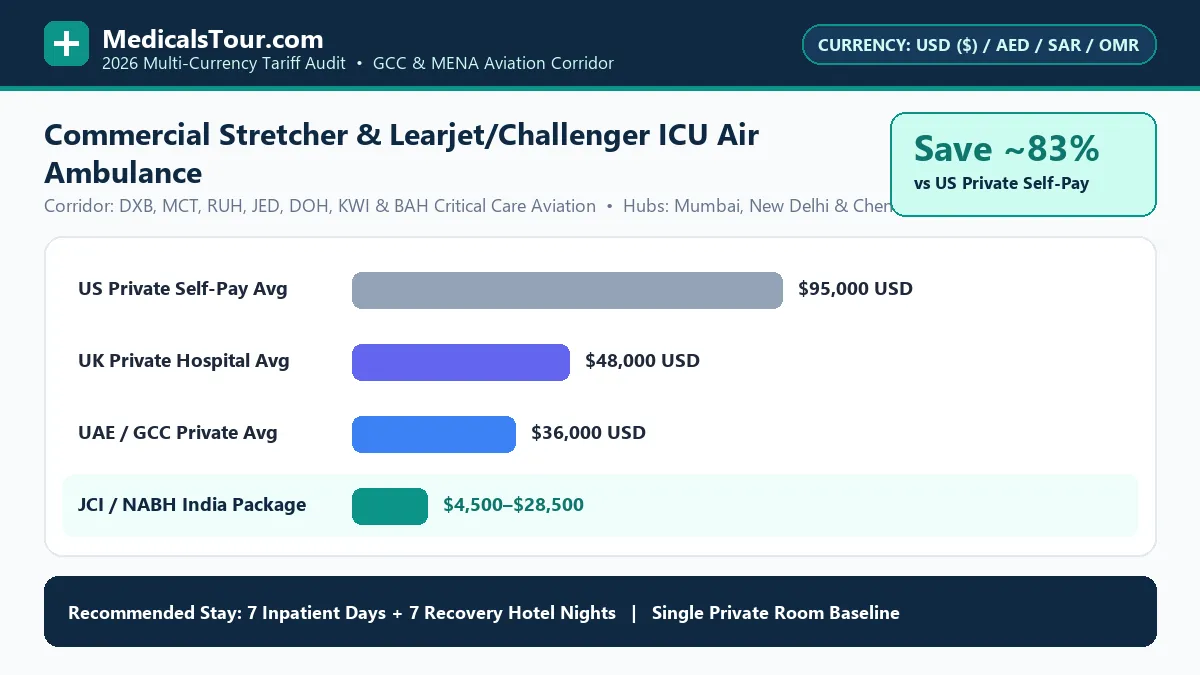
Notice the $12,000 to $19,000 USD cost gap between Tier 2 and Tier 3. A conscious, hemodynamically stable stroke patient in Muscat, Sohar, Dammam, or Sharjah with a nasogastric feeding tube and urinary catheter who breathes room air—or needs just 2 L/min supplemental oxygen—almost always qualifies for a Commercial Airline Stretcher rather than a private air ambulance jet, provided your family allows 72 hours for airline engineering seat-block installation and MEDIF sign-off.
Once on the ground, proximity between runway and ICU matters enormously for fragile transfers. In New Delhi, Manipal Hospital in Sector 6, Dwarka sits barely 10 to 12 minutes from Indira Gandhi International Airport Terminal 3 and the General Aviation apron, providing immediate neuro-ICU, trauma, and cardiac stabilization without fighting 50 minutes of central city traffic; on India’s western coast, Apollo Hospitals in Navi Mumbai coordinates rapid highway cardiac-ambulance intake directly off Mumbai’s international arrival corridors.

How a 9-Seat Commercial Airline Stretcher Works on Emirates, Oman Air, Saudia & Air India
Families who have never seen a commercial stretcher rig often picture an exposed hospital gurney wedged awkwardly into an aisle. In reality, widebody Boeing 777, Boeing 787 Dreamliner, and Airbus A330/A350 aircraft operated by Emirates, Oman Air, Saudia, Qatar Airways, Etihad Airways, Kuwait Airways, Gulf Air, and Air India carry engineered structural stretcher kits certified by the FAA and EASA.
Four hours before departure at DXB, MCT, RUH, JED, or DOH, airline maintenance technicians fold flat a block of six to nine contiguous Economy Class seats at the rear window bulkhead of the cabin, bolt an elevated aluminum stretcher frame onto the seat tracks, top it with a high-density medical mattress and four-point safety restraint harnesses, and hang a heavy, floor-to-ceiling wraparound privacy curtain around the entire bay. Dedicated therapeutic oxygen cylinders (`2 to 6 L/min` continuous flow) mount beneath the frame, while adjacent aisle seats are assigned to your accompanying ACLS flight physician or critical-care nurse and one family member.
Understanding how airlines calculate the commercial stretcher fare prevents shock when quoting tickets: the carrier charges one full-fare unrestricted IATA Economy base tariff plus a stretcher surcharge equivalent to 5 to 8 displaced economy seats, supplemental medical oxygen cylinder fees ($150–$350 per sector), two round-trip tickets for the medical escort/family member, and ground tarmac high-lift ambulance handling at both origin and destination airports.
Even with all nine seat blocks, ground ambulances, and a flying ICU nurse bundled together through an accredited aeromedical desk, total outlay between Muscat or Dubai and Mumbai or Delhi lands around $5,400 to $8,900 USD—less than one-third the charter fee of a private jet.
Carrier aircraft selection matters when booking a Gulf commercial stretcher. Narrowbody single-aisle jets used on certain regional frequencies—such as older Boeing 737 configurations or dense low-cost A320 layouts—either cannot accommodate rear-bulkhead stretcher rigs or lack wide lavatory turn radiuses for horizontal loading. Always prioritize widebody twin-aisle rotations (Emirates B777-300ER, Qatar Airways B787/A350, Saudia B777/B787, Oman Air B787, or Air India B787/A350) when your aeromedical coordinator submits the seat-block request.
Mastering the IATA MEDIF Form: Hemoglobin, Pneumothorax & Cabin Altitude Physics
Every commercial stretcher booking, onboard oxygen request, or Business-Class WCHC wheelchair assist hinges on a single two-part international document: the IATA Medical Information Form (MEDIF), submitted to the airline’s Aviation Medicine Desk 48 to 72 hours before takeoff. Part 1 is signed by the patient or next-of-kin; Part 2 must be filled out line-by-line and stamped by the attending hospital physician in Dubai, Riyadh, Muscat, or Doha within 72 hours of flight departure.
Airline flight surgeons reject incomplete MEDIF submissions daily over four physiological safety thresholds caused by commercial cabins being pressurized to 6,000–8,000 feet (where Boyle’s Law expands trapped gas pockets by ~30% and alveolar oxygen drops):
- Hemoglobin Minimum (≥ 8.5 to 9.0 g/dL): Airline medical officers routinely reject chronic oncology, GI-bleed, or renal patients whose hemoglobin sits at 7.1 g/dL unless they receive a pre-flight packed red-blood-cell transfusion bringing Hb safely above 8.5–9.0 g/dL (with post-transfusion lab proof attached to the MEDIF) plus in-flight supplemental oxygen.
- Untreated Pneumothorax (Absolute Contraindication): Any residual air in the pleural cavity without a functioning Heimlich flutter valve—or within 7 to 14 days of chest-drain removal unconfirmed by clean upright chest X-ray—is strictly grounded from commercial altitude.
- Recent Craniotomy, Laparotomy or Retinal Gas Bubble: Intracranial air (pneumocephalus) after brain surgery or intraocular SF6/C3F8 gas bubbles after vitreoretinal repair expand dangerously at 8,000 feet; see exact surgical waiting windows in our Fit-to-Fly Certificate After Surgery Guide.
- Precise Vital Signs & Drain Output Numbers: Never write vague words like “Stable” on MEDIF Part 2—record exact resting BP (`124/78 mmHg`), pulse (`76 bpm`), respiratory rate (`16/min`), SpO2 on room air vs oxygen (`96% on 2L O2`), Glasgow Coma Scale (`E4V5M6 = 15/15`), and catheter/NG tube sizes.
If a seated Business- or Economy-Class pulmonary or cardiac traveler plans to carry a personal FAA-approved Portable Oxygen Concentrator (POC)—such as an Inogen One G5 or Philips SimplyGo Mini—instead of ordering airline oxygen cylinders, aviation lithium-ion rules require bringing spare batteries rated to power at least 150% of total gate-to-gate flight duration (since seat AC outlets are never guaranteed for life-support medical devices) and listing exact device serial and watt-hour specs on the MEDIF.
Why Lying Flat in Business Class Does NOT Replace a Stretcher (The Taxi/Takeoff Rule)
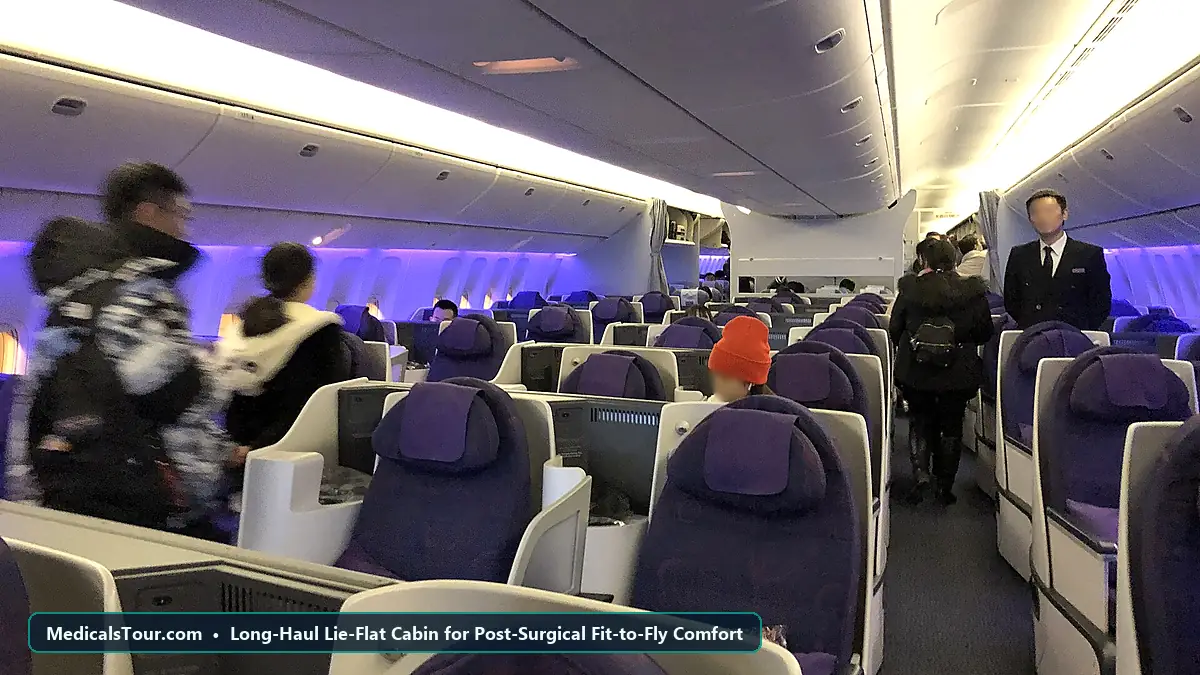
At least twice a week across Gulf airports, a well-meaning family purchases two $2,200 Business-Class tickets for a parent with an unstable lumbar burst fracture, post-hip-dislocation traction, or orthostatic syncope—reasoning that modern Emirates, Qatar Qsuite, or Oman Air Apex suites recline 180 degrees flat like a bed. At the boarding gate, the cabin purser and airport duty manager deny boarding on the spot.
Why? Under mandatory civil aviation crashworthiness regulations (GCAA, GACA, EASA, and DGCA), every Business- and First-Class suite seat is certified for crash impact forces exclusively in the upright taxi, takeoff, and landing position! Passengers in Business Class must sit upright for 20 to 30 minutes during taxi-out and climb, during severe mid-flight turbulence over the Arabian Sea, and for the final 25 minutes of approach and landing—and they must transfer laterally out of a narrow airport aisle chair (`WCHC`) over fixed suite shells.
If your orthopedic or neurosurgical consultant writes “Strict supine spinal immobilization — zero axial sitting load permitted” prior to spinal decompression or fusion (compare surgical options in our Spine Surgery & Fusion Cost Guide), Business Class is legally unusable; book a certified rear-cabin Economy Stretcher or fixed-wing air ambulance instead. Conversely, if a recovering cardiac or knee patient can comfortably sit upright at 40 degrees for 25 minutes and simply wants horizontal leg elevation during the three-hour cruise (check surgical timelines in our Heart Bypass CABG Cost Guide), Business Class with pre-booked `WCHC` wheelchair-to-seat assistance is ideal.
Airline medical desks also enforce standard IATA calendar cooling-off windows after acute vascular events before clearing either Business Class or commercial stretchers: uncomplicated non-ST-elevation myocardial infarction after successful stenting typically clears commercial altitude at 5 to 7 days, complicated heart failure or large anterior STEMI requires 10 to 14 days of documented rhythm and ejection-fraction stability, and acute ischemic stroke normally clears commercial stretcher transport between Day 5 and Day 10 once repeat CT rules out hemorrhagic transformation or worsening cerebral edema.

Dedicated Bed-to-Bed ICU Air Ambulances: Learjet, Hawker & Sea-Level Pressurization
When a loved one in Riyadh, Jeddah, Kuwait City, Doha, Muscat, Dubai, or Baghdad is intubated on a mechanical ventilator, sedated on propofol/fentanyl, supported by norepinephrine and vasopressin infusions after cardiogenic shock, or recovering from acute hemorrhagic stroke with raised intracranial pressure, a dedicated fixed-wing Bed-to-Bed ICU Air Ambulance is the sole safe lifeline.
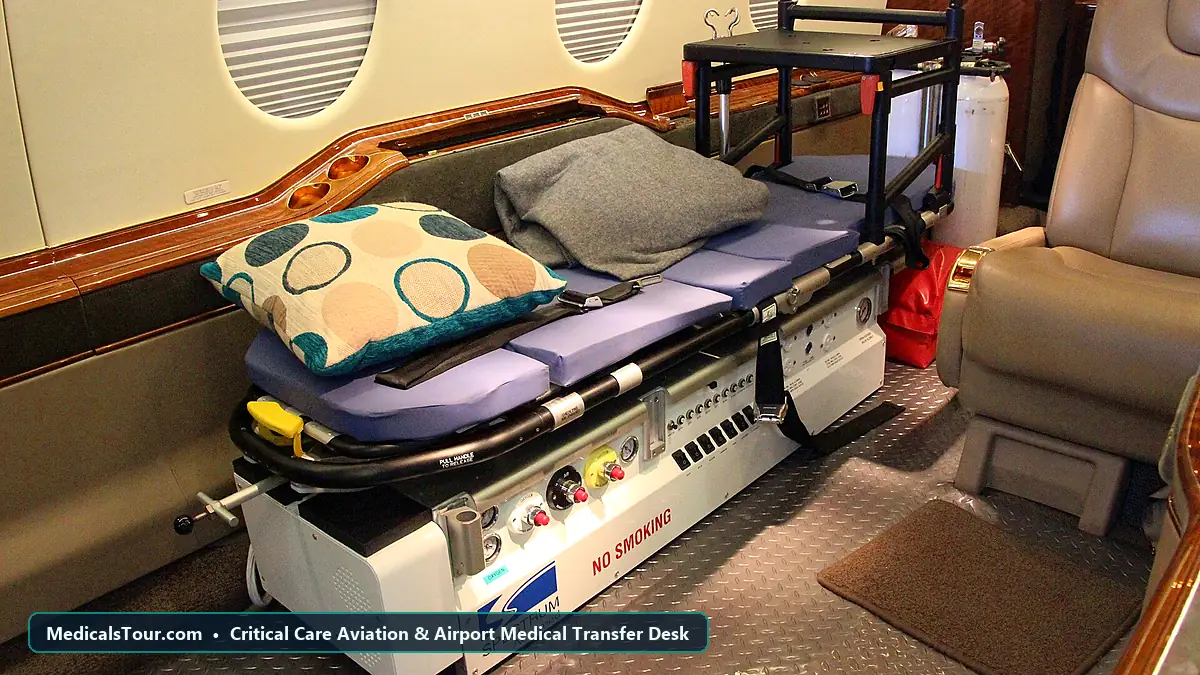
Accredited aeromedical operators stationed at Dubai Al Maktoum (`DWC`), Riyadh (`RUH`), Muscat (`MCT`), New Delhi (`DEL`), and Mumbai (`BOM`) deploy twin-engine medical jets—primarily Bombardier Learjet 45XR/60, Hawker 800XP/900XP, and Challenger 604/605 aircraft—outfitted as flying tertiary ICU bays:
- Full Critical-Care Suite On Board: LifePort stretcher base with 3,500+ liters of liquid/compressed medical oxygen, Hamilton T1 transport ICU ventilator (invasive & NIV modes), Zoll X-Series biphasic defibrillator/pacer with end-tidal CO2 capnography, four-channel Braun syringe infusion pumps, i-STAT handheld arterial blood-gas analyzer, and portable suction.
- True “Sea-Level Cabin” Capability: Unlike commercial jets locked at 7,500-foot cabin altitude, private medical jets can fly slightly lower (25,000–28,000 feet) while maintaining full differential pressure so internal cabin altitude stays at sea level (0 to 1,500 feet)—life-saving for pneumocephalus, decompression illness, bowel obstruction, or severe ARDS oxygenation failure!
- Wing-to-Ward Clinical Crew: A senior critical-care anesthesiologist/intensivist and flight ICU nurse walk directly into your Gulf hospital ICU to perform a formal bedside handover before wheeling the patient out—never leaving the patient at an airport curb.
Neonatal and infant ICU transfers follow an even stricter equipment protocol. When moving a 2.8-kilogram premature infant or prostaglandin-dependent cardiac newborn out of Muscat, Sharjah, Jeddah, or Manama, verify that the air-ambulance provider mounts a certified aviation Airborne Neonatal Transport Incubator equipped with servo-controlled thermal warming, blended low-flow oxygen/air mixers (preventing retinopathy of prematurity), neonatal pressure-controlled ventilation, and inline nitric oxide cylinders.
Flight routing range also distinguishes light Learjets from midsize Hawker 800XP or Challenger 604 cabins: while Muscat, Dubai, Abu Dhabi, Doha, and Bahrain sit well within nonstop range of Mumbai and New Delhi on any medical jet, departures from western Saudi Arabia (Jeddah or Tabuk) or Baghdad headed all the way down to Chennai occasionally require a 35-minute technical fuel stop unless booked on a longer-range Challenger 604/605.
Tarmac Apron Ambulance Transfers (‘Airside High-Lift’) & Emergency Visa Clearance
What happens the moment a commercial stretcher flight or private Learjet touches down at New Delhi (`DEL`), Mumbai (`BOM`), or Chennai (`MAA`)? Stretcher patients do not get wheeled up a crowded passenger jetway or queued behind 300 tourists at biometric e-Visa counters.
| Arrival Step | Commercial Airline Stretcher Protocol | Private Fixed-Wing Air Ambulance Protocol |
|---|---|---|
| Aircraft Deplaning | Scissors-lift hydraulic medical catering/ambulift truck docks at rear right aircraft door once regular passengers disembark. | Receiving hospital ACLS cardiac ambulance drives directly onto the General Aviation / FBO apron beside the jet’s airstair door (subject to BCAS tarmac pass). |
| Immigration & Customs | Airport Health Officer (APHO) & Bureau of Immigration duty officer verify stamped Medical Visa / e-Medical Visa & passport via coordinated stretcher medical gate channel. | Dedicated FBO General Aviation immigration & customs officers clear patient, 1–2 family companions & flight medics inside the private terminal in 15 minutes. |
| Hospital ICU Handover | Direct stretcher-to-stretcher transfer into receiving JCI hospital ICU ambulance waiting at the airside medical gate. | Zero terminal walking; continuous ventilator & syringe-pump handover straight onto inpatient ICU bed within 20–45 minutes of wheels-down. |
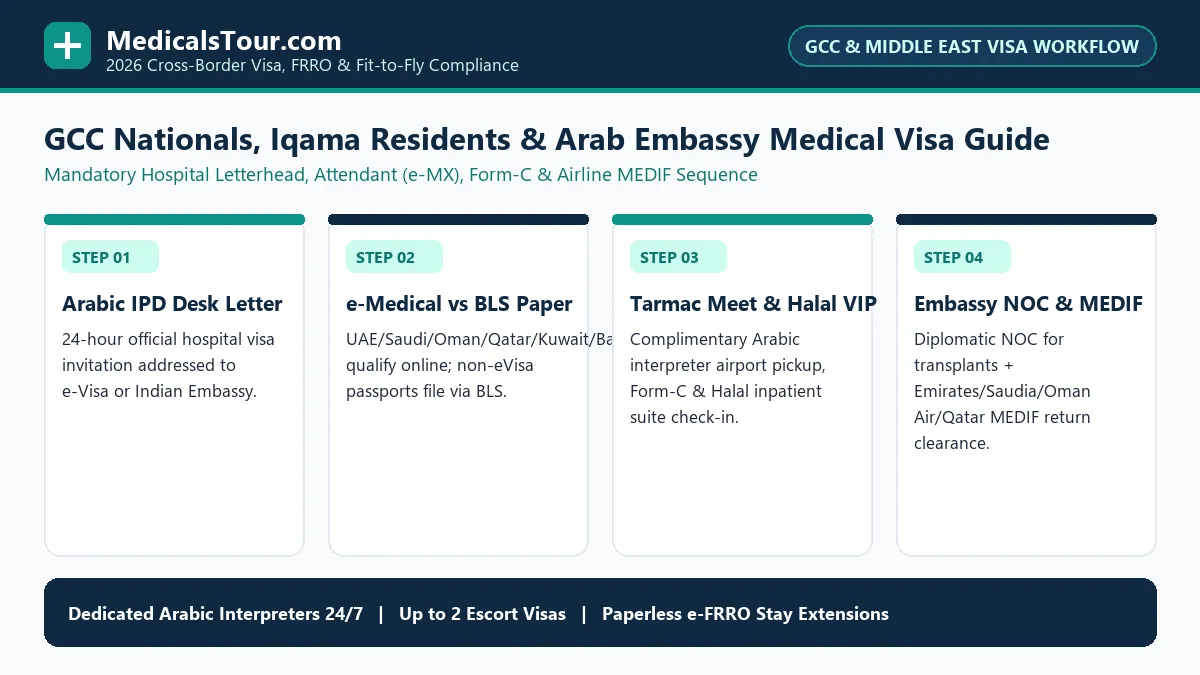
Ensure emergency visas are triggered simultaneously when mobilizing an air ambulance! Citizens and residents across all six GCC states qualify for expedited 12-to-24-hour clearance under the India e-Medical Visa for Oman, UAE & Gulf Travelers when the receiving Indian hospital’s Medical Director emails an Emergency ICU Admission Acceptance Letter directly to Indian Embassy consular welfare officers in Abu Dhabi, Dubai, Muscat, Riyadh, Doha, or Kuwait.
Note one vital airport security requirement on the Indian side: Bureau of Civil Aviation Security (BCAS) and airport operator rules at DEL, BOM, and MAA require the receiving hospital’s International Desk to submit the ground ambulance vehicle registration number, driver national ID, and attending ICU doctor’s credentials at least 12 to 24 hours before flight arrival to issue an airside tarmac entry permit—so forward confirmed flight manifests immediately upon booking.
Avoiding Charter Broker Markups & Checking GCC Insurance Repatriation Riders
Two financial checks save Gulf families $4,000 to $12,000 USD during high-stress aeromedical hours. First, before wiring $24,000 out of pocket for a private air ambulance, check your patient’s corporate GCC health insurance certificate (Bupa Global, Cigna, Allianz Care, Daman Thiqa/Enhanced, GIG Gulf, QLM, or Tawuniya) or premium credit-card travel benefits for an “Emergency Medical Evacuation / Cross-Border Transfer to Nearest Center of Medical Excellence” clause. When a local Gulf hospital signs a clinical attestation stating that required quaternary intervention (for instance, pediatric ECMO, proton therapy, or specialized LVAD/transplant care) is unavailable locally, international assistance desks such as International SOS, Allianz Partners, or Maple/Eurocross frequently fund 100% of medically necessary air-ambulance or stretcher transport!
Second, if paying privately, avoid opaque European website “charter lead aggregators” that own zero aircraft and simply tack a $5,000 broker fee onto an Indian or Gulf operator’s jet. Ask two blunt questions before signing any charter contract: “What is the exact tail registration number (`VT-XXX` or `A6-XXX`) of the aircraft positioned on the ramp right now?” and “Does this all-inclusive quote cover both origin Gulf ground ambulance, destination Indian tarmac high-lift fees, and hospital-to-bed transfer?”
Ask about empty-leg repositioning windows too: because Indian-registered Learjet and Hawker air ambulances fly critical patients between Delhi/Mumbai and Dubai/Muscat/Riyadh multiple times every week, booking a return leg of an aircraft already parked on the tarmac at Al Maktoum (`DWC`) or Muscat (`MCT`) can trim charter quotes by 20% to 30% overnight.
Across Medical Tour’s critical-care aviation desk audits, verifying aircraft tail registration and receiving-hospital ICU bed lock simultaneously cuts mobilization delays in half. Explore all regional clinical routes on our Medical Corridors Hub and calculate transport, ICU deposit, and companion apartment budgets inside our Medical Trip Budget Planner.