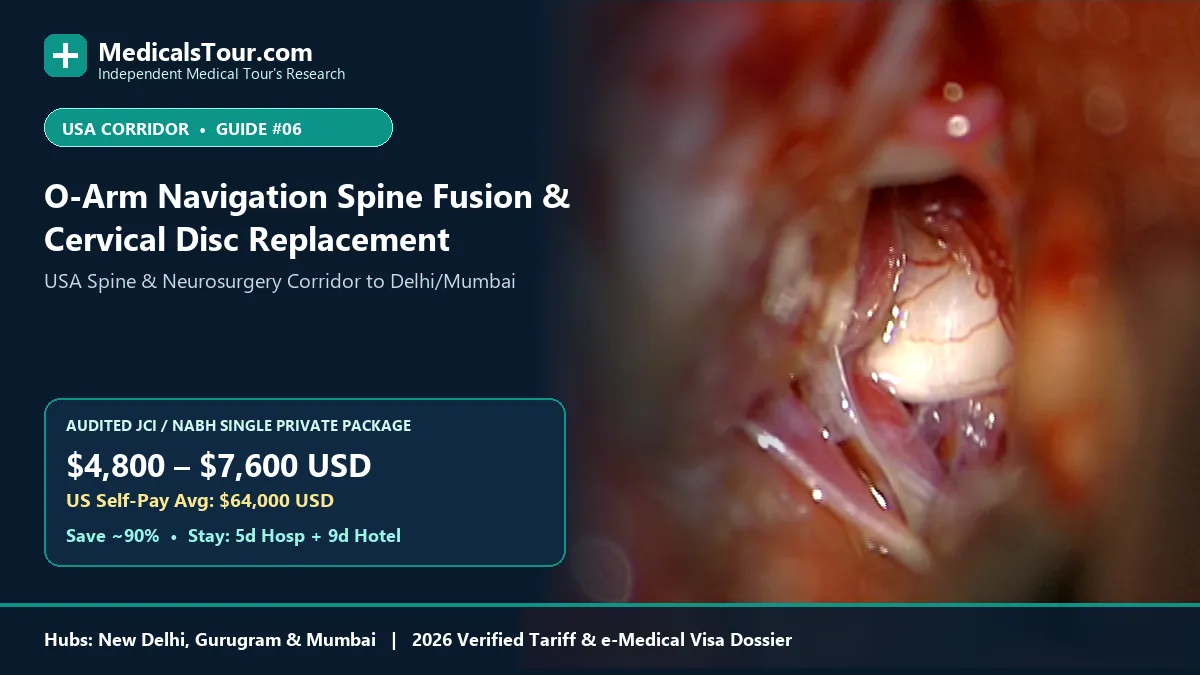
Two distinct roadblocks push Americans with debilitating sciatica, lumbar spinal stenosis, or cervical radiculopathy to investigate neurosurgical centers in New Delhi and Mumbai. For self-pay patients—including independent tradespeople, tech consultants between contracts, and early retirees—the hurdle is raw domestic sticker shock: a single-level minimally invasive transforaminal lumbar interbody fusion (MIS-TLIF) routinely generates combined hospital facility, pedicle-screw hardware, neuromonitoring, and surgeon bills of $64,000 to $98,000 USD in Dallas, Seattle, or Atlanta. For commercially insured 42-year-olds with herniated C5–C6 or C6–C7 neck discs, the frustration is clinical utilization policy: several US insurance carriers approve rigid Anterior Cervical Discectomy and Fusion (ACDF)—bolting neck vertebrae together and accelerating adjacent-segment disc degeneration—while refusing to authorize motion-preserving Artificial Cervical Disc Replacement (CDR).
Inside advanced spine and neurosurgical suites at Max Super Speciality Hospital, Saket in New Delhi and Sir H.N. Reliance Foundation Hospital in South Mumbai, fellowship-trained ortho-spine and neuro-spine teams operate with continuous multimodal intraoperative neuromonitoring (IONM), Medtronic O-Arm S8 3D stealth navigation, Globus ExcelsiusGPS / Mazor X spine robotics, and 4K full-endoscopic keyhole towers.
Audited 2026 Single Private packages run $4,200 to $5,400 USD for full-endoscopic lumbar discectomy and $5,600 to $7,900 USD for 1-level O-Arm-navigated fusion or US FDA-approved Medtronic Prestige LP / Centinel Spine prodisc-C cervical disc arthroplasty—provided pre-flight upright dynamic imaging locks down your exact spinal biomechanics before you board a plane. Because unaddressed nerve-root ischemia slowly turns reversible paresthesia into permanent axonal muscle weakness, getting timely decompression inside an instrumented quaternary neuro-OR beats waiting out another deductible year on escalating gabapentin doses. Below is our engineering, hospital, and long-haul aviation roadmap for US spine travelers.
2026 Spine & Neurosurgery Tariff Comparison: Keyhole Endoscopy, Fusion & Artificial Discs
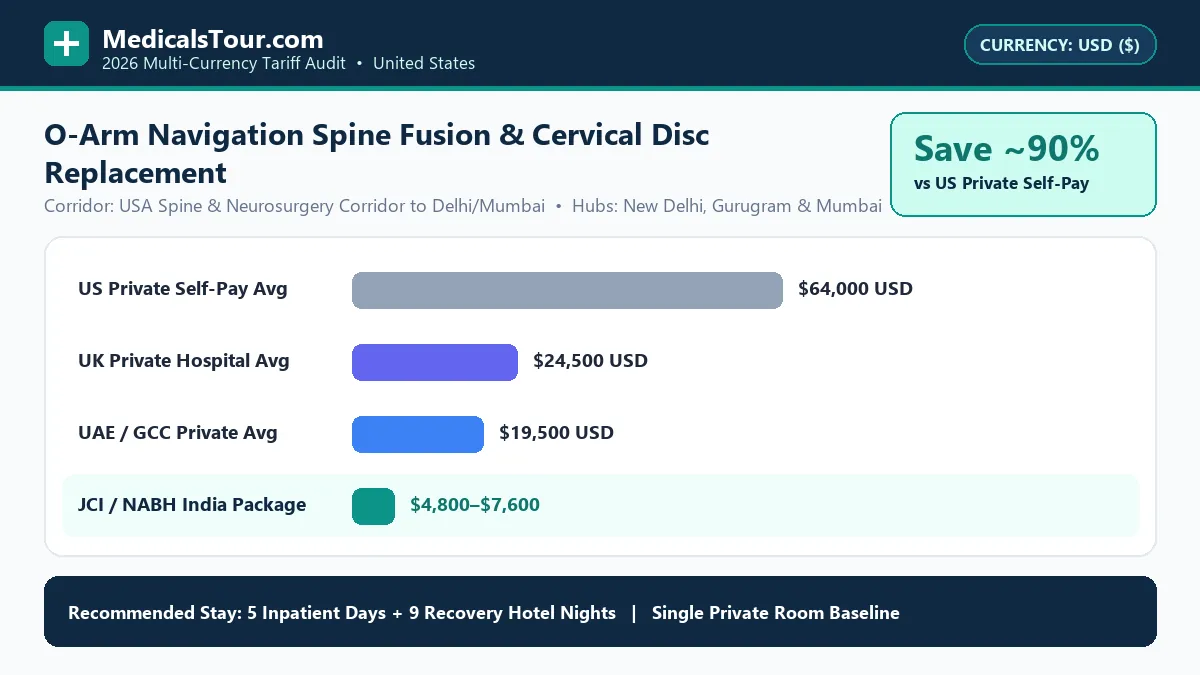
Spinal surgery quotes fluctuate more than knee replacement estimates because hardware count scales directly per vertebral level—each fused lumbar segment requires four cannulated titanium pedicle screws, two contoured cobalt-chrome or titanium rods, bone morphogenetic graft or demineralized bone matrix (DBM), and a PEEK or 3D-printed porous titanium interbody cage. Cross-checking Medical Tour’s 2026 neurosurgical cost ledger alongside our Minimally Invasive Spine Surgery & Microdiscectomy Cost Guide establishes clear single-level vs two-level benchmarks:
| Spinal Procedure & Navigation Technology | US Self-Pay Cash Tariff | India JCI Single Private Package | Hardware Brands & Inpatient + Hotel Stay |
|---|---|---|---|
| Full-Endoscopic Transforaminal / Interlaminar Discectomy | $26,000 – $44,000 | $4,200 – $5,400 | Richard Wolf / Joimax 8mm 4K endoscope (zero hardware); 1–2 Hosp + 6–7 Hotel nights. |
| Microscopic Tubular Lumbar Decompression / Laminectomy | $29,000 – $48,000 | $4,600 – $5,800 | Zeiss Kinevo 900 surgical microscope + METRx tubular retractors; 3 Hosp + 7 Hotel nights. |
| 1-Level O-Arm Navigated MIS-TLIF / OLIF Lumbar Fusion | $64,000 – $98,000 | $5,600 – $7,600 | Medtronic Solera/CD Horizon sextant screws + titanium/PEEK cage + O-Arm + IONM; 4–5 Hosp + 9 Hotel nights. |
| 1-Level Artificial Cervical Disc Replacement (CDR) | $48,000 – $76,000 | $5,800 – $7,900 | Medtronic Prestige LP or Centinel prodisc-C Vivo motion-preserving disc; 3–4 Hosp + 8 Hotel nights. |
| 2-Level Cervical ADR or Hybrid (1 CDR + 1 ACDF) | $68,000 – $105,000 | $7,800 – $10,200 | Dual-level imported cervical prostheses + continuous SSEP/MEP neuromonitoring; 4 Hosp + 9 Hotel nights. |
If your lumbar MRI shows adjacent second-level stenosis requiring a 2-level MIS-TLIF fusion (6 pedicle screws + 2 interbody cages), expect Indian JCI Single Private quotes to step up transparently by roughly $1,400 to $2,100 for the additional level’s imported Medtronic or DePuy Synthes Viper hardware—compared with a $28,000+ second-level chargemaster jump in US hospitals. Also budget $350 to $580 for Day-1 outpatient pre-anesthesia clearance, standing whole-spine EOS/digital radiographs, DEXA bone-mineral density testing (crucial in post-menopausal women or patients over 60 to rule out occult osteoporosis T-scores below -2.5 before torquing pedicle screws!), and nasal MRSA screening.
Preventing Arrival Day Surprises: The 3-Scan Pre-Flight Spine Protocol
Here is the most important piece of practical advice a cross-border healthcare operations analyst can give an American spine patient: a supine 1.5T MRI alone is never enough to lock in a guaranteed surgical plan from 8,000 miles away. When you lie flat on your back with a bolster under your knees inside an MRI bore, an unstable L4–L5 spondylolisthesis (vertebral slippage) frequently slides 4 millimeters backward into normal-looking alignment—masking dynamic mechanical instability until an Indian spine surgeon orders standing X-rays after you land in Delhi or Mumbai, unexpectedly converting a planned $4,800 tubular decompression into a $7,200 instrumented fusion.
Eliminate mid-trip clinical surprises completely before buying airfare by transmitting three inexpensive US outpatient imaging studies together in raw uncompressed DICOM (.dcm) format:
- Recent High-Resolution 3T MRI (Acquired Within 60–90 Days): Thin-slice T1, T2, and STIR sagittal and axial cuts through every cervical or lumbosacral disc space delineating nerve-root impingement, central canal cross-sectional area in square millimeters, Modic endplate edema, and facet-joint synovial cysts or T2-bright fluid clefts (a telltale marker of subtle hypermobility).
- Standing Dynamic Flexion-Extension Lateral X-Rays ($110–$180 Cash in the US): Shot upright under gravity while bending maximally forward and leaning gently backward; exposes >3.5mm sagittal translation or >11° angular motion that makes fusion biomechanically mandatory over simple discectomy.
- Thin-Slice Non-Contrast Helical CT Scan (Mandatory for Cervical Disc Replacement Candidates): MRI struggles to distinguish soft cartilage from calcified bone spurs. A 1mm cervical CT confirms preserved posterior facet joint cartilage (qualifying you for motion-preserving Prestige LP or Mobi-C disc arthroplasty) versus severe facet arthrosis, bridging osteophytes, or Ossification of the Posterior Longitudinal Ligament (OPLL—common in Asian and older Western spines), where anterior fusion or posterior laminoplasty is far safer for the spinal cord.
When patients over 55 present with multilevel MRI disc bulges alongside mild diabetic peripheral neuropathy, bringing a recent lower- or upper-extremity EMG / Nerve Conduction Velocity (NCV) study helps your Indian neurosurgeon confirm exactly which single nerve root is firing acute denervation potentials—avoiding over-operating on silent adjacent levels. Fusion candidates must also stop all nicotine products 4 weeks pre-flight, as cotinine constricts endplate micro-vessels and triples lumbar pseudarthrosis non-union risk.
Inside the Neuro-Spine OR: Medtronic O-Arm S8, Robotic Guidance & Live Neuromonitoring
Patients naturally feel heightened vulnerability around spinal cord, cauda equina, and cervical recurrent laryngeal nerve anatomy compared with extremity arthroplasty. Flagship JCI spine centers in India neutralize freehand anatomical guesswork with four redundant technological layers built into international surgical packages:
- Intraoperative 3D O-Arm CT & StealthStation S8 Navigation (or Mazor X Stealth / ExcelsiusGPS Robotics): Rather than squinting at grainy 2D C-arm fluoroscopy shots, a mobile Medtronic O-Arm ring spins 360 degrees around the radiolucent Jackson carbon-fiber operating table after prone positioning, building a sub-millimeter 3D CT volume registered to infrared optical arrays. Pedicle-screw placement accuracy exceeds 99.2%, preventing medial pedicle breaches toward traversing nerve roots or anterior vascular injury—while sparing the patient repeated X-ray exposure.
- Dedicated Clinical Neurophysiologist Running Multimodal IONM: Throughout every cervical disc replacement, thoracic myelopathy decompression, scoliosis correction, and lumbar fusion, an in-room neurophysiologist monitors real-time Somatosensory Evoked Potentials (SSEP), Transcranial Motor Evoked Potentials (tcMEP), triggered pedicle-screw stimulation EMG, and spontaneous free-run EMG—alerting the surgeon instantly before microscopic nerve traction occurs.
- Zeiss Kinevo 900 Exoscope/Microscope & Ultrasonic Bone Scalpel: Misonix BoneScalpel piezoelectrically cuts calcified lamina bone on contact while bouncing harmlessly off elastic dural membranes—dramatically cutting incidental dural tear rates during severe spinal stenosis decompressions.
- 8mm Awake/Twilight Full-Endoscopic Keyhole Discectomy: For contained L4–L5 or L5–S1 disc extrusions without instability, transforaminal/interlaminar 4K endoscopes dilate muscle fibers sequentially without stripping multifidus tendons off spinous processes—letting patients walk to the bathroom three hours post-op with barely a Band-Aid over the flank.
For L2–L5 degenerative spondylolisthesis or collapsed disc spaces needing sagittal lordosis restoration, Indian spine institutes also perform muscle-sparing Oblique Lateral Interbody Fusion (OLIF) and Anterior Lumbar Interbody Fusion (ALIF) using wide-footprint 3D-printed porous titanium cages whose trabecular micro-pores actively attract host osteoblasts—achieving indirect neural foraminal height expansion without ever entering the posterior spinal canal or retracting scarred nerve roots.
Comparing Max Saket South Delhi & Sir H.N. Reliance Foundation Hospital Mumbai
Both anchor hospitals on this corridor pair quaternary neurosurgical hardware with flat, wheelchair-and-walker-friendly urban convalescence zones that protect recovering backs from potholed commutes. Upon airport arrival and hospital discharge, request a spacious Toyota Innova Crysta captain-seat MPV (standard with hospital international desks) rather than a low-slung compact sedan so you step laterally onto a hip-height bucket seat reclined to 115 degrees without stooping:
Max Super Speciality Hospital, Saket (Press Enclave Marg, South Delhi)
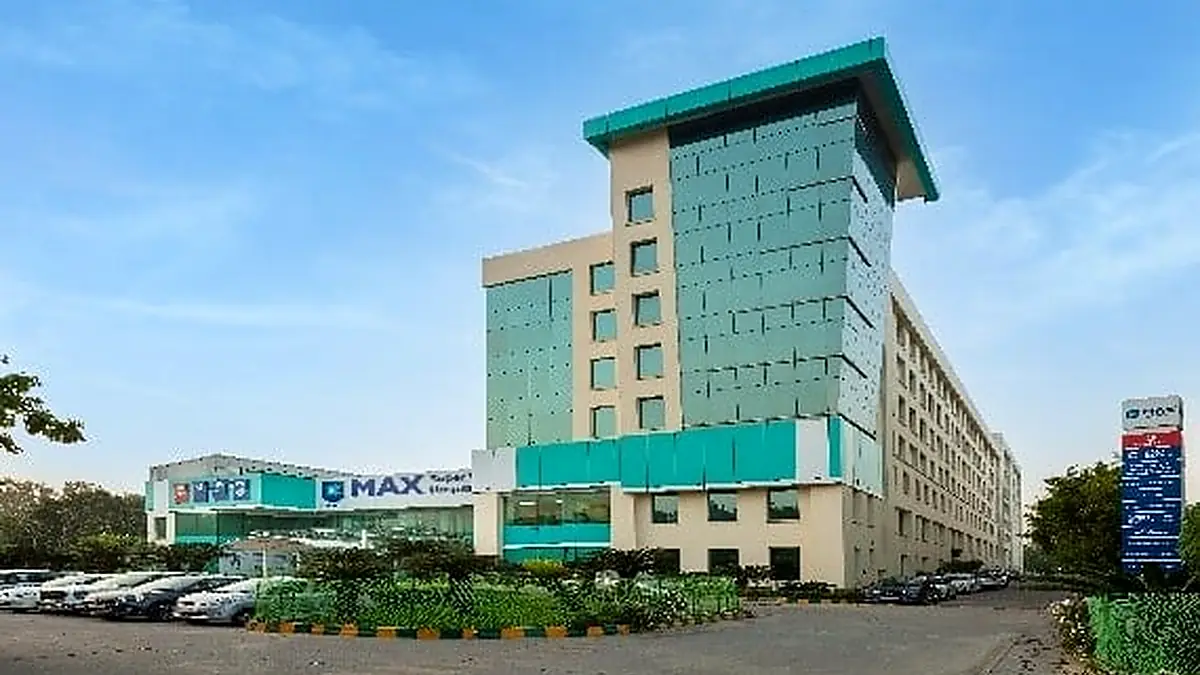
Located 25 to 35 minutes from DEL Terminal 3 via wide Nelson Mandela Marg, Max Hospital Saket sits directly opposite Select CITYWALK and DLF Avenue—South Delhi’s cleanest, flattest landscaped pedestrian plaza belt. Inside the West Block Neurosciences & Spine Institute, dedicated neuro-anesthesiologists and Neuro-ICU nurses manage post-op lumbar and cervical pathways around the clock. Patients discharged on Day 3 or Day 4 stay five minutes away at Sheraton New Delhi Saket or Hilton Garden Inn Saket (requesting a raised toilet seat and firm lumbar bed board from housekeeping prior to check-in), completing four short, climate-controlled 10-minute indoor walks daily across smooth marble mall concourses without navigating high street curbs, stray scooters, or December morning haze.
Sir H.N. Reliance Foundation Hospital (Girgaon, South Mumbai)
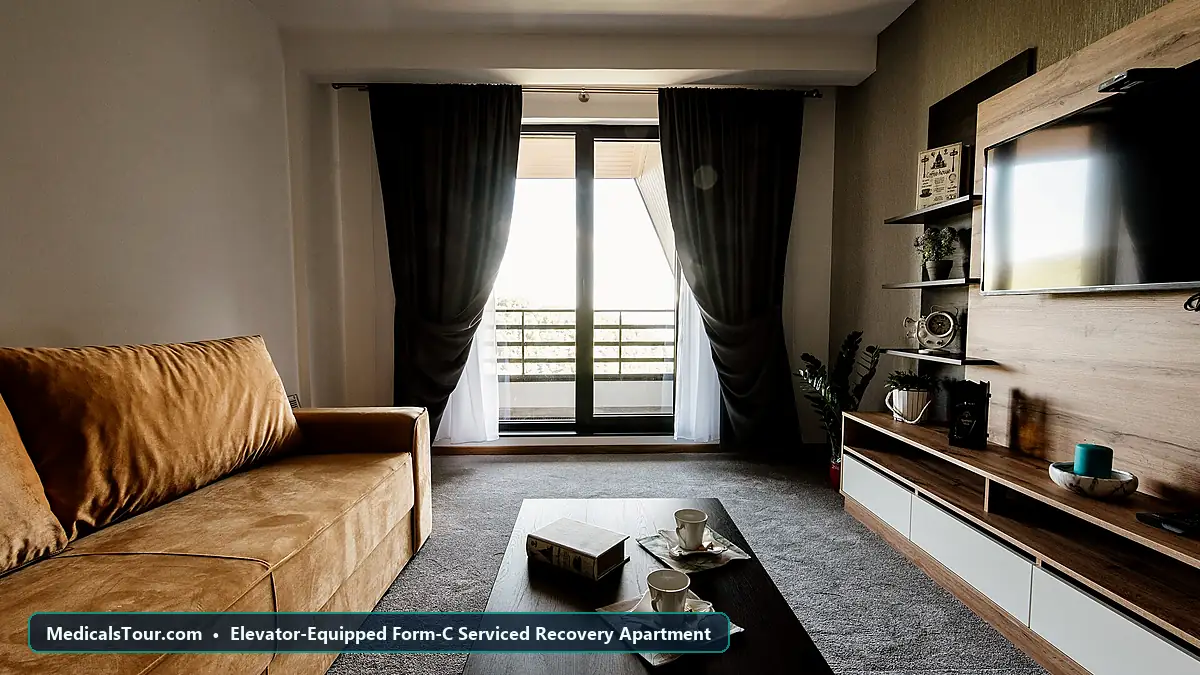
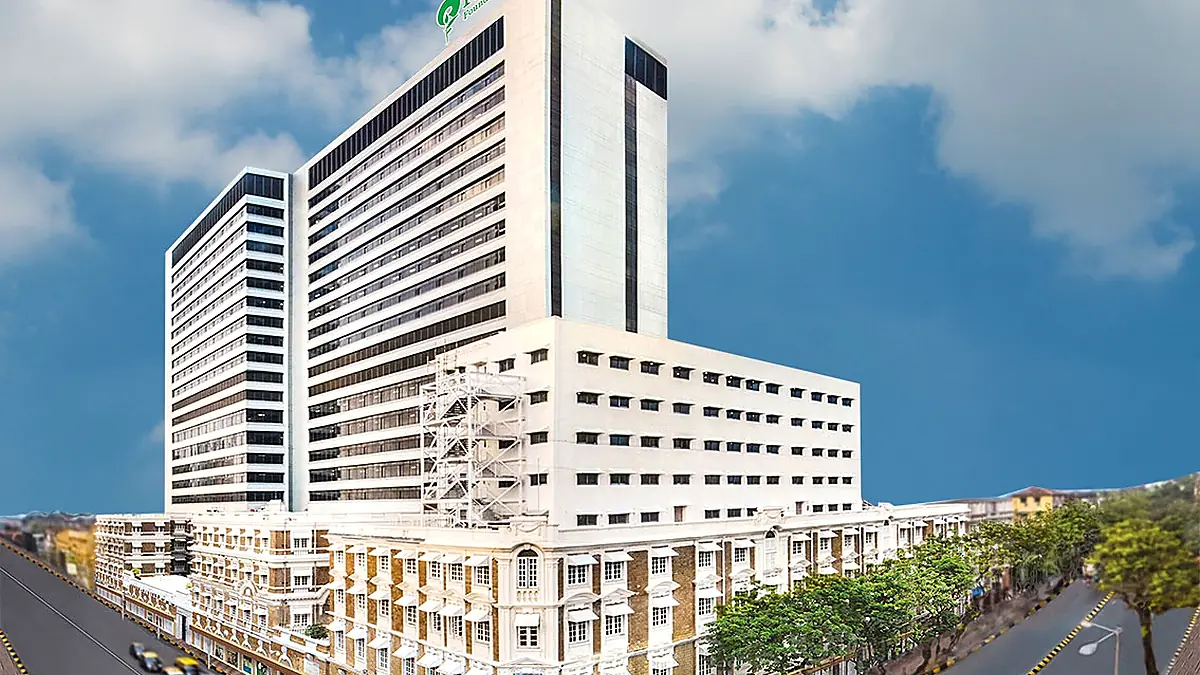
In historic South Mumbai near Marine Drive and Charni Road, Sir H.N. Reliance Foundation Hospital houses LEED-Gold, JCI-accredited hybrid neurovascular and O-Arm robotic spine theaters inside a whisper-quiet 19-story quaternary tower. International spine patients praise its acoustic soundproofing, electric zero-shear Hill-Rom beds, and dedicated spine rehabilitation floor featuring body-weight-supported gait harnesses and outpatient home-visit neuro-physiotherapists on Days 5 through 12. Accompanying spouses enjoy effortless cab access to Trident Nariman Point, The Oberoi Mumbai, InterContinental Marine Drive, and elevator-equipped serviced apartments in Breach Candy and Cuffe Parade—where flat sea-facing Marine Drive sidewalks invite gentle evening strolls. Both hospitals also keep in-house custom orthotists on call to fit breathable mesh Taylor thoracolumbar braces or Aspen cervical collars matched precisely to your torso height before your first hallway walk.
Red-Flag Symptoms: When You Must Never Board a Plane With Spinal Compression
Just as unstable resting chest pain rules out commercial flights for cardiac patients, three acute neurological syndromes constitute urgent domestic surgical emergencies that must never wait for an overseas e-Medical Visa, SWIFT wire clearance, or a 15-hour transoceanic flight:
- Cauda Equina Syndrome (CES): New-onset “saddle anesthesia” numbness across the groin, buttocks, or inner thighs; sudden urinary hesitancy, painless bladder retention, or overflow incontinence; loss of rectal sphincter tone; or rapidly progressive bilateral ankle/toe weakness. Permanent autonomic bladder and sexual nerve paralysis occurs within 24 to 48 hours unless decompressed immediately at your nearest US emergency hospital.
- Acute Progressive Motor Foot-Drop (MRC Grade ≤ 3/5 Developing Over Days): If your tibialis anterior muscle suddenly loses the strength to lift your forefoot off the floor this week, immediate local microdiscectomy gives the compressed L5 nerve root its best shot at motor recovery.
- Rapidly Decompensating Cervical Spondylotic Myelopathy: Sudden hand clumsiness (inability to button shirts or hold utensils), wide-based unsteady gait, electric Lhermitte shocks shooting down the spine on neck flexion, and severe cord compression with bright T2 intramedullary cord edema—where sudden aircraft turbulence or an abrupt airport taxi stop risks acute spinal cord contusion.
At the opposite end of the spectrum, reputable Indian neuro-spine chiefs repeat a classic clinical rule on video calls: “We operate on concordant dermatomal nerve deficits, never on isolated MRI radiologist text.” Nearly 40% of pain-free 50-year-olds carry incidental annular tears or mild disc bulges on MRI. By contrast, chronic sciatica lasting months from a contained lumbar disc protrusion, neurogenic claudication from lumbar canal stenosis (legs aching after walking two blocks, relieved promptly by sitting), stable Grade I degenerative spondylolisthesis, or persistent unilateral C6/C7 arm radiculopathy that has failed 6 to 12 weeks of structured physical therapy and selective CT-guided nerve-root blocks represent ideal, predictable elective travel candidates. Patients who have suffered months of severe sensory nerve compression should also set realistic neurological expectations: sharp radicular shooting pain typically vanishes the afternoon you wake from surgery, whereas residual toe or fingertip pins-and-needles remyelinate gradually at roughly 1 millimeter per day across 3 to 9 months.
Post-Op Dural Seal Integrity, Log-Roll Mobility & Cabin Ergonomics on the Flight Home
Flying prematurely—or sitting slumped in a 31-inch economy pitch seat—after lumbar or cervical spine surgery invites severe paraspinal muscle spasm, lower-limb deep vein thrombosis (especially because perioperative anticoagulants are withheld for 48–72 hours in spine surgery to prevent epidural hematomas, relying instead on pneumatic sequential calf pumps!), or positional headache if a pinpoint dural tear required fibrin-glue repair. Follow Medical Tour’s spine aviation matrix before locking in return flights via our Medical Trip Total Budget Planner:
| Procedure Category | Minimum Safe Flight Window | Cabin & Movement Rules for 14–16 Hour Return |
|---|---|---|
| 8mm Full-Endoscopic Discectomy | Post-Op Day 7 – Day 9 | Premium Economy bulkhead aisle minimum; stand & walk 4 minutes every hour; zero overhead-bin lifting. |
| 1-Level Cervical Artificial Disc or ACDF | Post-Op Day 10 – Day 12 | Wear soft Miami-J/foam cervical collar during taxiing, takeoff, turbulence & landing; confirm smooth swallowing & zero neck hematoma; angled/flat Business pod ideal. |
| 1-to-2-Level MIS-TLIF / OLIF Lumbar Fusion | Post-Op Day 13 – Day 16 | Lie-Flat Business Class strongly recommended: Nachemson intradiscal load is ~2.7x higher sitting at 90° than lying flat at 180°; wear lumbar corset only during airport transfers. |
| Any Case With Incidental Durotomy Repair | Minimum 14–18 Days Post-Repair | Surgeon must verify zero orthostatic CSF headache upright for 7+ consecutive days before signing Fit-to-Fly Medical Clearance; cabin altitude pressure changes aggravate unsealed dural repairs. |
Anterior cervical (ACDF or Prestige LP disc replacement) travelers should note that gentle surgical retraction beside the esophagus routinely causes 3 to 5 days of mild throat soreness when swallowing dry toast or large tablets—easily soothed with chilled yogurt smoothies, lozenges, and sleeping propped at 30 degrees on two hotel pillows while verifying crisp vocal clarity and flat neck contours before flying. Pack a memory-foam coccyx/lumbar support cushion for airport wheelchair rides, wear 20–30 mmHg graduated thigh-high compression stockings throughout the return journey, and arrange nonstop Air India routing (DEL/BOM to JFK, EWR, ORD, IAD, or SFO) whenever possible to eliminate mid-journey terminal walks.
BLT Precautions, Hardware Documentation & Returning to Desk or Physical Work in the US
Before checking out of Max Saket or HN Reliance Mumbai, rehearse the inpatient spine physiotherapist’s “No BLT” rule (No Bending forward at the waist, No Lifting anything heavier than a 5-to-8-pound half-gallon jug, No Twisting the shoulders against the pelvis) alongside the single-unit log-roll technique—keeping knees bent together and rolling onto your side as one rigid cylinder before pushing upright with your arms—for hotel beds and airline lie-flat suites. Pick up an aluminum grabber reacher and long-handled shoehorn ($12 at the hospital orthotics counter) plus a slip-on pair of Sketchers or Birkenstocks with grippy rubber soles so you never bend down to tie shoelaces in airport security lines.
Assemble a clean neurosurgical continuity packet for your US primary care physician, physiatrist, or outpatient spine physical therapist containing:
- Implant Traceability Stickers & 3.0T MRI-Conditional Certification: Titanium-alloy pedicle screws (Ti-6Al-4V ELI), PEEK/titanium cages with tantalum radiographic markers, and Medtronic Prestige LP titanium-ceramic cervical discs are non-ferromagnetic and cleared for future 1.5T and 3.0T MRI scanners—carrying the exact manufacturer serial sticker stops overly cautious US imaging centers from refusing future scans.
- Post-Op Standing AP/Lateral Radiographs & Operative Note: Baseline Day-10 upright films documenting interbody cage lordosis, disc-height restoration, and pedicle purchase so your US doctor has an exact Day-Zero benchmark for Month-3 and Month-6 bone-fusion X-rays (and remind your US dentist and PCP to avoid prescribing NSAIDs like ibuprofen, naproxen, or celecoxib for 90 days after spinal fusion, as COX-2 inhibition slows osteoblast bone bridging—while maintaining Vitamin D3 above 35 ng/mL, 1,200 mg dietary calcium, and 1.2 g/kg daily protein!).
- Phased Return-to-Work & Core Stabilization Calendar: Gradually build flat outdoor walking from three 12-minute bouts daily in Week 2 up to 45 brisk minutes by Week 6. Remote standing-desk computer work typically resumes at Week 2 after endoscopic discectomy or cervical ADR and Week 3–4 after 1-level MIS-TLIF, progressing to McGill “Big Three” neutral-spine core conditioning at Week 6 and full manual loads once CT/X-ray confirms solid arthrodesis—compare companion travel logistics across our International Patient Corridors.