Sit in a GP waiting room in Rathmines, Wilton in Cork, or Salthill in Galway with worsening hip osteoarthritis, a prolapsed lumbar disc, or severe pelvic endometriosis and the arithmetic of Irish hospital access quickly turns sobering. Across the Republic of Ireland, combined Health Service Executive (HSE) outpatient consultant queues and National Treatment Purchase Fund (NTPF) inpatient surgical lists still hold hundreds of thousands of patients—frequently stretching eighteen to thirty-six months from initial GP referral to operating-theatre admission for non-emergency joint arthroplasty, spinal decompression, or multidisciplinary excision of deep infiltrating endometriosis.
Even holding private health insurance with Vhi Healthcare, Laya Healthcare, or Irish Life Health does not always guarantee fast surgical relief. Newly enrolled members face statutory five-year waiting periods on pre-existing orthopaedic or gynaecological conditions, mid-tier plans impose steep shortfalls at high-tech Dublin hospitals, and self-paying privately at Blackrock Clinic, Hermitage Medical Clinic, Mater Private, or Bon Secours Cork routinely costs €14,500 to €22,500 before post-op physiotherapy is even counted. Meanwhile, post-Brexit cross-border pathways into Northern Ireland were curtailed and the HSE’s EU Cross-Border Directive strictly excludes hospitals outside the European Economic Area.
What thousands of Irish households discover—often after speaking with an Indian-trained registrar or FRCSI consultant inside their own local Irish hospital—is that JCI-accredited quaternary centres in South Delhi and Gurugram schedule surgery within ten days at €4,050 to €6,620 ($4,400–$7,200 USD), and Irish Revenue explicitly grants 20% income tax relief on qualifying surgical care worldwide. For self-employed farmers in Munster, tech workers in Dublin, or teachers in Connacht tired of spending another damp Irish winter on Solpadol and Keral, the clinical and financial math is straightforward. Drawing on Medical Tour’s 2026 Irish corridor audit, here is how clinical quality, Revenue Med 1 tax credits, and Dublin/Cork flight connections align.
HSE Waiting Lists, Private Insurance Traps and the 20% Med 1 Advantage
Before wiring a surgical deposit abroad, Irish patients should check two domestic entitlements first: whether NTPF waiting-list validation has offered a sponsored slot at a private Irish hospital after 12+ months on an active inpatient list, and whether an EU Cross-Border Healthcare Directive clinic in Spain or Poland fits your clinical need. When EU private clinics still demand €13,000–€18,000 upfront ahead of partial, slow HSE reimbursement—or lack dedicated robotic endometriosis and complex spine boards—self-pay travel to India wins on both speed and net Euro cost.
Crucially, Ireland operates one of Europe’s fairest tax codes for global self-pay patients under Section 469 of the Taxes Consolidation Act 1997 (Health Expenses Relief):
- Worldwide Hospital & Surgeon Eligibility: Revenue Commissioners rules confirm that you can claim 20% income tax relief on non-reimbursed surgical, hospital, diagnostic, and specialist fees paid anywhere in the world—not just inside the EU—provided the practitioner is a registered medical doctor and the facility is an approved hospital in the country where treatment takes place.
- Real-Time myAccount / Med 1 Filing: PAYE workers in Dublin, Cork, Limerick, or Waterford upload their itemized English hospital receipt directly into Revenue’s myAccount Real-Time Credits portal (or declare it on Form 12 / Form 11 self-assessment without waiting years), cutting a €5,200 robotic hip or endometriosis invoice down to €4,160 net.
- When Flights & Accommodation Also Qualify: Standard orthopedic or spine procedures that are clinically available in Ireland (even with a long wait) qualify for 20% relief on the medical and hospital bills only; if a highly specialized quaternary modality is certified as unavailable in Ireland, reasonable patient + one escort travel and accommodation can also qualify under Revenue guidelines.
- Shared Clinical Training Culture: Because generations of senior consultants across Beaumont, St. James’s, St. Vincent’s, and Cork University Hospital completed fellowships alongside—or originally graduated from—premier Indian medical institutes, Irish GPs read Indian discharge summaries with immediate familiarity.
Before booking airfare from Dublin, Cork, or Shannon, ask your Irish radiology clinic (whether Affidea, Alliance Medical, or a public HSE hospital X-ray records office under Data Protection / FOI access) for a digital download or CD of your raw DICOM MRI or CT scan. Sending uncompressed imaging to South Delhi or Gurugram ahead of travel allows a senior FRCS-trained joint or pelvic surgeon to hold a candid 20-minute video review with you and your spouse—confirming exact prosthesis size, theatre hours, and written EUR package caps before you pay a cent.
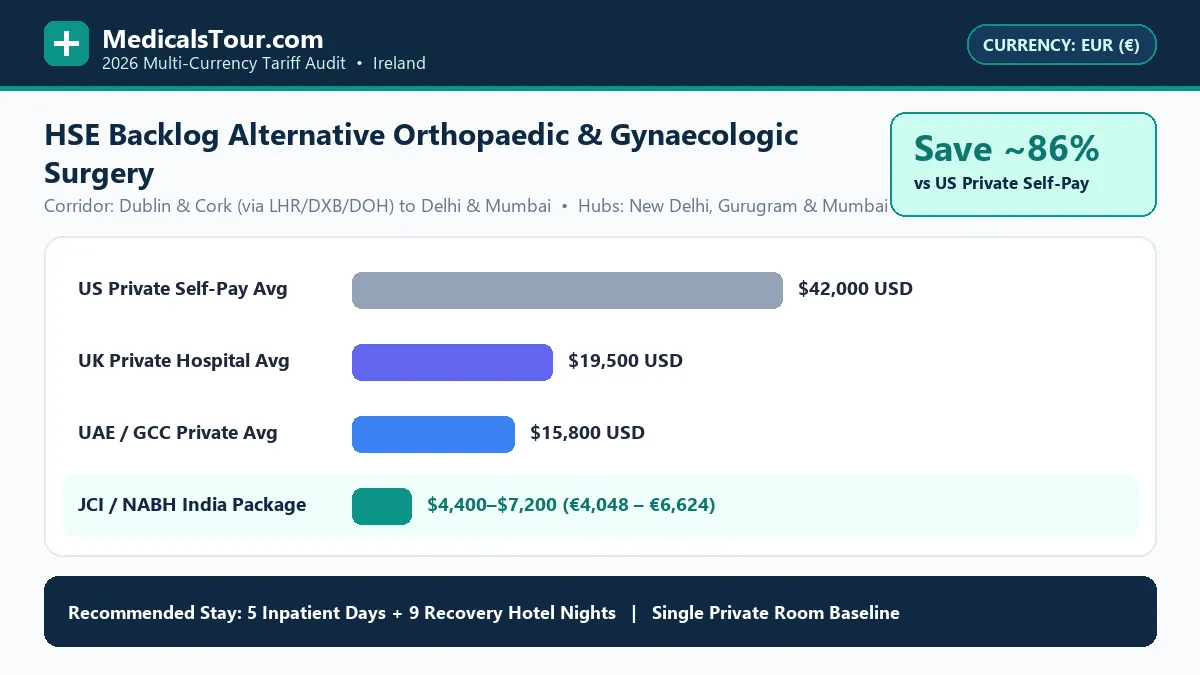
2026 EUR Price Comparison: Dublin and Cork Private Hospitals vs Delhi NCR
Self-pay estimates at Irish private hospitals often quote a base theatre-and-bed fee while billing consultant surgeon fees, consultant anaesthetist fees, MRI/histology, and prosthetic joint implants separately. Flagship hospitals in South Delhi and Gurugram bundle those elements into a single fixed USD package (1 USD ≈ €0.92 EUR). Test your exact household numbers—before and after 20% Revenue tax relief—inside our Medical Trip Total Budget Planner.
| Surgical Procedure | Ireland Private Self-Pay (€) | India JCI Package (€) | Net Cost After 20% Med 1 Relief (€) |
|---|---|---|---|
| Uncemented Ceramic Total Hip Replacement | €14,500 – €18,900 | €4,420 – €6,070 | ~€3,540 – €4,860 (medical portion) |
| Robotic Unilateral Total Knee Arthroplasty | €14,800 – €19,500 | €4,230 – €5,700 | ~€3,380 – €4,560 (medical portion) |
| Endoscopic Lumbar Microdiscectomy / Decompression | €9,800 – €14,500 | €4,140 – €5,340 | ~€3,310 – €4,270 (medical portion) |
| 1-Level O-Arm Navigated Spinal Fusion (TLIF) | €18,500 – €26,000 | €5,240 – €6,620 | ~€4,190 – €5,300 (medical portion) |
| 3D Laparoscopic / Robotic Stage 4 Endometriosis Excision | €11,500 – €17,800 | €4,050 – €6,260 | ~€3,240 – €5,010 (medical portion) |
| Robotic Uterine Fibroid Myomectomy / Hysterectomy | €10,900 – €15,900 | €3,950 – €5,610 | ~€3,160 – €4,490 (medical portion) |
Budget an additional €270 to €550 ($295–$600) for Day-1 outpatient pre-anesthesia cardiac echo, NABL blood panels, and discharge thromboprophylaxis, plus €85 to €140 per night for 8 to 9 post-discharge hotel nights in Saket or Gurugram. Always book a Standard Single Private Room rather than a luxury hospital suite: Indian hospital billing software applies a 20%–35% upward multiplier to surgeon and theatre charges when you upgrade ward room tiers. Even after factoring round-trip airfare out of Dublin Airport (€720–€1,380 depending on Economy or World Traveller Plus seating) and a companion’s hotel breakfast stay, an Irish patient undergoing ceramic hip replacement or robotic endometriosis excision routinely saves €8,500 to €13,500 compared with self-paying at Mater Private or Blackrock Health while cutting eighteen months off the calendar.
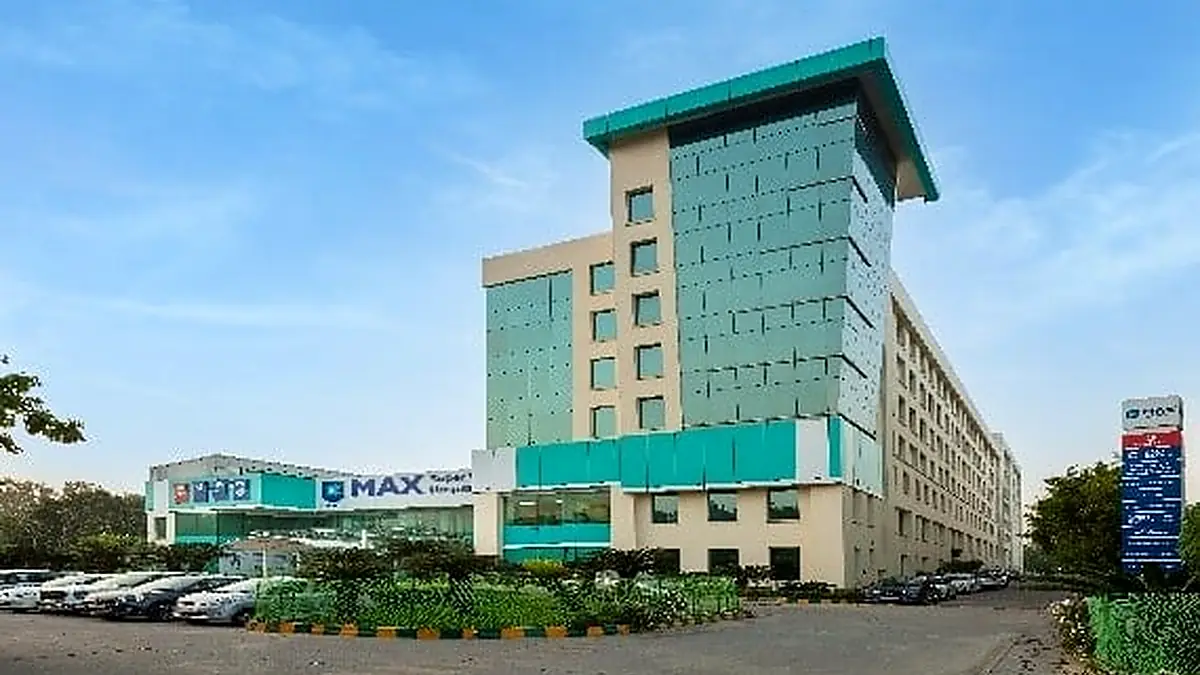
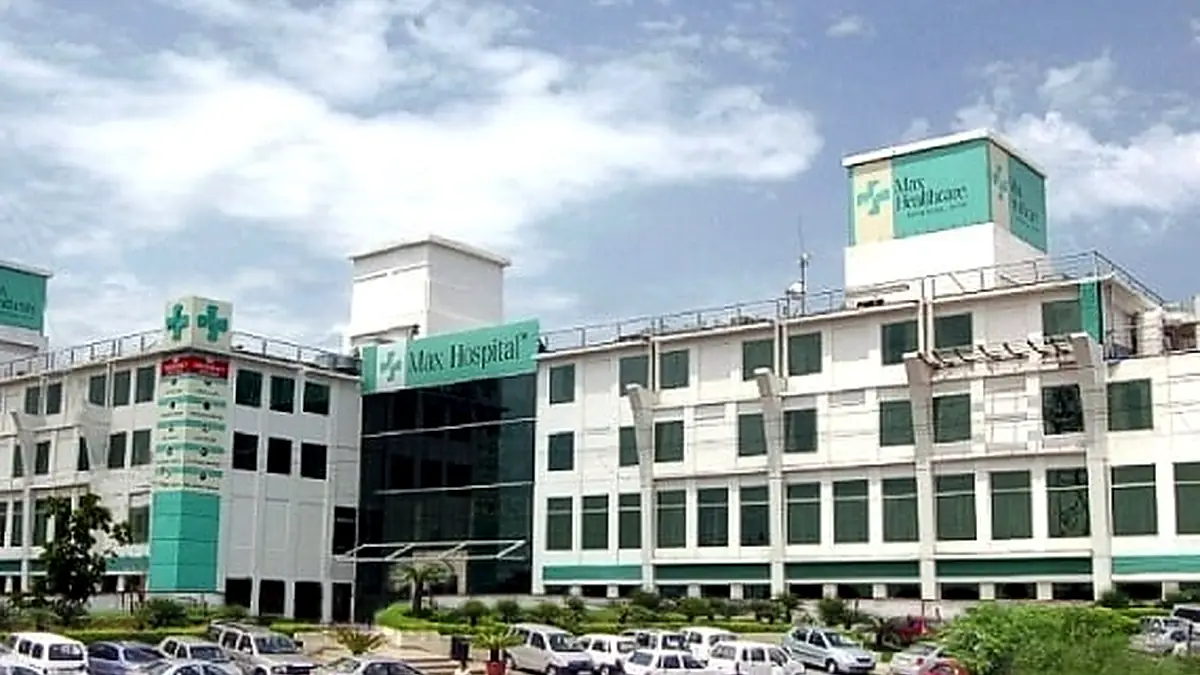
Inside Max Saket South Delhi and Max Sushant Lok Gurugram
Irish patients traveling for orthopaedics, neuro-spine, or complex gynaecological excision gravitate strongly toward the Max Healthcare network in Delhi NCR—combining JCI/NABH accreditation, UK-trained FRCS/MRCOG department chairs, and walkable, leafy recovery neighbourhoods 20 to 35 minutes from IGI Airport Terminal 3.
In South Delhi’s green institutional belt just 14.5 kilometers from Terminal 3 via Nelson Mandela Marg, Max Super Speciality Hospital, Saket operates 530+ beds split across its East and West Blocks. Unlike highway-isolated campuses, Max Saket sits directly opposite Select CITYWALK and DLF Avenue—meaning an accompanying spouse from Dublin, Galway, or Limerick can walk five minutes along paved pedestrian crossings to international cafes, Marks & Spencer, pharmacies, and serviced hotels (such as Hilton Garden Inn Saket or Sheraton New Delhi) between inpatient visiting hours. Clinically, Max Saket houses one of Asia’s highest-volume robotic joint, O-Arm spine, and minimally invasive gynae-laparoscopy centres, backed by NABL frozen-section histopathology and 24-hour consultant intensivist coverage that mirrors major Dublin academic teaching centres like St. Vincent’s or Beaumont.
Sixteen kilometers southwest of Terminal 3 in Sector 43, Max Hospital, Sushant Lok Phase-1 in Gurugram offers a calmer, boutique 300-bed tertiary footprint steps from Galleria Market and Millennium City Centre. Irish women travelling specifically for fertility-sparing myomectomy or bowel-involving endometriosis excision often appreciate Sushant Lok’s quieter nursing floors, rapid diagnostic turnaround, and easy access to flat, quiet serviced apartments in Sushant Lok B-Block and Sector 43 where post-laparoscopic recovery feels unhurried. Across both campuses, every clinical note, consent sheet, nursing chart, and pharmacy label is written entirely in standard Commonwealth medical English—using familiar British/Irish drug nomenclature such as paracetamol, enoxaparin, co-amoxiclav, and omeprazole—while ward kitchens gladly serve plain roast chicken, mashed potato, toasted brown bread, and hot tea with milk alongside therapeutic menus.
Orthopaedic Implants and Multidisciplinary Endometriosis Excision Standards
Two clinical specialties dominate Irish enquiries logged by Medical Tour’s patient research desk: bone-on-bone hip/knee/spine surgery stalled on NTPF lists, and Stage 3–4 deep infiltrating endometriosis (DIE) where Irish women routinely face multi-year waits for a joint gynaecological-colorectal-urological excision team.
Irish Joint Registry Parity & Spine Navigation
Orthopaedic teams at Max Saket and Max Sushant Lok implant the exact FDA-cleared and CE-marked prosthesis lines tracked by the Irish National Orthopaedic Register (INOR)—including Stryker Exeter / Accolade II stems, Stryker Triathlon Mako-navigated knees, DePuy Synthes Corail / Pinnacle ceramic hips, and Zimmer Biomet Persona systems. Every patient departs with original peel-off barcode implant stickers affixed to their typed operative note; compare detailed orthopaedic & spine line items in our Total Hip Replacement Cost Guide and Minimally Invasive Spine Surgery Cost Guide. Rapid-recovery regional anaesthesia blocks allow hip and knee patients to stand beside their bed with two ward physiotherapists within six hours of surgery, practising stair-climbing mechanics and car-seat transfers long before hotel checkout.
Excision vs Ablation in Stage 4 Endometriosis
Rather than superficial diathermy ablation that leaves deep fibrotic nodules behind on the uterosacral ligaments, rectovaginal septum, or ureter, accredited Indian pelvic-excision boards pair a 3D/Da Vinci Xi gynaecological laparoscopist with a colorectal and urological surgeon on standby under a single anaesthetic—pre-mapped via dedicated endometriosis-protocol 3T pelvic MRI. Read the complete surgical pathway in our UK & Europe Robotic Endometriosis & Fibroid Corridor Guide. Before you book flights from Dublin or Cork, upload your Affidea, Alliance Medical, or hospital DICOM MRI scans so the Max surgical board holds a video consultation to confirm exact theatre duration, bowel-prep requirements, and anti-adhesion barrier inclusions upfront in writing. Fertility-preserving patients also receive baseline and post-operative AMH hormone guidance alongside high-definition intraoperative excision video stills on an encrypted USB drive, giving your Irish reproductive endocrinologist or gynaecologist back in Dublin, Cork, or Galway complete anatomical clarity.
Flying from Dublin and Cork via Heathrow, Dubai or Doha on One PNR
While Dublin Airport (DUB) and Cork Airport (ORK) do not currently host a nonstop flight to New Delhi, Irish patients enjoy three effortless one-stop widebody corridors with single-ticket (single-PNR) through-checked luggage and coordinated wheelchair (WCHR / WCHS) gate assistance from Ireland straight to IGI Terminal 3:
| Irish Departure Route | Airlines & Transit Hub | Total Journey Time | Post-Op Return Ergonomics |
|---|---|---|---|
| Dublin (DUB) / Cork (ORK) → London Heathrow → Delhi | Aer Lingus / BA + British Airways, Air India or Virgin Atlantic (LHR) | ~11h 15m – 12h 30m | Breaks sitting into a 75-min hop + 8h 15m World Traveller Plus / Business leg. |
| Dublin (DUB T2) → Dubai (DXB) → Delhi / Mumbai | Emirates (Twice Daily ex-DUB) | ~12h 45m – 13h 30m | Widebody Boeing 777 from Dublin; smooth Terminal 3 buggy transfer in Dubai. |
| Dublin (DUB) → Doha (DOH) → Delhi / Mumbai | Qatar Airways (Daily Dreamliner/777) | ~12h 30m – 13h 20m | Splits long haul into two ~6.5-hour segments—ideal for lumbar spine patients! |
| Belfast / Northern Ireland Border Residents → LHR → DEL | British Airways ex-BHD / BFS via Heathrow | ~11h 30m | Convenient alternative for Ulster, Donegal, Monaghan & Louth families. |
Notice the hidden ergonomic perk of flying Emirates or Qatar Airways out of Dublin after spinal fusion or pelvic laparoscopy: breaking the flight roughly in half at Dubai or Doha gives you a guaranteed 90-minute upright walk and leg elevation break inside the transit lounge rather than sitting continuously for nine hours. Never book separate self-transfer tickets through London; a single PNR protects your luggage and wheelchair escort end-to-end. Passengers driving up from Munster, Kerry, Clare, or Galway to Dublin Airport can pre-book Terminal 2 short-term multi-storey parking linked by covered skybridge directly to Emirates and Aer Lingus check-in desks, avoiding cold shuttle-bus steps during your first fortnight back home. Aircoach express buses to Cork, Limerick, Galway, and Belfast also pull directly outside Dublin Terminal 1 and Terminal 2 forecourts with under-floor luggage bays handled by the driver.
Irish Passport e-Medical Visas, Dual UK/Irish Rules and GP Handover
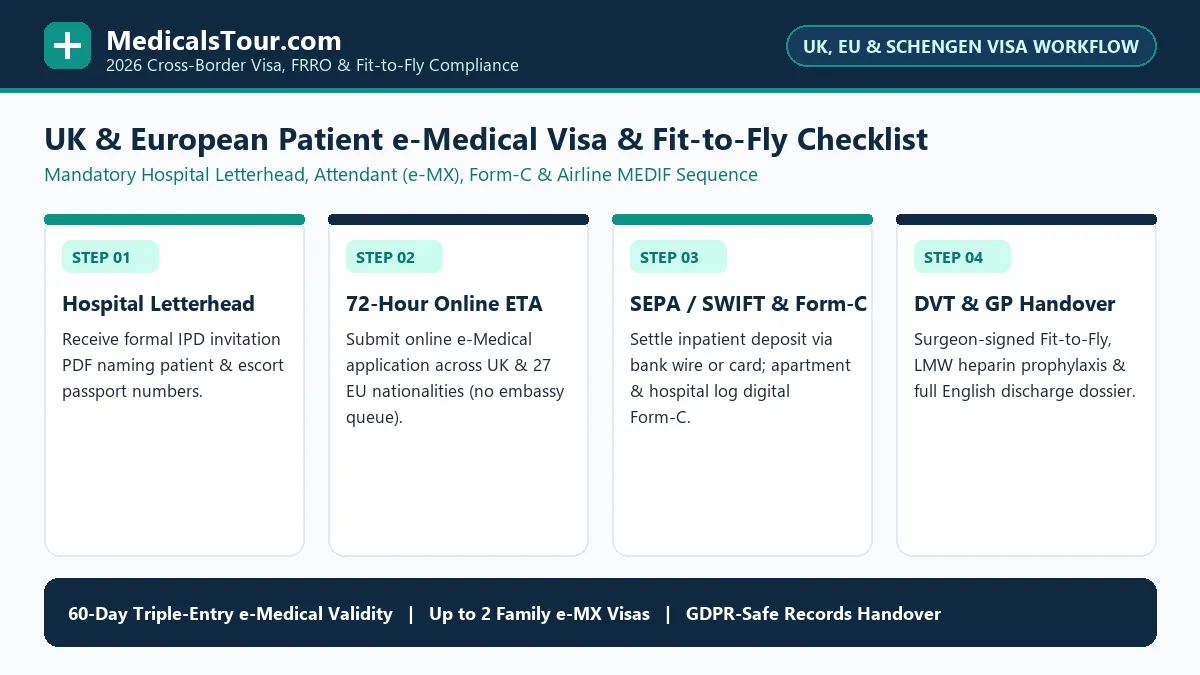
Holders of an Irish harp passport apply online for India’s 60-day triple-entry e-Medical Visa (indianvisaonline.gov.in) without posting physical passports to the Embassy of India on Merrion Road in Ballsbridge, Dublin. Approval normally arrives by email within 48 to 72 hours after uploading a smartphone passport scan, digital passport photo, and your stamped Max Healthcare Visa Invitation Letter.
Keep three nationality and clinical continuity tips in mind before leaving Ireland:
- Irish vs British Passport Holders in Border Counties: Both Irish and UK citizens now qualify online for India’s e-Medical Visa, though fee tiers on the Indian government portal differ slightly by passport nationality—always enter India using the exact same passport number typed on your ETA printout and hospital invitation letter. (Dual-passport families can cross-check UK specifics in our India e-Medical Visa Guide for UK, US & Canadian Citizens.)
- Department of Social Protection Illness Benefit: If you are a PRSI contributor claiming statutory Illness Benefit during post-operative convalescence back home, bring your typed Indian surgical discharge report directly to your Irish GP within 48 hours of landing at Dublin or Cork so your doctor can submit an electronic Certificate of Incapacity for Work (MED1/IB1) without administrative delay to the Department of Social Protection.
- Chartered Physiotherapist (ISCP) Handover: Hand your local Irish Chartered Physiotherapist your post-op radiograph link and Max Saket rehab sheet; unlike Nordic or Dutch public hospitals, private Irish physio clinics require zero post-travel isolation delay.
If your local Irish GP needs postoperative blood monitoring—such as full blood count, ferritin, CRP, or renal profile ten days after returning from New Delhi—packing a concise one-page surgical handover sheet signed by your Max consultant saves your GP surgery having to sift through forty pages of inpatient nursing telemetry charts. Patients holding a Medical Card or GP Visit Card in Ireland can still attend their regular family doctor for routine post-return wellness checks, while private blood draws or suture inspections at local primary-care centres in Cork, Galway, Waterford, or Dublin suburbs typically cost €50 to €75—and themselves qualify for 20% Revenue health-expenses tax relief.
AIB and Bank of Ireland SWIFT Wires, Revenue Receipts and Fit-to-Fly
Irish retail banking quirks catch out unprepared patients more often than flights. If you bank with AIB (Allied Irish Banks), remember that adding a new non-SEPA international payee and sending a wire above €1,000 via AIB Internet Banking requires your physical handheld AIB Card Reader—pack that plastic card reader inside your carry-on bag! Similarly, Bank of Ireland (365 online) caps daily international SWIFT transfers unless authorized via the BOI app KeyCode, while many younger Irish families compare exchange margins through Revolut Ireland or Wise before remitting USD/EUR to India. Full SWIFT MT103 field rules and RBI cash limits appear in our Hospital Forex, SWIFT Wire & Billing Guide.
Building a Bulletproof Irish Revenue Med 1 Tax Relief Folder
To ensure your 20% Revenue health-expense claim survives any six-year compliance check, ask Max’s International Billing Desk before discharge for:
- Itemized Final Zero-Balance Hospital Invoice: Stamped and signed in English, separating clinical/surgical/ward fees from any non-qualifying companion meals.
- Surgeon’s Medical Registration Details: Clearly printed on your discharge summary confirming treatment by a registered medical practitioner.
- Traceable Payment Proof: Your AIB, Bank of Ireland, PTSB, or Revolut SWIFT transfer confirmation or Visa/Mastercard receipt.
Collect your signed Fit-to-Fly Medical Certificate 48 hours before departure, and explore neighbouring European surgical guides on our International Medical Corridors Hub. Remember also that standard Irish holiday policies from Vhi MultiTrip, AA Ireland, or Chill Insurance exclude planned overseas medical procedures under pre-existing trip-purpose clauses; if you want dedicated surgical complication or hotel-extension cover, take out a specialist medical-travel policy prior to boarding in Dublin. Keep all original pharmacy receipts for post-discharge anticoagulants (Clexane or Eliquis) and analgesics in your Revenue folder as prescribed post-op medications also qualify toward your 20% tax credit. Finally, if staying in a private Saket or Sushant Lok serviced apartment rather than a commercial hotel, confirm at check-in that the property files your digital Bureau of Immigration Form-C registration so your departure stamp at IGI Terminal 3 clears without delay.