At a kitchen table in Austin or a small-business office outside Denver, the math behind cross-border surgery rarely starts with wanderlust. It begins when an independent contractor on a high-deductible ACA Bronze plan—or a 61-year-old early retiree bridging the four-year gap before Medicare eligibility—opens a hospital facility estimate quoting $46,800 for a unilateral knee replacement or $88,000 for an elective coronary bypass, excluding separate anesthesiology, neuromonitoring, and assistant-surgeon bills that arrive six weeks later. Even commercially insured Americans discover that out-of-network surgical hardware disputes, prior-authorization denials, and $18,400 family out-of-pocket maximums leave working households exposed to five-figure medical debt for non-emergent procedures.
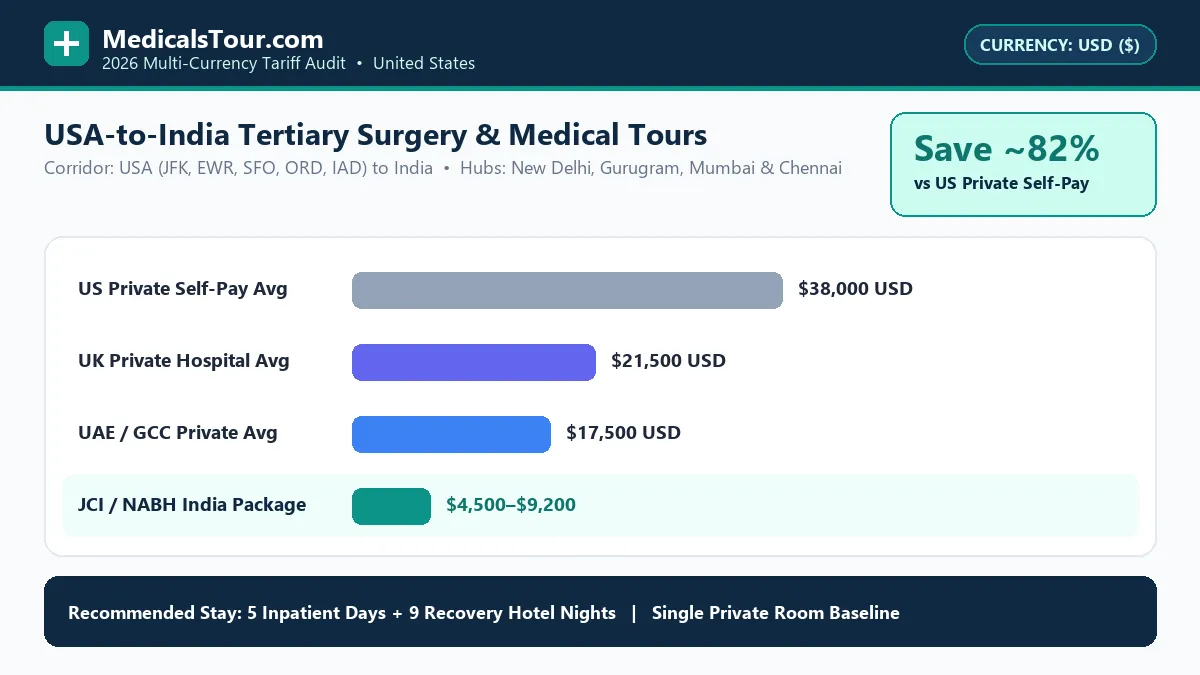
Fourteen hours across the polar corridor aboard Air India AI 102 out of New York JFK or AI 174 out of San Francisco, private quaternary campuses in New Delhi, Gurugram, Mumbai, and Chennai operate under a fundamentally different billing architecture. Facilities holding active Joint Commission International (JCI) 8th Edition Gold Seals quote fixed, pre-admission inpatient surgical packages between $4,500 and $9,200 USD—bundling operating room minutes, imported FDA-cleared implants, 1:1 ICU telemetry, consultant ward rounds, and Single Private room nursing onto one transparent proforma invoice. Cross-referencing Medical Tour’s 2026 cross-border tariff audits confirms that net savings routinely exceed 72% to 84% even after factoring in round-trip airfare, serviced apartments, and a traveling spouse’s meals.
Capturing those savings safely demands operational discipline rather than blind bargain-hunting. American families who thrive abroad treat the journey like a clinical supply-chain project: auditing JCI accreditation rosters instead of glossy broker websites, locking in Single Private room categories to avoid hidden 30% fee multipliers, transmitting uncompressed DICOM imaging before buying airline tickets, and building realistic post-discharge recovery buffers before the long flight home. What follows is the field-tested 2026 operational playbook our research desk hands US households planning tertiary care across India’s four primary hospital corridors.
Why US Chargemaster Pricing Diverges So Sharply From Indian JCI Bundles
First-time American patients often suspect that a $6,200 surgery quote in Gurugram or South Delhi must involve refurbished operating theater equipment or generic local implants. In practice, major corporate hospital groups in India purchase exact-match surgical consumables from the same multinational manufacturers—Stryker, Zimmer Biomet, Medtronic, Abbott, Edwards Lifesciences, and Intuitive Surgical—whose boxes sit inside sterile supply rooms in Houston or Boston. Hardware cost represents a surprisingly modest slice of a US hospital invoice; what drives a $38,000 to $92,000 American self-pay bill is fragmented fee-for-service chargemaster accounting, administrative billing overhead absorbing 25% of hospital revenue, defensive malpractice premiums, and unbundled facility fees charged by the quarter-hour.
Indian tertiary hospitals structure international self-pay care around all-inclusive DRG-style surgical packages anchored to a Standard Single Private Room. High daily surgical case volume—where a flagship cardiac or orthopedic institute completes 20+ major procedures daily across modular cleanroom theaters—amortizes robotic and navigation capital equipment across thousands of admissions annually rather than a few dozen. Nursing ratios and consultant salaries also reflect local purchasing-power parity despite physicians holding identical Western subspecialty training. When you review baseline quotes inside our India Treatment Cost Guides, you see how predictable inpatient bundling eliminates surprise post-discharge balance billing across major surgical specialties.
| Tertiary Procedure | US Self-Pay Cash Range | India JCI Single Private Package | Inpatient + Local Hotel Window |
|---|---|---|---|
| Stryker Mako Robotic Knee Replacement (1 Knee) | $39,000 – $54,000 | $4,600 – $6,400 | 4–5 Hosp + 8–10 Hotel Nights |
| Off-Pump Beating-Heart CABG Bypass | $78,000 – $122,000 | $5,600 – $7,900 | 6–7 Hosp + 9–11 Hotel Nights |
| 1-Level O-Arm Navigation Lumbar Fusion (TLIF) | $56,000 – $84,000 | $5,400 – $7,500 | 4–5 Hosp + 8–10 Hotel Nights |
| Da Vinci Xi Nerve-Sparing Prostatectomy | $38,000 – $58,000 | $6,400 – $8,800 | 4 Hosp + 9–10 Hotel Nights |
| Laparoscopic Sleeve Gastrectomy (FDA Staplers) | $19,500 – $28,500 | $4,700 – $6,300 | 3 Hosp + 7 Hotel Nights |
| All-on-4 Arch Implants (Straumann / Nobel, Stage 1) | $24,000 – $32,000 | $4,200 – $6,400 | Outpatient + 8–9 Hotel Nights |
Before wiring any deposit, run your exact procedure, companion count, and cabin class through our Medical Trip Total Budget Planner. Account for roughly $350 to $680 in Day-1 outpatient pre-anesthesia bloodwork, echocardiograms, pulmonary function tests, and MRSA nasal swabs, which hospitals bill outside the inpatient admission bundle.
Choosing the Right Clinical Hub: Delhi NCR, Mumbai, or Chennai?
India is a continental healthcare market rather than a single city destination, and picking the right metropolitan hub depends on your flight origin, winter or monsoon timing, and subspecialty complexity. Rather than relying on third-party medical tourism agencies that steer patients toward whichever clinic pays the highest referral commission, experienced families deal directly with hospital International Patient Services (IPS) desks at flagship campuses.
New Delhi & Gurugram (Delhi NCR): High-Volume Quaternary Campuses
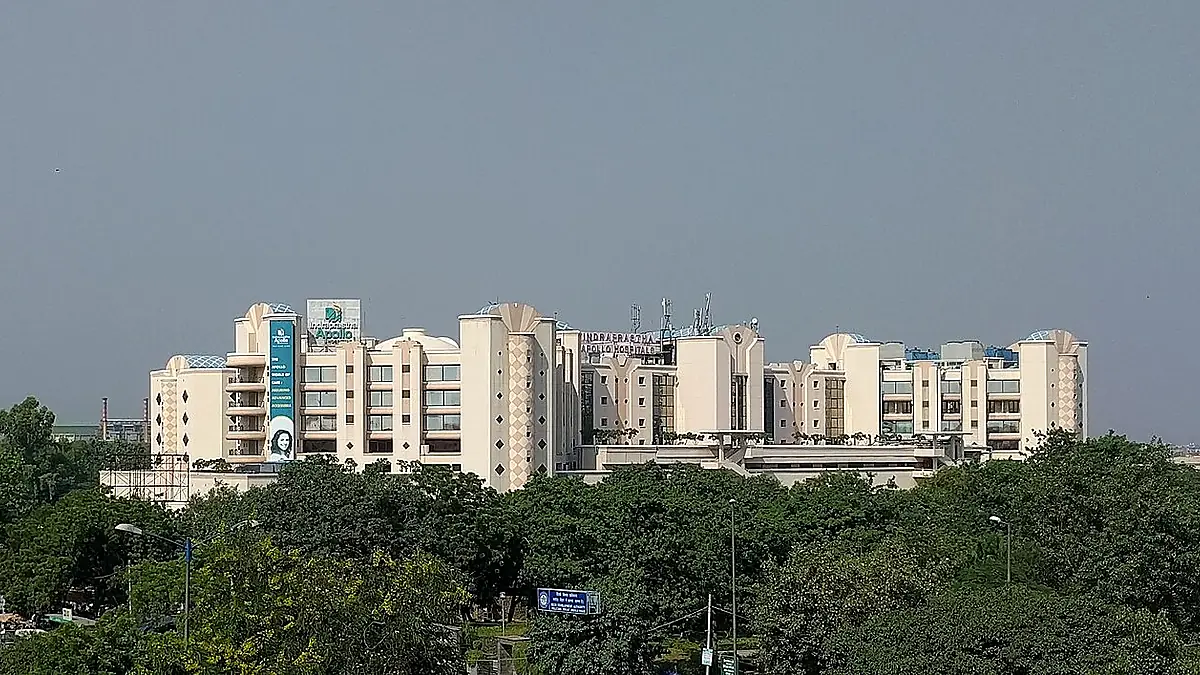
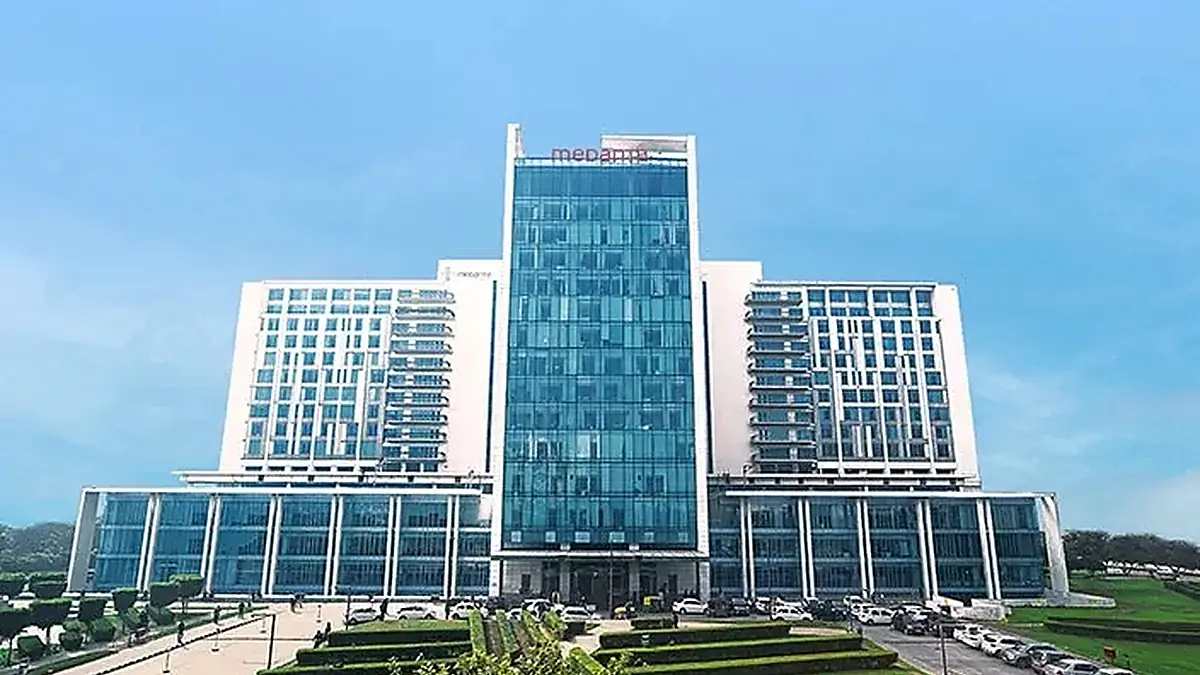
Serving nonstop arrivals into Indira Gandhi International Airport Terminal 3 (DEL), the National Capital Region concentrates enormous surgical volume across South Delhi and Gurugram’s expressway corridor. On Mathura Road (NH-19) in Sarita Vihar—roughly 40 minutes east of T3—Indraprastha Apollo Hospital, New Delhi operates a 710-bed JCI-accredited campus renowned for solid-organ transplantation, beating-heart cardiac bypass, and neurosciences, flanked by Jasola Apollo Metro Station. Twenty-five minutes southwest off NH-48 in Gurugram Sector 38, Medanta – The Medicity spans 43 landscaped acres with 1,300+ beds, dedicated cardiac and neuro-ICUs, and robotic urology and orthopedics floors purpose-built around surgeon-led institutes.
Mumbai: Western Coast Aviation Convenience & Boutique Tower Hospitals
For travelers boarding nonstop flights from JFK, Newark, or San Francisco into Chhatrapati Shivaji Maharaj International Airport Terminal 2 (BOM), Mumbai pairs JCI/NABH surgical towers in Andheri West (Kokilaben Dhirubhai Ambani Hospital, 25 minutes north via Western Express Highway), Girgaon (Sir H.N. Reliance Foundation Hospital), and Bandra Reclamation (Lilavati) with walkable coastal neighborhoods, high English fluency, sea breezes, and reliable five-star medical-rate hotels.
Chennai: Warm-Winter Convalescence & Proton Oncology
Between November and February—when North India experiences cool 48°F foggy mornings and seasonal air-quality dips—respiratory-sensitive Americans and long-stay cancer travelers frequently favor Chennai on the Bay of Bengal. Anchored by Apollo Greams Road, MGM Healthcare, MIOT International, and South Asia’s flagship pencil-beam proton center on Old Mahabalipuram Road (OMR), Chennai delivers 82°F winter recovery weather and serviced-apartment rates roughly 25% lower than Mumbai. Whichever city fits your specialty, request direct email contact with the hospital’s in-house International Patient Desk rather than routing personal diagnostic scans through unverified third-party call centers.
Auditing JCI vs NABH Accreditation & Surgeon Subspecialty Credentials
Any clinic can buy search ads targeting self-pay Americans, so independent credential verification is non-negotiable. Start by distinguishing between India’s two primary hospital quality seals—explained line by line in our JCI vs NABH Hospital Accreditation Guide. Joint Commission International (JCI), the global arm of the same Oakbrook Terrace organization that accredits Mayo Clinic and Cleveland Clinic, audits over 1,100 measurable elements every three years: surgical timeout verification, antimicrobial stewardship, high-alert medication barcoding, crash-cart readiness, and Central Sterile Supply Department (CSSD) biological spore tracking. India’s National Accreditation Board for Hospitals & Healthcare Providers (NABH), an ISQua-accredited standard, enforces equally rigorous national infection-control and fire-safety mandates, while NABL (ISO 15189) certifies diagnostic pathology labs and Individual Donor Nucleic Acid Testing (ID-NAT) hospital blood banks that eliminate viral window-period risks.
Beyond institutional plaques, audit the individual lead surgeon who will hold the scalpel or robotic console—not merely the department chairman pictured on a brochure:
- Verify International Fellowship Pedigree: Senior Indian department heads in cardiac, orthopedic, spine, and oncological surgery frequently hold UK Royal College fellowships (FRCS), American clinical fellowships from Houston, Cleveland, Rochester, or Pittsburgh, or high-volume Japanese/German endoscopic training alongside Indian MCh or DNB superspecialty degrees.
- Ask for Annual Procedure Volume & Surgical Site Infection (SSI) Rates: High-tier JCI institutes track SSI rates below 0.5% for clean orthopedic implant surgeries using ISO Class 5 laminar-flow theaters. Ask directly on your pre-travel video call how many cases of your exact procedure the named consultant personally performs per year—250+ annual robotic knees or 300+ off-pump CABGs is common at Delhi NCR and Chennai flagships—and verify in writing that the senior surgeon performs the critical steps personally.
- Confirm Implant Traceability Policies: Demand written confirmation on your pre-arrival estimate that the original manufacturer peel-off barcode sticker (showing Lot, REF, and expiration date) will be affixed to your physical discharge summary for future US physician reference.
Nonstop US-to-India Flight Routing, Cabin Ergonomics & Jet-Lag Recovery
Crossing 9.5 to 12.5 time zones before anesthesia requires smarter itinerary architecture than clicking the cheapest economy fare on an aggregator. Dehydration, lower-extremity venous stasis, and severe circadian disruption immediately prior to surgery elevate blood-pressure spikes and thromboembolic risk. Always land in India at least 48 hours before scheduled inpatient admission so Day 1 is spent resting and hydrating while Day 2 handles outpatient pre-anesthesia clearance.
| US Gateway Corridor | Primary Nonstop / 1-Stop Routing | Block Flight Time | Post-Op Cabin Recommendation |
|---|---|---|---|
| New York (JFK) / Newark (EWR) | Air India AI 102 (JFK–DEL), AI 106 (EWR–DEL), AI 116 (JFK–BOM) | 14h 15m – 15h 10m | Nonstop eliminates European transit walks; book lie-flat Business for spine/hip return. |
| San Francisco (SFO) | Air India AI 174 (SFO–DEL), AI 180 (SFO–BOM) or Emirates/Qatar 1-stop | 15h 45m – 16h 30m | Ultra-long-haul polar leg; Premium Economy bulkhead minimum outbound, lie-flat return. |
| Chicago O’Hare (ORD) & Washington Dulles (IAD) | Air India AI 126 (ORD–DEL), AI 104 (IAD–DEL) or Lufthansa/United via FRA | 14h 30m – 15h 20m | Pre-book WCHR wheelchair assist if changing terminals at Frankfurt, London, or Doha. |
| Dallas (DFW), Houston (IAH), Atlanta & LAX | Qatar Airways via Doha (DOH) or Emirates via Dubai (DXB) into DEL, BOM, MAA | 19h – 21h total | Splits journey into 14h + 3.5h legs; ideal for direct one-stop entry into Chennai (MAA). |
When booking return tickets, purchase flexible date-change fares rather than basic non-changeable inventory. If your surgeon wants two extra days for wound-drain removal or post-op hemoglobin stabilization, paying a $0 to $150 fare difference beats forfeiting a $1,900 long-haul ticket. Pre-assign IATA wheelchair code WCHR (can climb cabin steps and walk to lavatory, needs wheelchair across long airport concourses) at least 72 hours before departure—Terminal 3 gates at New Delhi and transit piers at Doha Hamad or Dubai Concourse B easily span 800 meters. Keep your US cellular SIM active on international roaming so US bank two-factor SMS texts arrive promptly during hospital payment, and activate a local Airtel eSIM at airport arrivals for fast local data.
India e-Medical Visa Rules for US Citizens & Accompanying Spouses
Never enter India on a standard e-Tourist Visa when your primary purpose is planned inpatient surgery. Indian hospital International Patient Desks are legally required under Bureau of Immigration mandates to upload every foreign inpatient’s passport and visa category into the Foreigners Regional Registration Office (FRRO) portal within 24 hours of admission. Arriving on a tourist visa for scheduled heart, joint, or oncology surgery triggers admission holds until emergency visa conversion paperwork is processed.
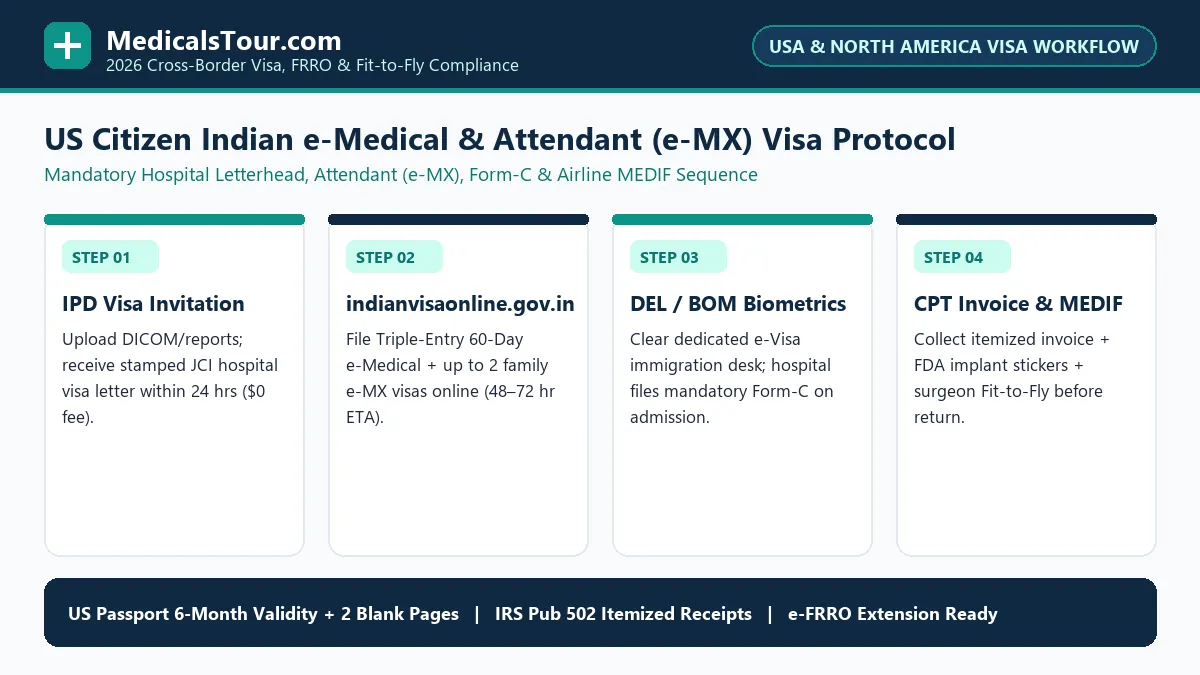
For American passport holders, the official government electronic pathway—detailed step by step in our India e-Medical Visa Guide for US, UK & Canadian Citizens—is straightforward and normally approved within 48 to 96 hours:
- Request an Official Hospital Visa Invitation Letter (VIL): Email your passport bio-page (valid at least 6 months with two blank pages), your companion’s passport bio-page, and diagnostic reports to your chosen hospital’s IPS desk. The hospital issues a signed letterhead VIL addressed to Indian Immigration naming both the patient and attendant, diagnosis, tentative admission date, and estimated cost—never rely on generic facilitator letters, which immigration officers reject.
- Submit the Online Application Only on the Official Portal: Apply exclusively via
indianvisaonline.gov.in—avoiding copycat private visa broker sites that charge $195+ markups over the statutory ~$80–$100 USD government fee. Upload a sharp 2×2-inch white-background photo, a clean passport bio-page PDF matching your middle name character-for-character, and the hospital VIL PDF under 300 KB. - Understand Validity & Attendant Rules: An e-Medical Visa grants 60 days of stay from arrival in India with Triple Entry (helpful if you require a brief follow-up visit). Up to two blood relatives or spouses can simultaneously obtain co-terminus e-Medical Attendant Visas referencing the patient’s application ID.
Print two physical color copies of your Electronic Travel Authorization (ETA) and the hospital VIL for the dedicated e-Visa biometric counters at DEL, BOM, or MAA immigration. Also verify before booking your post-discharge hotel or serviced apartment that the property holds an active Bureau of Immigration digital Form-C account—if an unexpected clinical delay ever requires extending your stay past 60 days, online FRRO extension portals strictly require your hotel’s digital Form-C certificate alongside a stamped physician letter.
Hospital Billing Mechanics: Room Multipliers, Exclusions & SWIFT Wires
Understanding how Indian corporate hospital ERP software calculates bills saves American families $1,500 to $3,200 on a single admission. In the United States, moving to a larger private room adds a flat nightly amenity charge. Across private hospital groups in Delhi, Gurugram, Mumbai, and Chennai, your inpatient Room Category acts as the master tariff multiplier for the entire clinical team. Upgrading from a Standard Single Private Room (already equipped with an en-suite bathroom, adjustable electric bed, TV, Wi-Fi, and a fold-out attendant sofa-bed) to an Executive Deluxe Room or Suite automatically inflates surgeon fees, anesthesia charges, OR theater hours, and bedside consults by 20% to 35%, plus triggers a 5% Government GST levy on daily room tariffs exceeding ₹5,000 INR.
Through Medical Tour’s independent billing audits, we advise self-pay Americans to book the Standard Single Private Room for the 4 to 7 inpatient hospital nights, and channel that saved $2,200 into a spacious five-star hotel suite or serviced apartment during the 8 to 10 post-discharge recovery days when you are actually awake and mobile enough to enjoy extra square footage.
Settling the Invoice Without Foreign-Exchange Friction
Before departure, read our Hospital Forex, SWIFT Wire & Billing Guide to prevent payment delays on admission morning:
- SWIFT Wire Transfer (Best Above $6,000): Wire 80% to 100% of the proforma estimate directly from your US bank (Chase, Bank of America, Schwab, Fidelity) to the hospital’s corporate beneficiary account 4 to 5 business days before admission. Include the patient’s passport number, UHID, and Indian RBI Purpose Code
P1101(Medical Treatment) on the wire memo, and carry the printed MT103 confirmation slip. Unused credit balances are refunded prior to discharge. - No-Foreign-Transaction-Fee US Credit Cards: Visa and Mastercard cards (such as Chase Sapphire or Capital One Venture) work smoothly at IPD cashiers for outpatient diagnostics and top-ups—just set an explicit India travel and high-dollar medical merchant authorization with your card issuer’s fraud desk before boarding, and declare cash above $5,000 USD on a Customs CDF form if carried physically.
16-Day Door-to-Door Execution Timeline & Continuity of Care Back Home
Bridging two healthcare systems works smoothly when your US primary care doctor or local physical therapist receives clean, standardized clinical documentation rather than cryptic shorthand. Conservative families can also purchase specialized medical travel complication insurance (such as Global Protective Solutions / Custom Assurance riders running ~$350–$900 depending on procedure tier) prior to departure for extra peace of mind. Whether you are evaluating robotic knee replacement costs, beating-heart CABG tariffs, or complex corridor options across our Global Medical Travel Corridors Hub, follow a structured 16-day operational cadence:
- Weeks 3–4 Pre-Trip (In the USA): Upload raw DICOM CDs (MRI, CT, or coronary angiogram) via secure cloud link for a video consult with your Indian lead surgeon; obtain your written Single Private Proforma Invoice and Visa Invitation Letter; book an appointment with your US PCP to establish baseline labs and schedule your post-return Day-21 check-in.
- Days 1–2 (Arrival & Pre-Op Workup): Meet the hospital airport concierge outside Customs (e.g., Pillar 16–18 at DEL T3 or Exit Gate B at BOM T2), check into a Form-C-registered hotel within 10 minutes of campus, rest on Day 1, and complete outpatient echocardiogram, viral serology, and anesthesia clearance on Day 2.
- Days 3–7 (Surgery & Inpatient Recovery): Inpatient admission, surgical procedure, 24–48 hours in ICU/HDU if indicated, followed by Single Private ward mobilization, incentive spirometry, and daily physical therapy.
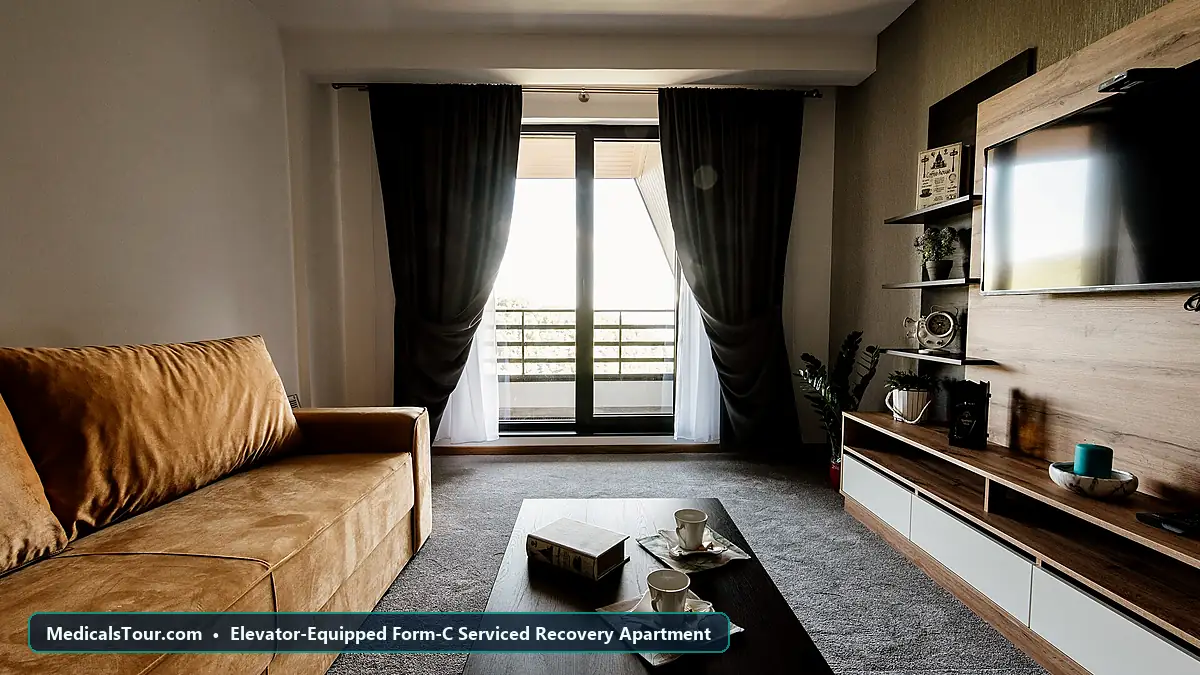
- Days 8–15 (Local Hotel Convalescence & Staple Check): Transfer to your nearby hotel or elevator-equipped serviced apartment; walk gentle indoor corridors; return to the outpatient clinic on Day 13 or 14 for wound inspection, dressing/staple removal, and a signed Fit-to-Fly certificate.
- Day 16 (Return Departure & DVT Protocol): Collect your complete English Discharge Dossier—typed operative note, NABL histopathology/lab PDFs, post-op X-ray/CT DICOM link, implant barcode stickers, and 30-day generic-labeled bridge medications—wear 20–30 mmHg graduated compression stockings, follow your surgeon’s blood-thinner schedule, and fly home safely.
On discharge morning, never book an afternoon flight departing the same day. Compiling zero-balance pharmacy reconciliations, typed surgical summaries, and pathology slides routinely takes four to five hours between 10:00 AM and 3:30 PM—making a calm evening check-in at your nearby recovery hotel the smartest buffer in cross-border medicine.