Medicare Part A and Part B pay zero dollars toward routine dental implants, and employer dental policies in the United States still cap annual maximums around $1,500 to $2,500—a ceiling barely changed since the late 1980s. When failing bridgework, advanced periodontal bone loss, or decades of fractured root canals leave an American retiree or 52-year-old professional needing full-arch restoration, private prosthodontic clinics in Chicago, Dallas, or Phoenix routinely present treatment plans quoting $26,000 to $34,000 per jaw ($52,000 to $65,000 for upper and lower full-mouth zirconia arches, excluding IV sedation and bone-grafting surcharges).
Many Americans initially look south toward border towns like Los Algodones or Cancun, only to hesitate when high-volume strip-mall clinics promise to extract teeth, drill implants, and torque down heavy permanent zirconia bridges inside a single 72-hour weekend. Living human jawbone biology does not obey airline weekend schedules. Across hospital-based maxillofacial and prosthodontic suites in Chennai, New Delhi, and Mumbai—anchored by campuses like Apollo Hospitals, Greams Road in Chennai and Max Super Speciality Hospital, Saket in South Delhi—board-certified Indian prosthodontists (MDS) enforce strict two-visit osseointegration protocols using Swiss Straumann and Swedish-American Nobel Biocare fixtures.
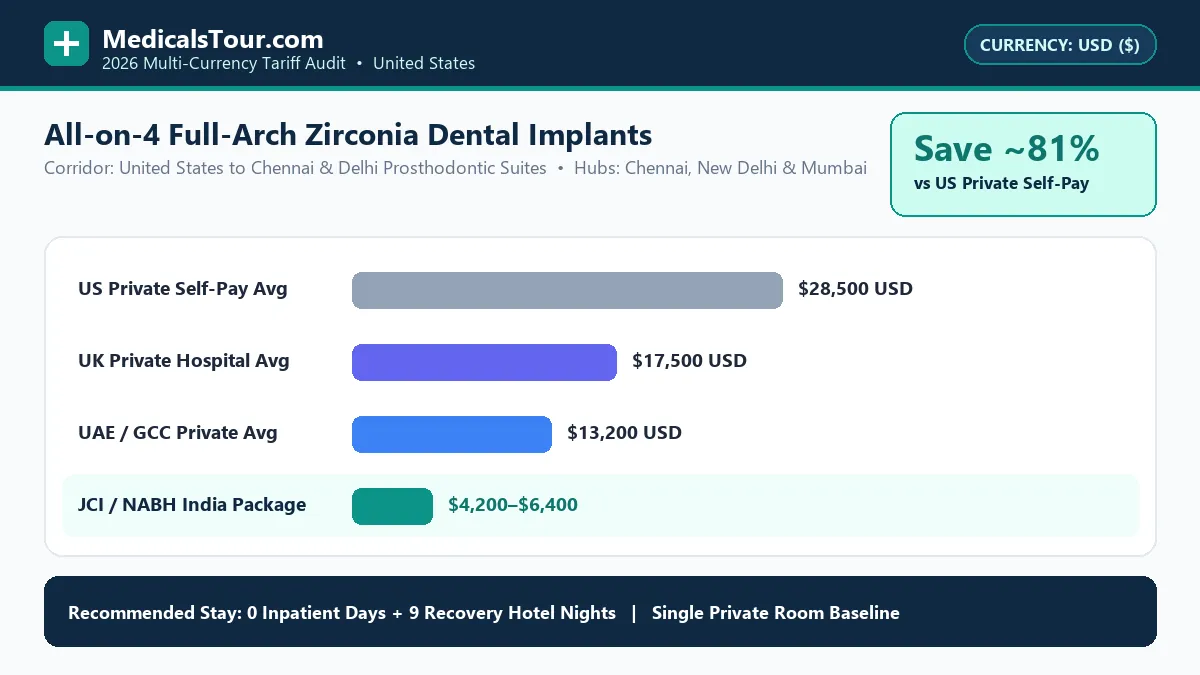
All-in single-arch All-on-4 or All-on-6 packages in India range between $4,200 and $6,400 USD—saving $36,000 to $45,000 on full-mouth rehabilitation even after paying for two round-trip tickets to India spaced four to five months apart. Unlike hurried dental-tourism storefronts where a single generalist drills implants and cements bridges in one room, hospital suites pair an oral-and-maxillofacial surgeon with a dedicated master prosthodontist and CAD/CAM ceramist. Before transmitting your US panoramic X-ray or 3D CBCT scan, review how fixture engineering, CAD/CAM titanium-bar milling, and hospital sedation backup separate lasting prosthodontics from tourist-clinic shortcuts.
2026 Prosthodontic Cost Audit: India vs US Private Clinics vs Mexico Border Towns
Comparing cross-border implant quotes requires separating three cost components: the titanium or titanium-zirconium fixture brand screwed into your maxilla or mandible, the original-manufacturer multi-unit abutment connectors, and the final CAD/CAM milled prosthesis. Using Medical Tour’s 2026 dental tariff database alongside our All-on-4 Dental Implants India Cost Guide, Full-Mouth Zirconia Crowns & Veneers Cost Guide, and Single-Tooth Straumann & Nobel Implant Guide, here is what transparent hospital-grade pricing looks like:
| Prosthodontic Treatment Scope | US Private Specialist Quote | Mexico Border Tourist Clinic | India Hospital Suite (2-Stage Total) |
|---|---|---|---|
| Single Implant + Titanium Abutment + Zirconia Crown | $4,200 – $6,100 | $1,550 – $2,200 | $780 – $1,150 (Nobel / Straumann) |
| All-on-4 Single Arch (Nobel Biocare + Final Zirconia Bridge) | $25,500 – $33,000 | $8,900 – $12,800 | $4,200 – $5,800 (Includes PMMA Temp + Final) |
| All-on-6 Single Arch (Straumann BLX + Ti-Bar Zirconia) | $29,000 – $38,000 | $10,800 – $14,900 | $5,200 – $6,400 (6 Fixtures + CAD/CAM Arch) |
| Full-Mouth Rehabilitation (Upper + Lower All-on-6 Arches) | $54,000 – $72,000 | $19,500 – $27,500 | $9,600 – $12,400 (Both Visits Combined) |
| Bilateral Sinus Lift + Guided Xenograft Bone Augmentation | $4,500 – $7,800 | $1,800 – $3,100 | $650 – $1,250 (Geistlich Bio-Oss + Membrane) |
Notice how billing milestones split cleanly across your two trips so you never wire 100% upfront: hospitals and accredited maxillofacial wings typically collect 55% to 65% during Visit 1 (covering surgical extractions, 3D surgical guide printing, Straumann/Nobel titanium implants, multi-unit abutments, and your screw-retained PMMA provisional arch—optionally reinforced with a thin internal laser-sintered cobalt-chrome mesh for heavy jaw clenchers at $180 extra) and collect the remaining 35% to 45% four months later during Visit 2 when your permanent zirconia bridge is milled and torqued into place. Even monitored hospital IV conscious sedation runs just $220 to $380 per arch in India versus $1,600+ per afternoon in US private offices. Plug your exact arch count, bone-grafting estimate, and two-trip flight assumptions into our interactive Dental Implant Savings Estimator to verify net household savings after hotels and airfare.
Why Reputable Indian Specialists Insist on Two Trips Instead of 72-Hour Permanent Zirconia
Understanding why ethical maxillofacial surgeons refuse single-trip final zirconia arches protects you from catastrophic implant failure. When teeth are extracted and titanium screws are torqued into fresh bone sockets (achieved at ≥35 Ncm primary mechanical stability), osteoblasts spend Weeks 3 through 12 remodeling around the microscopic surface threads—a physiological dip-and-rebound phase where initial mechanical bone grip temporarily drops before secondary biological fusion locks solid at Month 4.
Monolithic zirconia is intensely rigid and lacks natural periodontal ligament shock absorption. Bolting a heavy permanent zirconia bridge with distal cantilevers onto newly placed implants on Day 3 transmits unbuffered chewing micro-motion directly into healing bone, turning osseointegration into soft fibrous scar encapsulation—and causing implants to loosen painfully six months after you return to America. Worse, extracted gum ridges naturally remodel and shrink 1.5 to 3 millimeters during the first 12 weeks, leaving an unsightly, food-trapping gap and whistling speech air-leak underneath any “permanent” bridge fabricated on Week 1.
How the Safe Two-Visit India Schedule Works
- Visit 1 (8 to 10 Nights in Chennai or Delhi — ~60% of Package Fee): High-resolution 3D Carestream CBCT scan, facial digital smile design, atraumatic piezo-surgical extractions, Geistlich Bio-Oss xenograft bone augmentation if indicated, 3D-printed surgical-stent placement of 4 or 6 implants, and delivery within 48–72 hours of a lightweight, shock-absorbing, screw-retained CAD-milled PMMA fixed provisional bridge. You fly home with fixed, natural-looking teeth—never removable plastic dentures—while eating a soft fork-tender diet during healing.
- 4-to-5-Month Healing Interval Back in the US: Jawbone fuses solidly to the hydrophilic SLActive or anodized TiUltra titanium surfaces while gingival papilla contours stabilize completely.
- Visit 2 (7 to 9 Nights in India — ~40% Balance): Resonance Frequency Analysis (Osstell ISQ stability score > 70 verification on every fixture), micron-accurate digital intraoral photogrammetry scan (ICam4D / 3Shape Trios 5), passive-fit aluminum/resin verification jig try-in, wax/PMMA phonetic aesthetics mock-up so you approve tooth shade and lip support in natural daylight, and final calibrated torque-down of your custom CAD/CAM titanium-bar-supported Ivoclar IPS e.max ZirCAD Prime monolithic zirconia arch.
All-on-4 vs All-on-6 vs Zygomatic Implants: Engineering for Asian & Western Bone Profiles
While “All-on-4” (two vertical anterior implants plus two 30°-to-45° tilted posterior implants bypassing the maxillary sinus floor or mandibular mental nerve foramen) became the global marketing shorthand, Indian hospital prosthodontists frequently recommend upgrading the upper jaw to All-on-6 whenever anterior-posterior ridge spread permits. Upper maxillary bone is anatomically softer and more cancellous (Misch D3/D4 bone density) than dense cortical lower mandibular bone (D1/D2). Adding two extra Straumann or Nobel fixtures in the upper arch distributes heavy molar chewing forces across 50% more osseointegrated titanium surface area, eliminates long posterior bridge cantilevers, and provides critical mechanical redundancy—if a single fixture ever loses bone support 14 years down the road, your zirconia arch stays supported on five remaining pillars without starting over.
For American seniors who have worn upper acrylic dentures for 15+ years—or lost upper jawbone after failed root canals and sinus infections—standalone strip clinics often decline care or propose painful two-stage hip iliac-crest block grafts taking 12 months to heal. Inside hospital maxillofacial operating theaters at Apollo Greams Road or Max Hospital Saket, fellowship-trained oral-and-maxillofacial surgeons place 45mm-to-52.5mm NobelZygoma (zygomatic) or pterygoid implants anchored directly into dense, non-resorbing cheekbone (zygomatic) cortex under general anesthesia with 3D CT surgical navigation—restoring fixed immediate provisional teeth in 72 hours without hip bone harvests.
Equally important during Visit-1 surgery are two biological details: precise piezoelectric alveoloplasty (gently leveling uneven post-extraction bone peaks and tucking the prosthetic transition line 3mm above your high smile lip-line so artificial pink gum porcelain never flashes visibly when you laugh) and packing extraction sockets with autologous Leukocyte- and Platelet-Rich Fibrin (L-PRF) membranes spun chairside from a small tube of your own venous blood, which accelerates mucosal sealing before your Day-9 flight home. Before boarding your flight from the US, ask a local dental imaging center for an uncompressed 3D Cone-Beam CT (CBCT) scan exported in raw DICOM format ($180–$290 self-pay at US imaging labs) so your Indian team confirms exact millimeter sinus ridge height prior to ticket purchase.
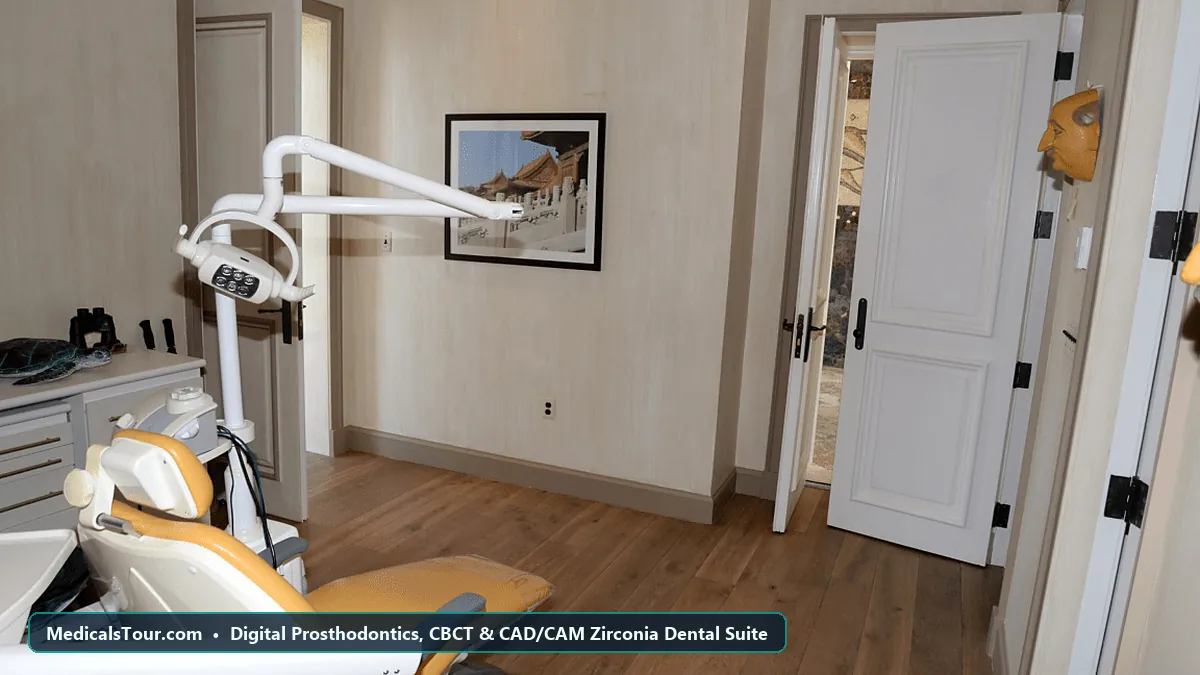
Implant Brand Compatibility: Ensuring Any US Prosthodontist Can Service Your Work
Nothing frustrates an American dentist back home more than a returning medical traveler who experiences a loose prosthetic screw or needs a peri-implant hygiene unscrewing three years later, sits in a domestic dental chair, and learns their overseas clinic used an obscure Korean, Brazilian, or generic clone implant whose proprietary internal hex screwdriver nobody in Ohio or California stocks.
Eliminate hardware lock-in completely by specifying Tier-1 universal implant ecosystems and genuine OEM prosthetic components in writing before paying any deposit:
- Straumann (Basel, Switzerland — BLX / Bone Level Tapered Roxolid SLActive): Engineered from a proprietary 85% titanium / 15% zirconium Roxolid alloy delivering ~35% higher fatigue strength than pure grade-4 titanium in narrow bone ridges, paired with chemically active hydrophilic SLActive surface chemistry that cuts healing risk in controlled diabetics; uses universal Straumann Torx/SCS prosthetic drivers stocked by virtually every US periodontist and prosthodontist.
- Nobel Biocare (Zurich / Yorba Linda, CA — NobelActive / NobelParallel CC TiUltra): The original clinical pioneer of the All-on-4 protocol and NobelZygoma system; uses universal Unigrip screwdrivers recognized in every American dental school and private maxillofacial office.
- Insist on Genuine Original-Manufacturer Angulated Multi-Unit Abutments (Not Third-Party Compatible Clones): Some budget clinics place genuine Nobel implants in the bone but top them with cheap $18 third-party “compatible” multi-unit abutments whose machining tolerances differ by 15 microns—causing chronic screw loosening and bacterial micro-leakage. Demand 100% genuine Nobel or Straumann straight and 17°/30° angulated multi-unit abutments (torqued with calibrated prosthetic ratchets to 35 Ncm on straight abutments and 15 Ncm on prosthetic bridge screws, orienting screw-access channels invisibly behind your upper front teeth) milled on 5-axis Amann Girrbach or Imes-Icore dental mills.
- Demand Your Official Implant Passport: Before leaving India after Visit 1, verify that your signed Implant Passport booklet contains hologram manufacturer peel-off LOT/REF stickers for every single fixture AND every multi-unit abutment alongside torque values (Ncm) and ADA tooth-number mapping.
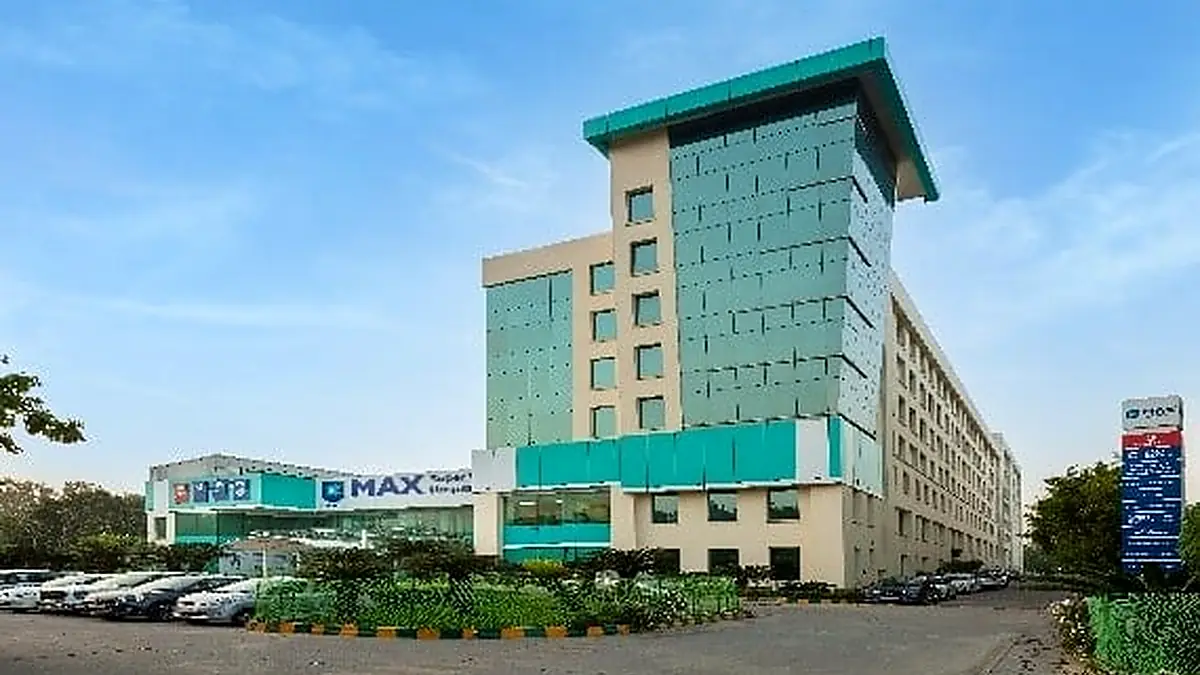
Hospital-Integrated Dental Wings vs Standalone Dental Studios: Who Needs Which?
India offers two high-performing clinical environments for international prosthodontics: JCI/NABH multi-specialty hospital dental and maxillofacial departments (such as Max Saket in New Delhi and Apollo’s tertiary maxillofacial suites in Chennai) and ISO-certified, MDS-led boutique prosthodontic studios in upscale neighborhoods like South Delhi’s Greater Kailash/Defence Colony or Chennai’s Nungambakkam/Alwarpet.
| Patient Medical Profile | Recommended Clinical Setting | Why Setting Choice Protects Safety |
|---|---|---|
| Healthy Adults Under 62 (Crowns, Veneers, 1–3 Implants) | Hospital Dental Wing or Accredited MDS Boutique | Local articaine anesthesia suffices; in-house 5-axis Roland/VHF milling labs speed ceramic try-ins. |
| Full-Mouth Extractions, Hypertension, Type 2 Diabetes, or Dental Phobia | JCI / NABH Hospital Dental & Maxillofacial Wing | Dedicated MD cardiac anesthesiologist administers monitored IV conscious sedation (propofol/dexmedetomidine) with crash-cart & ICU backup on the same floor. |
| Patients on Blood Thinners, Prior Stents/Valves, or Needing Zygomatic Implants | JCI Tertiary Hospital Operating Theater Only | In-house cardiology clearance, INR/platelet monitoring, and 24-hour inpatient observation eliminate post-extraction bleeding risks in hotels. |
Through Medical Tour’s patient-safety screening guidelines, any full-arch surgical extraction involving more than six teeth, bilateral lateral-window sinus elevation, or a patient taking oral bisphosphonates (Fosamax/alendronate—which requires CTX bone-turnover assessment to rule out medication-related osteonecrosis of the jaw!) or antiplatelet therapy belongs inside a tertiary hospital campus where internal medicine, hematology, RO dental-unit waterline disinfection, and Class-B vacuum autoclave spore monitoring operate under JCI governance.
Before flying for Visit 1, optimize three systemic bone-healing markers with your US primary physician: bring HbA1c below 7.5%, supplement serum 25-OH Vitamin D3 above 30 ng/mL (severe Vitamin D deficiency measurably impairs early titanium osteoblast attachment), and commit to 100% nicotine cessation—including vaping and nicotine pouches—at least 3 weeks prior to surgery through Week 8 post-op, since gingival vasoconstriction triples early fixture loss. Patients with prior mitral valve repair, prosthetic heart valves, or recent orthopedic joint replacements should also confirm their exact oral amoxicillin or clindamycin pre-medication dose 60 minutes before extractions.
Visa Choice, Soft-Food Hotel Living & Neighborhood Logistics in Chennai & South Delhi
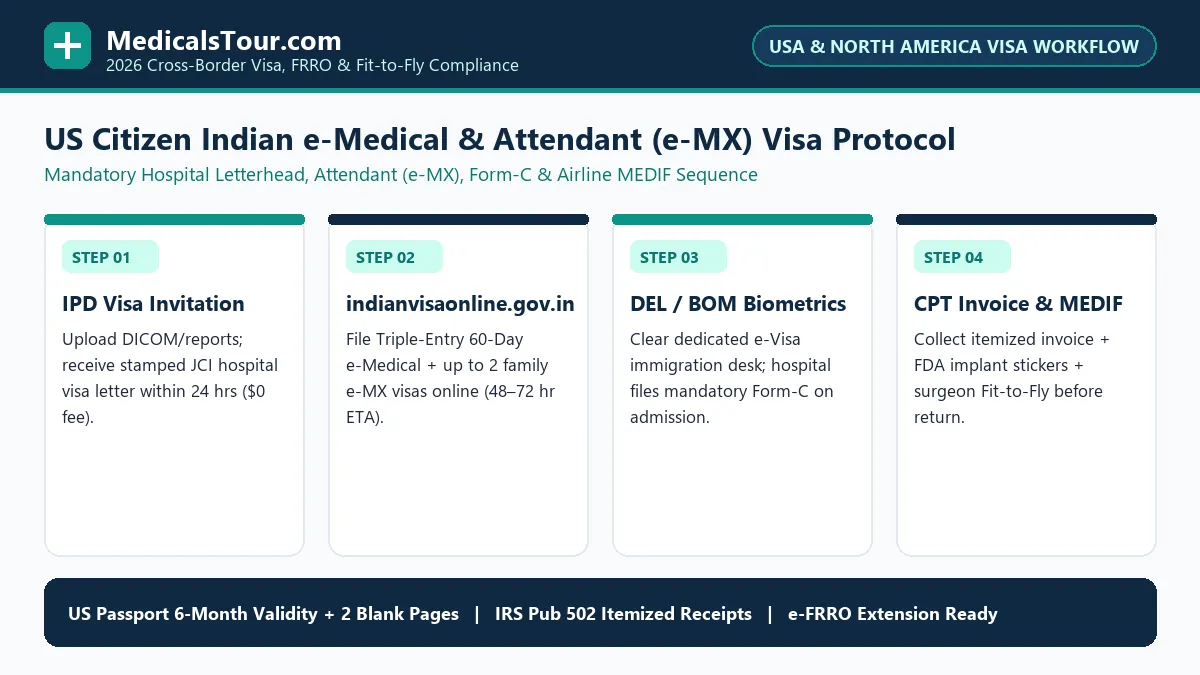
Because Stage-1 implant surgery requires a second trip four to five months later, double-check your Indian visa strategy before applying. As covered in our India e-Medical Visa Guide for US Citizens, a single 60-day e-Medical Visa expires 60 calendar days after your first arrival stamp—meaning Visit 2 five months later requires submitting a fresh online e-Medical Visa application (fortunately, US passport holders are permitted up to three e-Medical Visas per calendar year, or may obtain a 6-month/1-year regular paper Medical Visa via VFS Global if preferred). Never enter on a tourist visa if your prosthodontic plan involves hospital IV sedation or maxillofacial OR admission.
Chair time during both visits is surprisingly relaxed rather than grueling: on Visit 1, Day 1 covers 3D CBCT scanning, digital facial photography, and bloodwork (90 minutes); Day 2 is surgical placement under peaceful IV twilight sleep (2.5 to 3.5 hours); Days 3 and 4 involve brief 30-minute bite-registration and screw-retained PMMA delivery appointments; and Day 8 confirms occlusion and suture healing before your return flight—leaving afternoons free to rest in air-conditioned comfort.
During Days 2 through 8 of Visit 1, facial swelling peaks around 48 to 72 hours post-op (easily managed with hotel freezer gel packs applied 20 minutes on / 20 minutes off, sleeping elevated on two pillows, a short 3-day oral dexamethasone taper, and chlorhexidine 0.12% gentle mouth baths—never swishing vigorously, spitting forcefully, or drinking through a straw!) while chewing solid foods is off-limits. Indian culinary culture turns out to be an unexpected blessing for post-implant recovery. Both around Thousand Lights/Nungambakkam in Chennai (Taj Coromandel, Hyatt Regency Anna Salai, Somerset Greenways) and Press Enclave Marg/Saket in South Delhi (Sheraton Saket, Hilton Garden Inn), hotel kitchens and serviced-apartment cooks prepare protein-rich, zero-chew meals on request: smooth yellow moong-dal lentil soups, steamed soft rice idlis mashed in lukewarm sambar broth, soft-scrambled eggs, probiotic plain curd (dahi), papaya-banana protein smoothies, and pureed squash soups—simply specify zero green chili and mild seasoning so capsaicin never irritates sutured gumlines.
Occlusal Nightguards, Waterpik Hygiene & Protecting Your Zirconia Warranty at Home
When patients return to the United States after Visit 2 wearing dual monolithic zirconia arches, verify one non-negotiable engineering rule before final delivery: your permanent full-arch bridge must be 100% screw-retained onto multi-unit abutments (sealed cleanly with PTFE Teflon tape and tooth-colored composite plugs), never cemented onto custom abutments. Cemented full-arch bridges trap invisible subgingival resin cement that triggers destructive peri-implantitis bone loss and cannot be removed without sawing through $6,000 of zirconia, whereas a screw-retained titanium-bar bridge can be unscrewed safely in 15 minutes by any US prosthodontist if maintenance is ever needed.
Equally important, the single biggest mechanical threat back home is nocturnal bruxism (unconscious nighttime jaw clenching). Natural human teeth sit suspended in elastic periodontal ligaments packed with mechanoreceptors that signal your brain to release bite force when pressure spikes; titanium implants ankylosed directly to living jawbone lack those shock-absorbing nerve sensors, allowing nocturnal clenching to generate 600 to 900 Newtons of shear force capable of micro-fracturing opposing porcelain or loosening prosthetic multi-unit screws.
- Leave India With Two Custom Hard Acrylic Occlusal Guards: Have the hospital prosthodontic lab mill a primary hard Michigan-style flat-plane occlusal nightguard plus an identical backup spare ($90–$140 in India vs $750–$1,100 at US dental offices) directly from your final digital STL scan—and download your raw
.stlarch files onto a personal USB drive so any lab worldwide can 3D-print a replacement in 24 hours. - Master Daily Under-Bridge Intaglio Hygiene: Confirm during your Visit-2 PMMA try-in that the underside (intaglio) of your zirconia bridge is contoured with a smooth, convex, ovate pontic profile—never a concave “ridge-lap” shelf that traps rotting food! Pack a dual-voltage cordless Waterpik water flosser (filling the reservoir strictly with bottled or distilled water while in India), interdental TePe brushes, and Superfloss threaders to flush around abutments morning and night.
- Understand Written Warranty Fine Print: Leading hospital dental departments warrant Nobel/Straumann titanium fixtures for 10 years to lifetime and CAD/CAM titanium-bar zirconia prostheses for 5 to 7 years against material fracture—contingent on documented 6-month peri-implant maintenance cleanings (using titanium or PEEK plastic curettes, never scratching implants with stainless-steel scalers!) with your US dental hygienist. Compare flight hubs and combined checkup itineraries across our International Medical Corridors Hub before locking in Visit-1 dates.