More than 37 million American households now hold Health Savings Accounts (HSAs) paired with high-deductible health plans, accumulating over $130 billion in pre-tax healthcare balances—yet remarkably few account holders realize that HSA and Health Care Flexible Spending Account (FSA) dollars do not stop at the United States border. Under Internal Revenue Code Section 213(d) and IRS Publication 502 (Medical and Dental Expenses), legally performed surgical, diagnostic, fertility, and restorative dental procedures at licensed hospitals outside the United States qualify for tax-free HSA/FSA payment and itemized Schedule A medical tax deductions on the exact same clinical footing as domestic care.
Paying for a $5,800 robotic knee replacement at Medanta – The Medicity in Gurugram or a $6,200 spinal decompression at Sir H.N. Reliance Foundation Hospital in Mumbai with pre-tax HSA dollars effectively discounts an already low Indian surgical bill by another 24% to 37% depending on your federal, FICA, and state marginal income tax brackets. With annual IRS family HSA contribution limits now exceeding $8,550 (plus $1,000 age-55 catch-up allowances), a single year’s tax-sheltered HSA balance can cover an entire JCI major joint, cardiac, or All-on-4 dental restoration in India with zero out-of-pocket post-tax cash.
Surviving an IRS examination or FSA Third-Party Administrator (TPA) substantiation review, however, requires strict adherence to federal rules governing economy airfare, the statutory $50-per-night outpatient hotel cap, foreign pharmacy restrictions, and English CPT/ICD-10 invoice formatting—alongside emerging ERISA direct-contracting rules for self-funded US employers. Whether you are a solo W-2 software architect tapping a Fidelity HSA or a benefits director managing health-plan renewals for 600 employees, every IRS citation and billing protocol below keeps your cross-border transaction audit-proof. (Editorial note: This guide provides operational healthcare billing analysis rather than individualized legal or CPA tax advice; confirm personal return filings with a qualified US tax professional.)
IRS Publication 502 Line-by-Line Audit: What Qualifies in India (And What Triggers Penalties)
Taxpayers get into trouble with HSA custodians and IRS examiners not by going abroad for surgery, but by sweeping vacation side-trips, five-star hotel room service, or purely cosmetic procedures onto an HSA debit card. Non-qualified HSA withdrawals before age 65 incur ordinary income tax plus a steep 20% IRS penalty. Cross-checking IRC §213(d) alongside Medical Tour’s cross-border compliance matrix establishes crystal-clear boundaries:
| Expense Category on an India Medical Trip | HSA / FSA & IRS Pub 502 Status | Statutory Limit & Audit Substantiation Rule |
|---|---|---|
| Inpatient Surgery, ICU, Anesthesia, Labs & Implants | 100% Eligible | Must diagnose, cure, mitigate, or treat disease at a licensed hospital (includes inpatient meals & room bundled on hospital bill). |
| Restorative Dental (All-on-4, Implants, Crowns, Root Canals) | 100% Eligible | Functional mastication & caries/periodontal repair qualify; teeth whitening & purely cosmetic veneers on healthy teeth are excluded. |
| Patient Round-Trip Airfare (US to DEL/BOM/MAA) | Eligible (Transportation Rule) | Trip must be primarily for and essential to medical care; sightseeing detours to Goa or Taj Mahal risk disallowing airfare! |
| Companion Spouse Airfare | Conditionally Eligible | Eligible when physician documents in writing that post-anesthesia, sternal, or mobility safety requires a traveling attendant. |
| Post-Discharge Outpatient Hotel / Serviced Apartment | Capped at $50 / Night / Person | Strict IRC §213(d)(2) cap: max $50/night for patient alone, or $100/night total when a medically necessary companion shares lodging. |
| Outpatient Restaurant / Hotel Room-Service Meals & Visas | $0 — Not Eligible | Only meals billed as part of inpatient hospital care qualify; hotel groceries, Uber sightseeing & tourist extras must be paid with personal funds. |
One high-leverage benefit strategy many W-2 corporate employees overlook is stacking a Limited-Purpose Flexible Spending Account (LPFSA) on top of an active HSA. Federal rules permit HDHP enrollees contributing the full $4,300/$8,550+ to an HSA to simultaneously shelter another ~$3,200+ inside an employer LPFSA restricted strictly to dental and vision expenses—allowing you to pay the first $3,200 of an Indian All-on-4 implant arch or multifocal laser cataract procedure from expiring LPFSA funds before touching a single invested HSA dollar! Note also that dedicated airport-to-hospital medical transport and local taxis strictly to and from outpatient follow-up appointments qualify under medical transportation, whereas leisure cab rides do not.

The Foreign Prescription Drug Rule in IRS Pub 502 Most Travelers Miss
Read the specific subsection titled “Medicines and Drugs From Other Countries” inside IRS Publication 502 carefully before using an HSA card at an outpatient pharmacy counter in Gurugram or Mumbai. Federal tax law draws a sharp distinction between medications consumed in India as part of legal inpatient/outpatient medical care versus bulk foreign-manufactured pharmaceuticals carried back into the United States:
- 100% Eligible — Medications & Durable Medical Supplies Consumed On-Site: Anesthesia agents, IV antibiotics, recombinant IVF gonadotropin pens injected during your Mumbai cycle, inpatient analgesics, and hospital-dispensed orthopedic/post-op durable medical equipment—including 20–30 mmHg graduated surgical compression stockings, cervical collars, hinged knee braces, lumbar corsets, crutches, and sterile wound dressings—purchased legally as part of your physician-ordered procedure qualify fully under IRC §213(d).
- Generally Ineligible — Importing Foreign-Manufactured Pills Back to the USA: Under IRS Publication 502, you generally cannot deduct or pay with HSA funds for a foreign-made drug brought back across the US border unless that specific foreign product holds explicit FDA importation approval. Pay for your 30-day take-home bridge blister packs ($40–$120 total) and any general bariatric protein powders or wellness vitamins (which IRS rules classify as non-eligible nutritional supplements unless treating a specific diagnosed pathology) at discharge using a separate personal non-HSA credit card so your HSA withdrawal stays 100% audit-clean!
Similarly, elective cosmetic plastic surgery (facelifts, cosmetic rhinoplasty, liposuction, or hair transplantation for male-pattern baldness) is explicitly excluded under IRC §213(d)(9), whereas DIEP-flap breast reconstruction after mastectomy, scar revision from trauma, congenital deformity repair, or physician-prescribed bariatric surgery for clinical obesity (ICD-10 E66.01) qualifies fully. Comprehensive diagnostic executive longevity checkups—including 640-slice Coronary CT angiograms, 3T whole-body diagnostic MRIs, colonoscopies, mammograms, and blood biomarker panels—also qualify 100% under IRS Publication 502’s explicit allowance for physical examinations and diagnostic disease-screening tests even when zero symptoms are present prior to testing!
HSA Self-Reimbursement Strategy vs Swiping WEX / HealthEquity Cards Overseas
Never rely on physically swiping a US HSA or FSA Visa debit card (issued by HealthEquity, WEX, Optum Bank, Fidelity, or Lively) at an Indian hospital cashier counter at 8:00 AM on surgery morning! Three technical glitches routinely block HSA debit cards overseas: Merchant Category Code (MCC) mismatches when Indian payment gateways route transactions through general corporate codes instead of MCC 8062 (Hospitals) or MCC 8021 (Dentists), automated fraud freezes on $6,000 cross-border charges, and 2%–3% foreign currency conversion fees.
Smart American taxpayers use the far cleaner Pay-Direct & Self-Reimburse Method:
- Settle the Hospital Invoice via Personal No-FX Credit Card or US Bank SWIFT Wire: Follow the protocols in our Hospital Forex, SWIFT Wire & Billing Guide—earning 2% credit-card points on a Chase or Capital One card or sending a clean USD wire to Medanta Gurugram or HN Reliance Mumbai.
- Lock In the Exact USD Settlement Figure for IRS Form 8889: Because Indian hospital ERP systems generate the master tax invoice in Indian Rupees (INR), your US credit-card post date or outgoing SWIFT MT103 wire receipt establishes the exact, irrefutable US Dollar amount debited from your account—eliminating currency-conversion guesswork! Next April, when your HSA custodian issues IRS Form 1099-SA reporting gross distributions in Box 1, you enter that exact matching USD figure on Form 8889 Lines 14a and 15, resulting in $0 taxable income.
- Reimburse Yourself Online via ACH Now—Or Let Your Invested HSA Compound Tax-Free for Years: Under IRS Notice 2004-50, there is zero statutory time limit to reimburse yourself from an HSA for qualified medical expenses incurred after the HSA was originally opened. Many financially savvy patients pay $5,500 out of personal checking today, archive the digitized hospital and card PDFs in cloud storage, let their S&P 500 HSA index funds grow tax-free for a decade, and withdraw the $5,500 tax-free whenever desired!
One important family-tax boundary bears repeating before initiating any wire: an HSA can reimburse qualified medical bills for you, your legal spouse, and any qualifying tax dependents claimed on your Form 1040—even if your spouse or dependent child is covered under a separate non-HDHP PPO medical plan! Conversely, domestic partners not married under state law or adult children aged 24+ who no longer qualify as tax dependents on your federal return (even if still enrolled on your employer medical plan through age 26 under the ACA!) cannot have their surgical expenses paid tax-free from your personal HSA; adult children aged 18–25 covered by a family HDHP can open their own separate individual HSA instead.
How to Request an Audit-Ready English Invoice (ICD-10, CPT Equivalents & Zero-Balance Stamp)
While HSA custodians let account holders self-certify distributions (holding receipts for a potential IRS audit), Health Care FSAs, Limited-Purpose FSAs, and Health Reimbursement Arrangements (HRAs) require mandatory upfront Third-Party Administrator (TPA) receipt substantiation before releasing funds. A single-line receipt stating “Surgery Package — ₹4,85,000 Paid” will be rejected immediately by a US FSA reviewer at WEX, PayFlex, or WageWorks.
Watch how FSA plan-year dates interact with international travel: IRS FSA rules tie eligibility strictly to the Date of Service (when medical care is actually provided), never the date an advance wire deposit leaves your bank! Sending a deposit in December for a January surgery counts against your new January FSA balance—while two-visit dental implant travelers cleverly schedule Visit 1 (surgical placement) in November/December and Visit 2 (zirconia arch delivery) in April, tapping two consecutive annual FSA maximums ($6,400+ combined pre-tax) across a single full-mouth restoration! Before discharge day, hand your International Patient Coordinator this five-point billing specification:
- Patient Legal Name, DOB & Exact Service Dates: Matching your US passport and tax return, listing exact Admission Date and Discharge Date alongside a brief certification that no commercial insurer reimbursed any portion of the charge.
- ICD-10-CM Diagnosis Code Printed on Header: Every JCI hospital uses WHO ICD-10 coding natively (for example,
M17.11unilateral primary osteoarthritis right knee,M51.16lumbar disc disorder with radiculopathy, orK08.109complete loss of teeth). - Line-Item English Breakdown Mapped to Standard Procedure Descriptions: Separating Operating Theater charges, Surgeon & Anesthesiology fees, Implant serial/cost, Diagnostics, Inpatient Pharmacy, and Inpatient Room nights—eliminating any suspicion that cosmetic services or tourist hotel packages were bundled in.
- Official Hospital Stamp, Registration/CIN Number & “PAID — ZERO BALANCE” Receipt: Proving final settlement rather than a non-binding pre-op estimate. Compare baseline procedure breakdowns in our All-on-4 Dental Cost Guide, Spine Surgery Cost Guide, and broader India Treatment Cost Hub.
Schedule A Itemized Tax Deduction Math (7.5% AGI Floor) for Uninsured High-Cost Care
What if your procedure in India costs $28,000—such as Pencil-Beam Proton Therapy in Chennai or a living-donor organ transplant—and exceeds your $4,300 or $8,550 annual HSA contribution limit? Under Internal Revenue Code §213, US taxpayers who itemize deductions on Form 1040 Schedule A (rather than taking the standard deduction) may deduct unreimbursed qualified medical and dental expenses that exceed 7.5% of Adjusted Gross Income (AGI).
Consider a concrete household example modeled in our Medical Trip Total Budget Planner: a married self-employed couple with $120,000 AGI pays $31,000 out of pocket (not paid via HSA) for proton oncology radiation in Chennai plus $2,600 in patient + medically required companion economy airfare plus $3,500 in statutory lodging ($100/night cap × 35 nights) = $37,100 in qualified IRC §213 expenses. Subtracting the 7.5% AGI threshold ($9,000) yields a potential $28,100 Schedule A medical deduction—delivering substantial federal tax relief during a high-expense treatment year.
Keep three CPA compliance nuances in mind: first, check your state income tax threshold—states like New Jersey allow itemized medical deductions above just a 2% gross-income floor (far easier to clear than the federal 7.5% hurdle!), whereas California and New Jersey treat HSA investment earnings differently from federal rules; second, if your HSA balance is currently only $1,500 before leaving for a $6,000 surgery in Mumbai, IRS rules allow you to make future annual HSA contributions after returning and reimburse yourself tax-free for the remaining $4,500 over the next one or two tax years (provided the HSA was already legally open with at least $1 funded before the surgical expense occurred!); third, 1099 contractors and LLC/S-Corp owners must never write off personal overseas surgery as an IRC §162 “ordinary business travel trip”—route medical deductions strictly through an HSA, a formal Section 105 HRA / ICHRA, or Schedule A without double-dipping any HSA-reimbursed dollar.
How Self-Funded ERISA US Employers Build Cross-Border Centers-of-Excellence Programs
Individual patients are no longer the only Americans looking eastward. Over 65% of covered US workers sit inside self-funded ERISA employer health plans—meaning a 400-employee manufacturing firm in Ohio, municipality, or regional grocery chain pays every employee surgical claim directly out of company cash reserves via an administrative-services-only (ASO) carrier, protected only by stop-loss insurance above $125,000 to $200,000. Under the federal Consolidated Appropriations Act (CAA) of 2021, corporate benefits committees also carry heightened ERISA fiduciary liability to audit hospital price reasonableness rather than rubber-stamping $90,000 domestic hospital monopoly bills.
When a single employee’s domestic lumbar fusion ($88,000) or bilateral knee replacement ($92,000) threatens next year’s stop-loss renewal across the entire workforce, forward-thinking CFOs and benefits brokers add voluntary International Centers-of-Excellence (COE) Medical Travel Riders:
| ERISA Benefit Design Feature | Domestic In-Network Hospital Claim | Voluntary JCI India COE Option |
|---|---|---|
| Total Employer Plan + Travel Cost | $52,000 – $94,000 surgical claim | $11,500 – $15,500 (Includes JCI surgery + Business airfare + hotel) |
| Employee Deductible & Co-Insurance | $3,500 – $7,500 out-of-pocket | $0 Waived (Note: HDHP plans must satisfy statutory minimum IRS deductible before waiving to preserve HSA eligibility!) |
| Shared-Savings Employee Cash Incentive | $0 | $2,500 – $5,000 W-2 taxable shared-savings bonus + paid companion travel |
| Quality & Complication Safeguard | Variable local community hospital volume | Restricted strictly to JCI 8th-Edition flagships (e.g., Medanta, Apollo, HN Reliance) + 90-day global complication rider |
Well-structured ERISA international riders enforce four non-negotiable employee protections: 100% voluntary opt-in (zero coercion), mandatory pre-trip US specialist second-opinion confirmation that surgery is clinically warranted, lie-flat Business Class return seating on orthopedic/spine/cardiac procedures, and coordinated domestic continuity-of-care coverage for post-return physical therapy or cardiac rehab. Employers implement these riders cleanly via a one-page Summary of Material Modifications (SMM) to their ERISA Summary Plan Description (SPD), notifying their medical stop-loss carrier so every $65,000 surgical claim reduction lowers next year’s aggregate employee premium trend directly.
Compliance Checklist for HR Directors & Individual HSA Holders Before Booking Flights
Whether you are an individual engineer funding your own All-on-4 dental implants via a Fidelity HSA or a VP of People evaluating JCI direct-contracting options through Medical Tour’s institutional tariff benchmarks, lock down five pre-trip documentation steps:
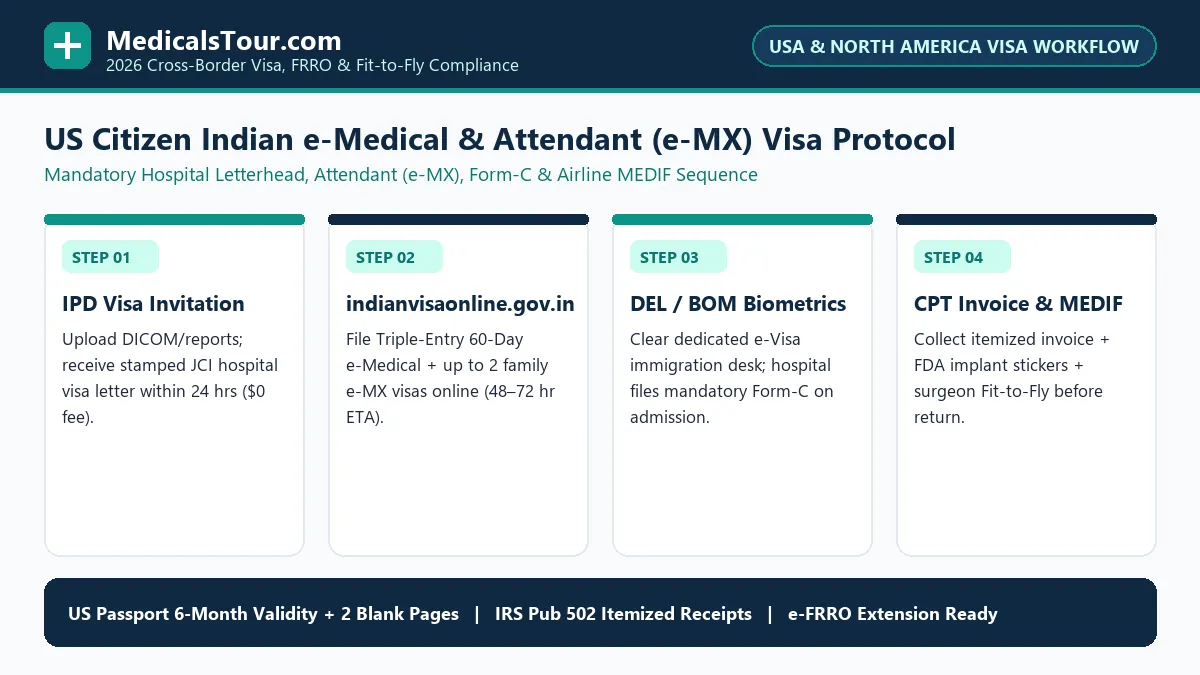
- Obtain a Pre-Trip Letter of Medical Necessity (LMN): Signed and dated prior to ticket purchase by your US physician (or licensed specialist), stating your clinical diagnosis (with ICD-10 code), recommended surgical/diagnostic procedure, and—if bringing a spouse—explicitly confirming that an accompanying adult attendant is medically essential for post-surgical mobility, sternal precautions, or post-anesthesia monitoring.
- Keep Trip Itinerary Strictly Medical: Fly from your US home airport directly to your hospital city (DEL, BOM, or MAA), recover at your nearby Form-C hotel, and fly directly home once Fit-to-Fly cleared. Adding a five-day leisure resort extension in Rajasthan or Kerala muddies the IRS “primarily for medical care” airfare test.
- Segregate Payment Cards Cleanly: Use one dedicated zero-FX US credit card or SWIFT wire for hospital + airfare + hotel room-only invoices, and a completely separate personal card for companion restaurant meals, take-home foreign pharmacy blister packs, and non-covered incidentals. Note too that paying airfare with frequent-flyer airline miles yields $0 HSA reimbursement value—only actual cash outlays paid for taxes/fees or revenue tickets can be reimbursed!
- Meet Annual FSA Run-Out Deadlines (Typically March 31): Unlike perpetual HSAs, employer FSAs enforce strict plan-year claim submission cutoffs—upload itemized English receipts promptly upon landing home!
- Archive a 5-File Digital Audit Folder for 7 Years: Save numbered PDFs (
01_Physician_LMN.pdf,02_Itemized_Hospital_ZeroBalance_Bill.pdf,03_USD_Card_Or_SWIFT_Settlement.pdf,04_Boarding_Passes.pdf, and05_Hotel_Folio_50Dollar_Cap.pdf) in backed-up storage alongside your tax-year Form 8889 and Form 1099-SA, and explore specialty hospital guides across our International Medical Travel Corridors.