Drive home along a rain-slicked M25 or A1(M) dual carriageway on a November evening at age sixty-three and early nuclear sclerotic cataracts announce themselves unmistakably: oncoming LED headlights starburst into blinding halos, motorway exit signs blur until the last hundred yards, and restaurant menus require holding an iPhone torch at arm’s length. Yet when British patients visit their high-street optometrist for an NHS cataract referral, they quickly discover two frustrating policy realities. First, many Integrated Care Boards (ICBs) still enforce visual-acuity rationing thresholds alongside 6-to-12-month waiting lists per eye. Second—and far less widely understood—NHS rules strictly limit public cataract surgery to basic single-focus monofocal Intraocular Lenses (IOLs), barring patients from simply paying a £600 “top-up” difference to upgrade to spectacle-free trifocal or astigmatism-correcting toric optics.
If you want freedom from both varifocal driving glasses and reading spectacles—or if you face private self-pay quotes at Optical Express, Optegra, Moorfields Private, or Spire UK—bilateral Femtosecond Laser-Assisted Cataract Surgery (FLACS) or Refractive Lens Exchange (RLE) with premium Alcon PanOptix Trifocal, Alcon Vivity EDOF, or Carl Zeiss AT LISA tri toric implants bills £6,400 to £8,800 ($8,100–$11,200 USD) for both eyes. Complex 25-gauge pars plana vitrectomy for an epiretinal membrane peel or macular hole adds £5,800 to £7,900 per single eye.
Compiled from Medical Tour’s 2026 ophthalmology tariff audit across Chennai, New Delhi, and Mumbai, this guide details how British patients complete bilateral premium trifocal lens surgery over a calm seven-night outpatient trip for £1,100 to £2,200 ($1,400–$2,800 USD) total for both eyes—and highlights the life-critical aviation cabin-pressure distinction between routine lens patients and retinal gas-bubble cases.
The NHS Monofocal Rationing Rule—and Why UK High-Street Trifocal Quotes Top £8,000
Under Department of Health & Social Care guidance prohibiting the mixing of NHS-funded and privately funded elements within a single surgical episode, an NHS trust cannot supply a free theatre slot and phacoemulsification surgeon while billing you exclusively for an upgraded Zeiss trifocal or toric lens—unless you suffer rare severe corneal pathology such as post-keratoplasty astigmatism. Even patients happy with basic monofocals routinely collide with regional NHS Integrated Care Board (`ICB`) “second-eye” delays despite NICE Guideline `NG77` advising against visual-acuity rationing: once Eye #1 achieves `6/6` distance clarity, high-myopia patients (-5.00D or stronger) are often left waiting nine months for Eye #2 with nauseating anisometropia (double-sized retinal images) on stairs. Opting for multifocal, Extended Depth of Focus (EDOF), or routine corneal astigmatism correction in Britain forces patients 100% into private clinics, where headline “from £2,695 per eye” adverts rapidly climb past £7,800–£8,800 bilateral once toric cylinder tariffs, OCT scans, and consultant surcharges are itemized.
Meanwhile, India operates the highest-volume microsurgical ophthalmology ecosystem on earth—performing more than seven million cataract and intraocular procedures annually and serving as a global clinical trial and fellowship training hub for Western ophthalmic surgeons. Flagship Indian tertiary eye departments run swept-source optical coherence biometry, femtosecond capsulotomy lasers, and 3D heads-up digital surgical microscopes continuously five days a week rather than renting laser consoles one afternoon a fortnight, compressing institutional cost per eye by 70% to 78% while implanting identical imported German and American foldable acrylic optics.
To check broader medical fee structures across Indian tertiary centres as you build a short-stay itinerary, browse our India Treatment Cost Guides alongside our interactive Medical Trip Budget Planner.
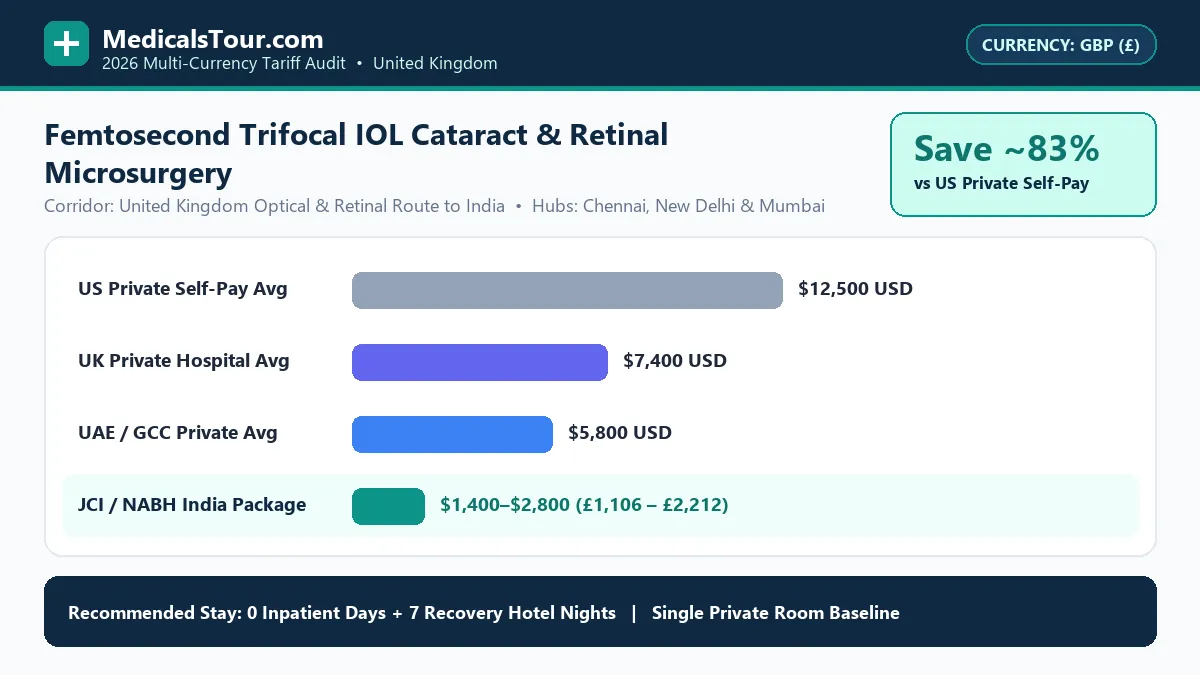
2026 Ophthalmic Tariff Comparison in GBP (£) & USD ($): Bilateral IOLs & Vitrectomy
All cataract and refractive lens exchange procedures are painless 15-minute day-case microsurgeries performed under topical numbing eye drops (zero needles around the eye in 95%+ of cases, zero inpatient overnight ward stays). The 2026 benchmarks below reflect complete bilateral (both eyes) packages for lens procedures and unilateral packages for vitreoretinal microsurgery at accredited hospitals in Chennai and New Delhi:
| Ophthalmic Procedure & Imported Lens Tier | UK Private Clinic Avg (GBP £ / USD $) | India Accredited Hospital (GBP £ / USD $) | Optical Profile & Clinical Scope |
|---|---|---|---|
| Bilateral Micro-Incision Phaco + Imported Aspheric Monofocal IOL (Alcon Clareon / J&J Tecnis Eyhance — Both Eyes) |
£4,600 – £6,000 ($5,850 – $7,600) |
£1,100 – £1,450 ($1,400 – $1,850) |
Crisp distance & dashboard intermediate vision; light reading glasses still used for fine print. |
| Bilateral Trifocal / EDOF IOL Package (Both Eyes) (Alcon PanOptix, Alcon Vivity EDOF or Zeiss AT LISA tri) |
£6,400 – £8,200 ($8,100 – $10,400) |
£1,650 – £2,100 ($2,100 – $2,650) |
Full distance, computer & smartphone near focus; includes Zeiss IOLMaster 700 biometry & post-op drops. |
| Bilateral Femtosecond Laser (FLACS) + Trifocal Toric IOL (Astigmatism Correction ≥0.75D — Both Eyes) |
£7,400 – £9,200 ($9,400 – $11,700) |
£1,950 – £2,450 ($2,480 – $3,100) |
Blade-free Catalys/LenSx laser capsulotomy + Verion digital axis-marker alignment for cylindrical astigmatism. |
| 25G / 27G Pars Plana Vitrectomy (Per Eye) (Epiretinal Membrane Peel, Macular Hole or Vitreous Haemorrhage) |
£5,800 – £7,900 ($7,350 – $10,000) |
£1,500 – £2,200 ($1,900 – $2,800) |
Sutureless micro-cannula retinal surgery + endolaser / silicone oil if indicated (see strict gas flight rules below!). |
| Implantable Collamer Lens — EVO Visian ICL (Both Eyes) (Adults 21–42 Unsuitable for LASIK due to Thin Corneas) |
£6,200 – £7,800 ($7,850 – $9,900) |
£1,850 – £2,350 ($2,350 – $2,980) |
Reversible Staar Surgical Swiss phakic lens correcting -3D to -18D myopia without corneal tissue ablation. |
Important Contact-Lens Washout Rule Before Leaving the UK
Accurate intraocular lens power calculation depends on pristine corneal curvature measurements. If you wear soft toric or spherical contact lenses in the UK, stop wearing them at least 7 full days before flying to India (and pause rigid gas-permeable RGP lenses for 21 days pre-scan) so corneal warpage rebounds completely before Day-1 Zeiss IOLMaster 700 and Pentacam mapping. Budget £95 to £160 ($120–$200) extra only if pre-op macular OCT reveals occult dry/wet age-related macular degeneration requiring an anti-VEGF evaluation or specular microscopy check.
Bring your oldest UK optician prescription cards from five or ten years ago inside your hand luggage as well—especially if you once wore thick hypermetropic (+3.50D+) or high-myopic (-6.00D+) spectacles or underwent historic radial keratotomy / LASIK. Historical refractive baselines help Indian optical biometry physicists cross-validate axial length and effective lens position across Barrett Universal II, Hill-RBF 3.0 AI, and Kane fourth-generation formulas before ordering your exact 0.5-dioptre toric step.
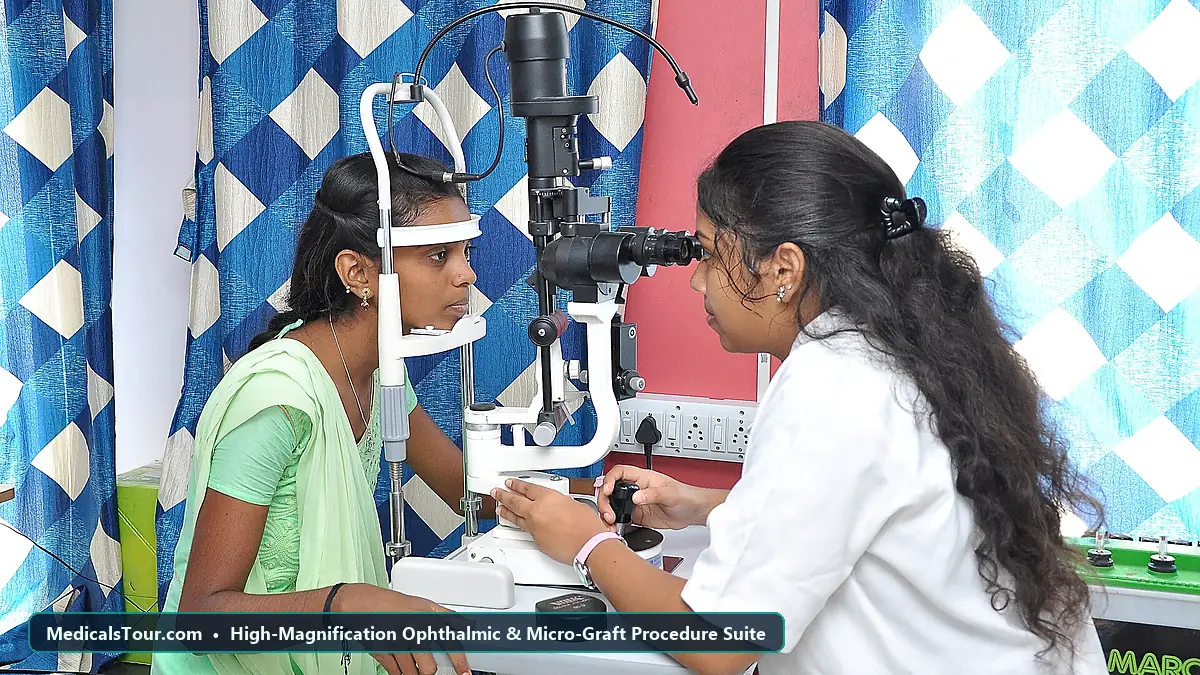
Inside the Optical Biometry & Laser Suite: Alcon PanOptix, Vivity & Zeiss AT LISA
Choosing the right intraocular optic matters far more to your twenty-year visual happiness than saving £200 between lens boxes—and ethical Indian ophthalmic consultants spend thirty minutes reviewing your night-driving habits, macular health, and tear-film stability before recommending a lens platform. Classic diffractive Trifocal lenses (Alcon Clareon PanOptix or Carl Zeiss AT LISA tri 839MP) split incoming light across three focal points (far motorway signs, 60 cm laptop/car dashboard, and 40 cm paperback reading), liberating roughly 90% of recipients from spectacles altogether, though they produce mild concentric halo rings around pinpoint night headlights during the first three to six months of neural adaptation.
Conversely, British patients who drive extensively at night on unlit country lanes—or whose pre-op spectral-domain Macular OCT shows mild epiretinal cellophane changes, early glaucoma, or previous corneal LASIK—are steered away from diffractive trifocals toward wavefront-shaping Extended Depth of Focus (EDOF) lenses such as Alcon Clareon Vivity or J&J Tecnis PureSee. EDOF optics deliver monofocal-clean night contrast from infinity right down to arm’s-length computer and supermarket-shelf range with virtually zero halo glare, requiring only weak +1.00 readers for tiny medicine-bottle print in dim pub lighting.
Pre-treating dry eye in the UK for fourteen days prior to your Heathrow flight pays huge optical dividends too. Unstable tear films from mild Meibomian Gland Dysfunction (`MGD`) or blepharitis distort anterior corneal keratometry readings by up to 0.50 dioptres; applying a warm microwaveable eye mask for five minutes nightly and instilling preservative-free hyaluronate drops four times daily before flying ensures razor-sharp Day-1 biometry. Indian diagnostic suites also run automated non-contact specular microscopy to count corneal endothelial cell density—verifying healthy `>2,200 cells/mm²` reserves or deploying protective dispersive viscoelastic (`Viscoat`) if subtle Fuchs’ endothelial dystrophy is detected. When corneal astigmatism exceeds 0.75 dioptres, pairing a Toric optic with digital Callisto/Verion iris registration locks rotational alignment within one degree inside the capsular bag.
Sequential Bilateral Scheduling at Apollo Greams Road and Manipal Dwarka
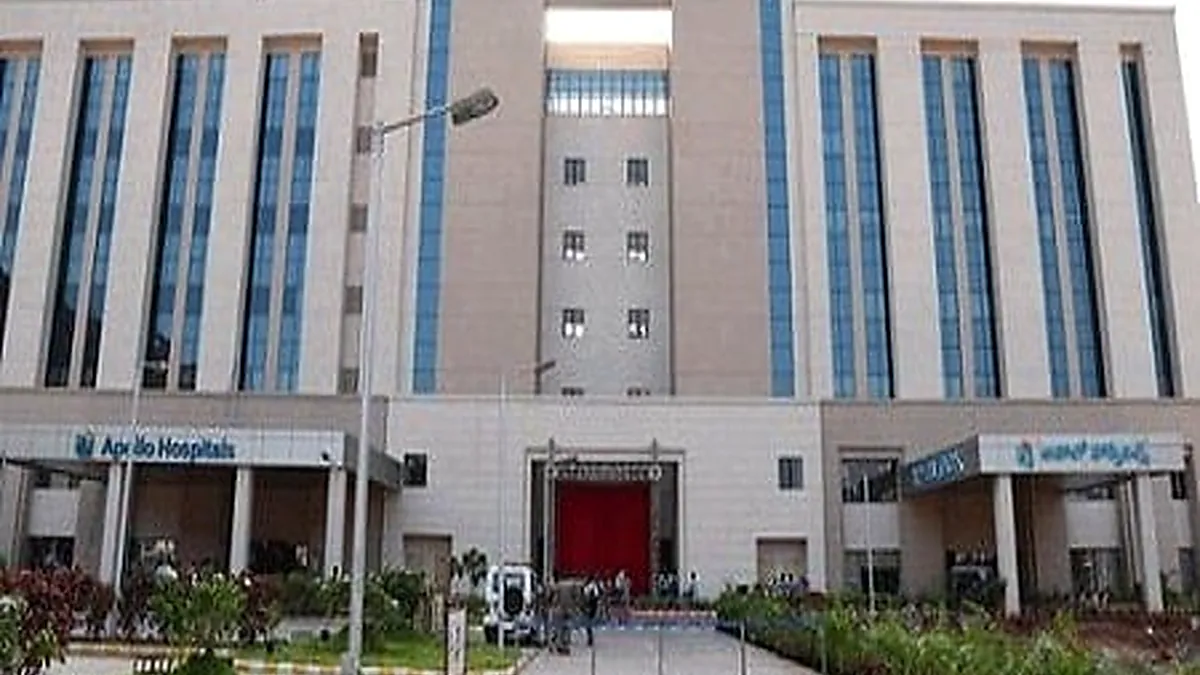
Two high-access cities anchor the UK ophthalmic corridor. In Southern India, Apollo Hospitals on Greams Road in central Chennai—working alongside Chennai’s world-renowned sub-specialty ophthalmic ecosystem—offers senior FRCS/FRCOphth-trained anterior-segment and vitreoretinal consultants, direct British Airways `BA 035` arrivals from Heathrow, and warm dry winter sunshine. In New Delhi, Manipal Hospital Dwarka sits barely twenty minutes from IGI Terminal 3 (linked to Heathrow five times daily across BA, Virgin Atlantic, and Air India), featuring Zeiss Lumera 700 microscopes, Alcon Centurion active-fluidics phaco consoles, and walkable four-star hotels across Sector 6 and Aerocity.
One vital medical history alert applies to older British men booking cataract surgery in either city: even if you stopped taking prostate alpha-1 blockers such as tamsulosin (`Flomaxtra` / `Contiflo`), alfuzosin, or doxazosin years ago, always tell your Indian ophthalmic surgeon at the Day-1 slit-lamp consult. Alpha-blockers permanently relax iris dilator muscle tone, causing Intraoperative Floppy Iris Syndrome (`IFIS`); forewarned microsurgeons effortlessly neutralize `IFIS` using intracameral phenylephrine/lidocaine (`Mydrane`) or Malyugin pupil expansion rings without needing you to stop urinary medication.
Rather than operating on both eyes simultaneously on the same afternoon—which carries tiny bilateral endophthalmitis or refractive surprise trade-offs—Indian hospital consultants favour Delayed Sequential Bilateral Cataract Surgery (DSBCS) spaced 48 to 72 hours apart during a single seven-night stay. Operating on the more cataractous eye on Day 2 allows the surgeon to inspect Day-3 morning visual acuity, anterior chamber clarity, and refractive hit accuracy to within 0.25 dioptres before fine-tuning Eye #2 on Day 4, followed by final dilated slit-lamp clearance on Day 7.

CRITICAL Aviation Rule: Intraocular Gas Bubbles (SF6/C3F8) vs Silicone Oil & IOL Travel
Every British patient and accompanying spouse reading this guide must memorize one absolute ophthalmic aviation law that separates routine cataract/lens surgery from detached-retina vitrectomy: you can fly safely 48 to 72 hours after cataract, RLE, LASIK, or ICL lens surgery, whereas flying with an unresorbed intraocular gas bubble (`SF6` or `C3F8`) causes catastrophic, permanent blindness.
During retinal detachment or macular-hole repair, vitreoretinal surgeons frequently inject an expansile gas tamponade—either sulfur hexafluoride (`SF6`, lasting 2–3 weeks) or perfluoropropane (`C3F8`, lasting 6–8 weeks)—to press the healing retina flat. Under Boyle’s Law, climbing inside an airliner pressurized to 8,000 feet causes trapped intraocular gas to expand by 30%+, rocketing intraocular pressure above 70 mmHg within minutes and occluding the central retinal artery. When an international traveler requires urgent vitrectomy in India and must fly home within 10 to 14 days, surgeons deliberately choose medical-grade Silicone Oil tamponade (which is incompressible liquid and completely safe inside pressurized cabins, though requiring a minor oil-removal day procedure 3–6 months later) rather than expansile gas.
| Ophthalmic Procedure Type | Earliest Safe Heathrow Flight Window | Cabin Pressure & Post-Op Travel Rules |
|---|---|---|
| Uncomplicated Cataract / Trifocal RLE (Eye #2) | 48 – 72 Hours after 2nd Eye | Completely unaffected by cabin pressure; wear UV wraparound sunglasses & apply preservative-free lubricating drops hourly. |
| EVO Visian ICL / Femto-LASIK / SMILE | 48 – 72 Hours Post-Procedure | Confirm stable vault/IOP on Day-2 slit lamp; avoid eye rubbing & sleep with clear polycarbonate shields for 5 nights. |
| Vitrectomy (ERM Peel) with Fluid/Balanced Salt Only | 5 – 7 Days Post-Op | Safe once sclerotomy ports seal cleanly and surgeon confirms zero air/gas bubble on dilated indirect ophthalmoscopy. |
| Vitrectomy with Silicone Oil Tamponade | 7 – 10 Days Post-Op | Incompressible liquid tamponade—safe for commercial cabin altitude with signed Ophthalmic Fit-to-Fly Letter. |
| Vitrectomy with `SF6` or `C3F8` Gas Bubble | STRICTLY NO FLYING for 3–8 Weeks | Zero air travel permitted until surgeon verifies 0% residual gas bubble on gonioscopy/ophthalmoscopy; patient wears red medical alert wristband. |
When a British retinal patient undergoes macular-hole or inferior-detachment vitrectomy using flight-safe silicone oil tamponade, ask your coordinator in Chennai Greams Road or Dwarka to deliver a rented ergonomic ophthalmic face-down (“prone”) massage cradle cushion to your hotel room for Days 1 through 5. Resting your forehead on a horseshoe-shaped breathable cradle over a table mirror lets you read an iPad placed flat underneath or chat comfortably with your spouse while keeping the silicone buoyancy vector pressed gently against the healing macula without straining your cervical spine.
When Standalone Eye Travel Makes Financial Sense—and Combining Dental Diagnostics
Let us run honest British household arithmetic. If you only require single-eye basic monofocal cataract surgery, spending £680 on a Heathrow return flight plus £450 on seven hotel nights eats into savings when a local UK Newmedica or SpaMedica self-pay monofocal slot costs £2,400. Cross-border ophthalmic travel hits its financial sweet spot when you require bilateral premium Trifocal or EDOF Toric lenses: paying £1,850 for both eyes in Chennai or Delhi plus £1,250 for flights, visa (via our UK Citizen India e-Medical Visa Guide), and a week in a comfortable hotel totals roughly £3,100 all-in—saving £4,000 to £5,600 net compared to £7,600–£8,800 on Harley Street or high-street UK laser chains.
Diabetic patients from the UK gain an extra diagnostic safeguard during that week: high-resolution swept-source OCT Angiography (`OCT-A`) screens capillary perfusion across the central fovea in ninety seconds without intravenous fluorescein dye, ruling out subclinical Diabetic Macular Oedema (`DMO`) before any lens is chosen—or administering targeted anti-VEGF stabilization (`aflibercept` or `faricimab`) alongside safe monofocal/EDOF selection. Pack polarized Category-3 UV400 wraparound sunglasses from home so bright subcontinental afternoon glare never bothers freshly dilated pupils.
Because bilateral cataract recovery leaves your mornings and afternoons completely free—with zero systemic anaesthesia fatigue or walking restrictions—many British retirees pair their seven-to-ten-day Chennai or Dwarka stay with comprehensive preventive cardiac screening or titanium dental implant placement inside the very same hospital building. Adding two Straumann dental implants or zirconia crown restorations alongside bilateral trifocal lenses multiplies single-flight ROI dramatically; compare dental surgical fees in our Single-Tooth Straumann & Nobel Implant Cost Guide.
Preservative-Free Drop Tapers, YAG Capsulotomy & UK High-Street Optometrist Follow-Up
Before boarding your return flight from Delhi or Chennai to Heathrow, ask the hospital pharmacy for two complete sealed sets of your 4-week post-operative eye-drop taper—typically moxifloxacin antibiotic drops for 7–10 days, tapering prednisolone or loteprednol steroid drops over 4 weeks, nepafenac NSAID drops (preventing cystoid macular oedema), and preservative-free sodium hyaluronate 0.15%–0.2% single-dose lubricating vials to combat dry 12%-humidity aircraft cabin air without benzalkonium chloride corneal irritation. Pack all eye drops inside a clear 100 mL liquids pouch in your hand luggage alongside your printed IOL Implant Cards (recording exact dioptre power, cylinder axis, and serial number for Left and Right eyes).
During Weeks 1 and 2 back in Britain, observe simple splash hygiene: keep tap water out of your eyes in the shower, skip swimming pools and dusty gardening for three weeks, and avoid bending head-below-waist to lift heavy suitcases. Memorize the universal ophthalmic `RSVP` urgent red-flag rule: mild sandy grittiness is normal after corneal micro-incisions, whereas escalating Redness, sudden Sensitivity to light, a curtain/drop in Vision, or deep throbbing Pain warrants walking straight into your nearest NHS acute Hospital Eye Casualty (`Eye A&E`—such as Moorfields, Western Eye, Birmingham & Midland Eye Centre, or Manchester Royal Eye Hospital) with your printed Indian operative card. At Week 4 to 6 post-surgery—once minor corneal hydration settles—book a routine £35–£50 refraction check at any UK high-street optometrist (Specsavers, Boots Opticians, or an independent practice) to verify unaided DVLA driving-standard vision (`6/12` / `20/40` number-plate read at 20 metres).
Once your high-street UK optometrist confirms crisp unaided binocular distance acuity at Week 5, check the back of your pink UK photocard driving licence: if your card carries restriction code `01` (eyesight correction mandatory while driving), submit an updated optician confirmation to the DVLA in Swansea so your legal licence record reflects spectacle-free trifocal or EDOF vision before motor-insurance renewal.
From Medical Tour’s ophthalmic follow-up data, remember one harmless late biological event: 15% to 25% of cataract patients worldwide develop mild haziness on the natural capsule membrane behind any artificial lens one to four years later (Posterior Capsule Opacification)—permanently cleared in three painless minutes by a standard outpatient YAG laser polish in the UK. Explore more UK-to-India surgical routes inside our International Medical Travel Corridors hub.