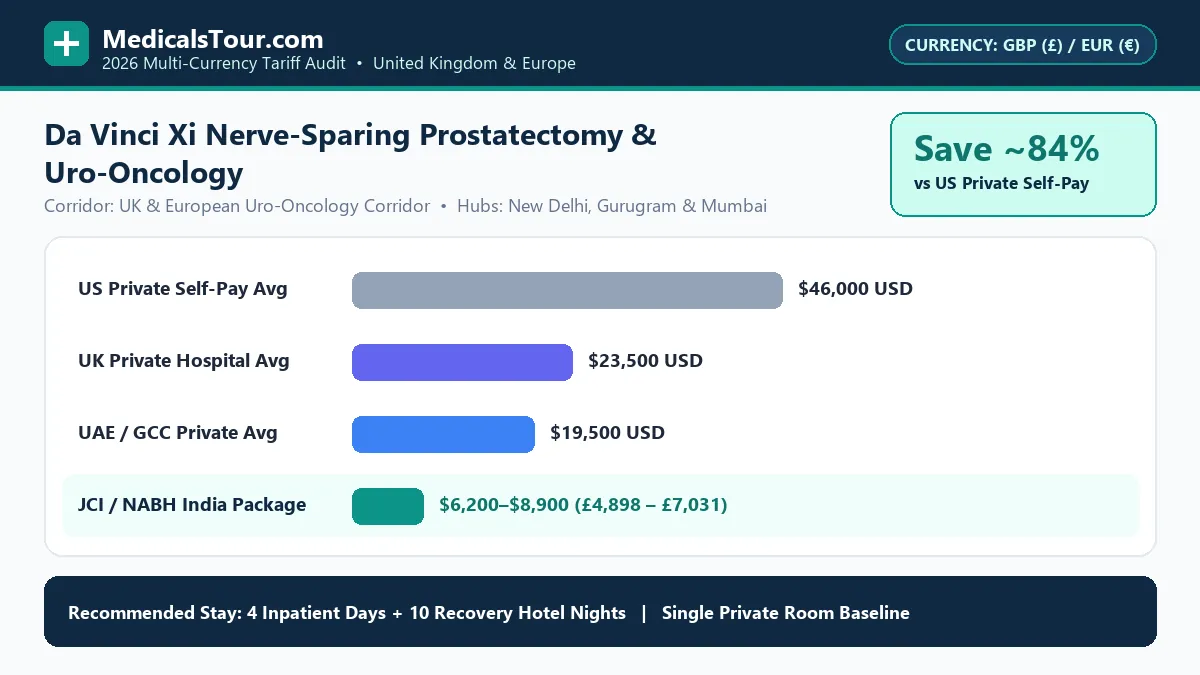
Receiving a Gleason 3+4=7 or 4+3=7 transperineal prostate biopsy report—or spotting an enhancing 3.8-centimetre cortical mass on a renal CT—triggers an uncomfortable race against hospital scheduling calendars across Britain, Ireland, and continental Europe. Even under urgent two-week-wait cancer pathways, overstretched NHS Trusts and regional European public hospitals frequently breach the statutory 62-day diagnosis-to-treatment target once multiparametric MRI slots, nuclear staging scans, multidisciplinary team (MDT) sign-off, and limited Da Vinci robotic theatre lists stack sequentially. Requesting an uninsured private self-pay quote in London, Manchester, Dublin, or Munich eliminates the wait, yet replaces it with a hospital estimate of £21,500 to £26,500 (€24,800 to €30,500) before pre-operative PSMA PET-CT imaging is even counted.
Across Mumbai, New Delhi, and Gurugram, high-volume uro-oncology institutes equipped with fourth-generation Intuitive Da Vinci Xi four-arm surgical systems admit international patients within seven to ten days of remote record review. Audited through Medical Tour’s 2026 surgical tariff desk, complete Single Private Room bundles for bilateral nerve-sparing robotic radical prostatectomy or partial nephrectomy run $6,200 to $8,900 (£4,890 to £7,020 / €5,720 to €8,210)—deploying the exact same EndoWrist articulated instruments, V-Loc barbed sutures, and Gallium-68 nuclear tracers used in Western European academic centres.
For men weighing whether an eight-to-nine-hour nonstop flight from London Heathrow, Paris Charles de Gaulle, Frankfurt, or Milan makes clinical sense, two practical benchmarks matter above everything else: the lead console surgeon’s personal robotic case volume and a disciplined post-operative catheter removal protocol before boarding the aircraft home. Below is how the surgical workflow, pathology verification, and fourteen-day recovery schedule operate step by step.
NHS 62-Day Cancer Breaches & Private European Urology Tariffs vs Indian Da Vinci Xi Suites
Robotic urological oncology carries heavy fixed overhead in Western private hospitals because operating rooms bill per minute alongside Intuitive Surgical single-use robotic drapes, 10-life EndoWrist instrument depreciation, separate consultant surgeon and assistant fees, consultant anaesthetist charges, and whole-mount histopathology. Add a pre-surgical Gallium-68 or Fluorine-18 PSMA PET-CT scan—now standard of care under EAU and NICE guidelines for staging unfavourable intermediate- and high-risk prostate cancer—and a self-funding patient in London or Dublin pays £2,350 to £3,100 before ever putting on a theatre gown.
Indian JCI-accredited quaternary hospitals bundle four-arm Da Vinci Xi theatre usage, anaesthesia consumables, four inpatient ward nights in a Single Private Room, nursing care, and CAP-aligned synoptic pathology into fixed package tiers. Nuclear oncology diagnostics carry similarly transparent pricing, as detailed in our PET-CT & Oncology Surgery Cost Guide.
| Urological Procedure / Staging Scan | UK Private (£ GBP) | Western EU Private (€ EUR) | India JCI Hospital ($ USD / £ / €) |
|---|---|---|---|
| 68Ga / 18F-PSMA Whole-Body PET-CT Scan | £2,350 – £3,100 | €1,850 – €2,600 | $410 – $560 (£325 / €380) |
| Da Vinci Xi Nerve-Sparing Radical Prostatectomy | £19,500 – £24,800 | €21,000 – €26,500 | $6,600 – $8,900 (£5,200 / €6,090) |
| Da Vinci Xi Partial Nephrectomy (Firefly ICG) | £18,800 – £23,500 | €19,800 – €25,000 | $6,200 – $8,400 (£4,890 / €5,720) |
| Robotic Radical Cystectomy + Intracorporeal Conduit | £26,000 – £34,000 | €28,500 – €36,000 | $9,200 – $12,800 (£7,250 / €8,490) |
| 120W Moses 2.0 HoLEP (Enlarged BPH Gland >80g) | £7,800 – £10,600 | €7,200 – €9,800 | $2,850 – $4,100 (£2,250 / €2,630) |
Every Indian corporate hospital indexes non-implant surgical tariffs to your inpatient bed tier. Admission into a Standard Single Private Room—which already includes a private en-suite bathroom, adjustable sofa-bed for your spouse, television, and climate control—locks in the base package figures above. Electing an Executive Deluxe Room or Presidential Suite scales surgeon, anaesthetist, and room-hour charges upward by 20% to 35% without changing the Da Vinci Xi console or theatre team.
What Base Urology Proforma Quotes Exclude
When auditing a pre-travel estimate from Mumbai or New Delhi, set aside $650 to $1,150 outside the surgical bundle for three predictable outpatient items: Day 1 nuclear staging (68Ga-PSMA PET-CT plus 2D echo and urine culture), immunohistochemistry or genomic decipher panels if high-grade pathology warrants adjuvant oncology review, and 28-day take-home pharmacy supplies covering low-molecular-weight heparin syringes, silicone catheter leg-bag spares prior to TWOC, and daily phosphodiesterase-5 inhibitor tablets.
Surgical Technique Audit: Bilateral Nerve-Sparing RARP, Retzius-Sparing & NeuroSAFE Margins
Peer-reviewed urological registries from Europe and North America consistently show that radical prostatectomy outcomes—measured by the ”trifecta“ of undetectable post-op PSA (<0.02 ng/mL), pad-free urinary continence, and recovery of erectile function—continue improving well past a surgeon’s first 500 robotic cases. At flagship referral centres in Mumbai, New Delhi, and Gurugram, department chairs typically log 1,000 to 2,500+ personal Da Vinci console procedures, operating four to six robotic pelvic cases weekly rather than two cases a month.
When evaluating an Indian surgical opinion over video, review your PI-RADS v2.1 3T MRI lesion map and systematic/targeted biopsy cores against four anatomical details:
- Graded Athermal Nerve Sparing: Using 10x magnified 3D high-definition Da Vinci Xi vision and seven-degree wristed micro-scissors, surgeons tailor dissection plane by side—performing full intrafascial nerve sparing on a tumour-free lobe while selecting interfascial or incremental partial nerve sparing opposite an anterior or mid-gland lesion, avoiding monopolar electrocautery heat injury to the cavernous nerves.
- NeuroSAFE Intraoperative Frozen-Section Assessment: When intermediate-risk disease abuts the posterolateral prostatic capsule, leading Mumbai and Delhi institutes offer real-time NeuroSAFE frozen-section margin checking. Immediately after prostate extraction—while the surgeon completes extended pelvic lymph-node dissection if Briganti or Memorial Sloan Kettering nomogram nodal risk exceeds 5% to 7%—genitourinary pathologists ink and cryosection the neurovascular margin inside 35 minutes. If malignant glands reach the inked edge, selective secondary resection clears residual tumour under the same anaesthetic, maximizing safe nerve preservation.
- Total Anatomical & Retzius-Sparing Reconstruction: Multi-layer posterior musculofascial reconstruction (Rocco stitch) combined with anterior periurethral suspension—or a posterior Retzius-sparing approach in suitable gland anatomies that leaves the puboprostatic ligaments and dorsal venous complex undisturbed—markedly reduces early post-catheter stress leakage during weeks two through six.
For men diagnosed with locally advanced clinical stage cT3a disease or ISUP Grade Group 4–5 adenocarcinoma, robotic surgery in Mumbai and Delhi is never planned in isolation. Pre-operative pelvic lymphadenectomy templates cover the external iliac, obturator, and internal iliac nodal packets up to the ureteric crossing, giving radiation and medical oncologists back in Britain or Europe exact pathological staging rather than relying on imaging estimates alone. Early structured penile rehabilitation—combining daily low-dose tadalafil (5 mg) started immediately after catheter removal with vacuum erection device coaching if bilateral nerve traction occurred—is written directly into your post-discharge protocol.
Robotic Partial Nephrectomy with Firefly ICG & High-Power Moses 2.0 HoLEP for Large Prostates
Beyond prostate cancer, two distinct urological cohorts travel regularly from Britain, Ireland, and Italy to Indian tertiary centres. The first comprises men and women diagnosed with localized T1a (<4 cm) or complex hilar/endophytic T1b (4–7 cm) kidney tumours. In smaller European district hospitals without dedicated robotic renal lists, complex central tumours are still occasionally steered toward laparoscopic radical nephrectomy, sacrificing healthy nephrons and accelerating long-term cardiovascular and chronic kidney disease risk. Indian robotic uro-oncologists pair thin-slice 3D CT renal vascular reconstruction with Da Vinci Firefly near-infrared fluorescence imaging. Intravenous indocyanine green (ICG) illuminates segmental renal artery perfusion in real time, enabling super-selective clamping that holds warm ischemia strictly below 15 to 20 minutes while two-layer barbed-suture sliding-clip renorrhaphy seals collecting-system calyces.
The second major group consists of men aged 60 to 82 suffering severe benign prostatic hyperplasia (BPH)—often living for nine to fourteen months on NHS or Irish HSE waiting lists with an indwelling urethral catheter, recurrent urinary tract infections, or bladder stones caused by 100-gram to 200-gram prostates. Conventional monopolar or bipolar TURP struggles safely above 80 grams, while minimally invasive office treatments such as UroLift clips or Rezum water-vapour therapy frequently prove inadequate when a large intravesical median lobe ball-valves the bladder neck. High-volume Indian endourology departments utilize 120-watt Lumenis Pulse 120H holmium lasers equipped with Moses 2.0 contact-vaporization and enucleation technology. Anatomical Holmium Laser Enucleation of the Prostate (HoLEP) peels obstructive adenoma lobes cleanly off the surgical capsule regardless of gland size, morcellates tissue intravesically for complete histological checking to rule out incidental prostate carcinoma, requires zero abdominal incisions, and stops continuous saline irrigation within 18 to 24 hours—even in cardiac patients requiring carefully bridged antiplatelet therapy.
When simultaneous bladder calculi accompany chronic prostatic obstruction—a frequent complication in men who have worn long-term suprapubic or urethral catheters on European waiting lists—Indian endourologists fragment and evacuate the stones cystoscopically using the exact same holmium laser fibre during the single HoLEP anaesthetic, adding minimal theatre time and sparing the patient a staged second admission.
Evaluating Kokilaben Dhirubhai Ambani Hospital Mumbai & Max Super Speciality Saket
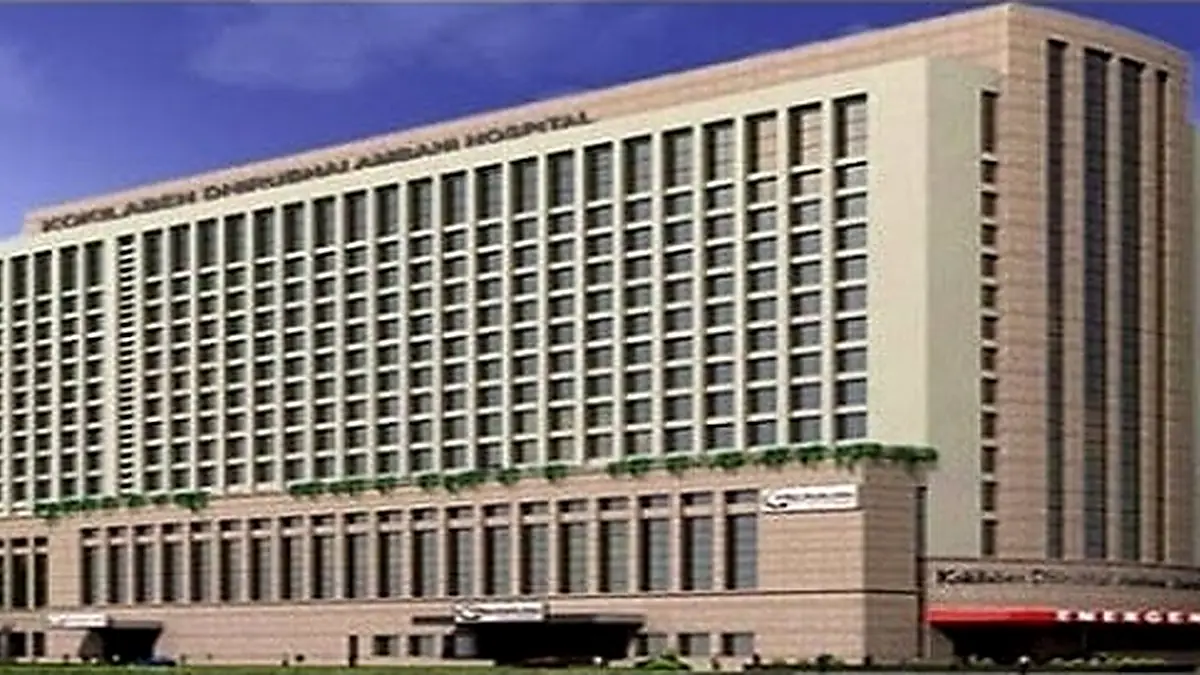
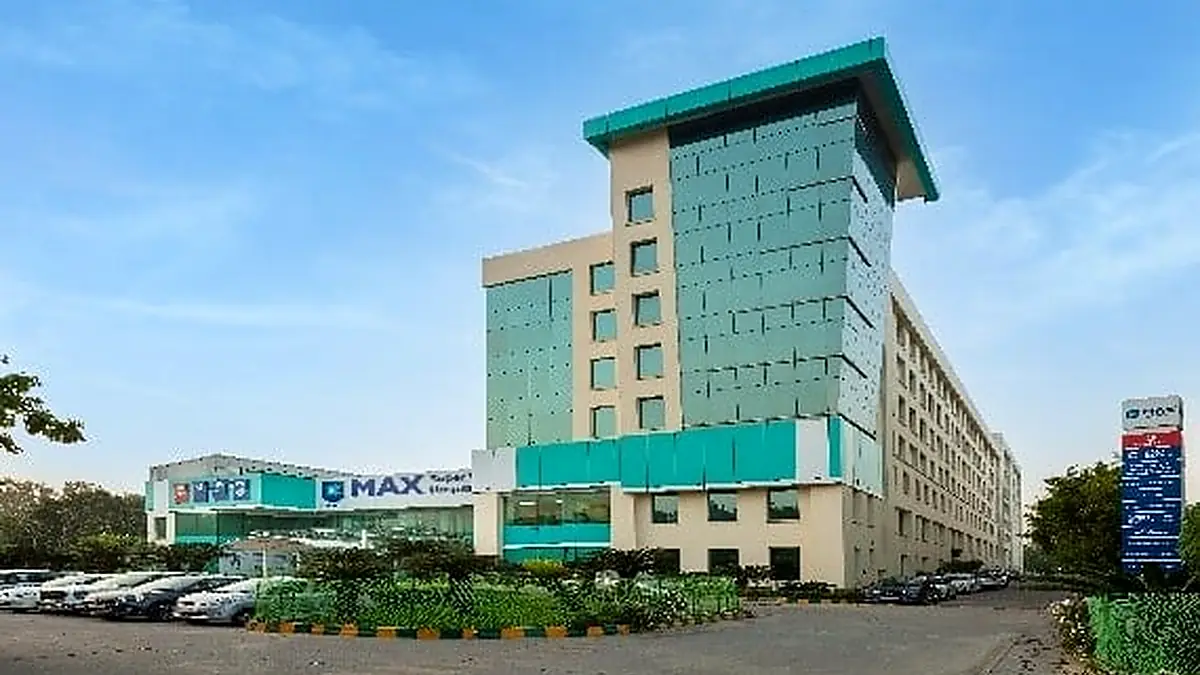
Two JCI-accredited flagships anchor most UK and European urology itineraries, each offering distinct logistical strengths. In western Mumbai, Kokilaben Dhirubhai Ambani Hospital in Four Bungalows, Andheri West operates on a strict Full-Time Specialist System (FTSS): every consultant uro-oncologist, nuclear physician, and uroradiologist is salaried full-time on campus rather than splitting private chambers across suburban clinics. Kokilaben’s Center for Cancer houses multiple Intuitive Da Vinci consoles, high-resolution 68Ga-PSMA PET-CT, 3T multiparametric MRI, and rapid frozen-section pathology under one roof, located 25 to 35 minutes from Mumbai Airport Terminal 2 (served nonstop from London Heathrow, Paris CDG, Frankfurt, Munich, Amsterdam, and Zurich).
In South Delhi, Max Super Speciality Hospital, Saket runs one of North India’s busiest Da Vinci Xi uro-oncology and renal transplant programmes, supported by weekly multidisciplinary tumour boards uniting medical oncology, VMAT/SBRT radiation oncology, and uro-pathology. Travelers flying direct into New Delhi IGI Terminal 3 from Heathrow, Birmingham, Paris, Frankfurt, Milan, Rome, Vienna, or Warsaw—who can compare route specifics in our Italy to India Cardiac & Urology Guide inside our International Medical Corridors Hub—value Saket’s leafy residential streets, quiet serviced guest residences, and flat walking pavements during post-discharge convalescence.
At both hospitals, international patient coordinators arrange airport tarmac wheelchair assistance on request, pre-book Day 1 staging appointments before your plane takes off from Europe, and issue direct mobile WhatsApp escalation contacts for the urology clinical fellow on call. Accompanying spouses also benefit from hospital-vetted serviced residences within a ten-minute taxi radius—such as Lokhandwala and Versova apartments near Kokilaben in Mumbai, or Malviya Nagar and Panchsheel Enclave apartments near Max Saket in New Delhi—equipped with walk-in showers rather than high-sided bathtubs so post-operative bathing stays effortless while abdominal port dressings heal.
Pre-Travel Histopathology Block Review, 68Ga-PSMA PET-CT & Cardiology Clearance
Sound surgical governance requires independent diagnostic verification before removing an organ. Four steps completed from home in Europe compress your pre-operative ground time in India to just forty-eight hours:
- Native DICOM Imaging Upload: Request your raw multiparametric 3T prostate MRI or triphasic renal CT dataset on CD or NHS/clinic portal download—not merely a two-paragraph PDF radiology summary—and upload the uncompressed `.dcm` folder to the Indian hospital’s PACS link so the operating surgeon can measure apical urethral length, median lobe protrusion, and accessory pudendal arteries firsthand.
- Biopsy Slide or Paraffin Block Review: Whenever Gleason scoring sits on a clinical borderline (such as high-volume ISUP Grade 1 vs Grade 2, or suspected intraductal/cribriform architecture), ask your UK or EU hospital cellular pathology department to release stained H&E slides or representative formalin-fixed paraffin-embedded (FFPE) blocks with a formal chain-of-custody letter for review by the Indian hospital’s NABL-accredited uro-pathologist on Day 1.
- Anticoagulant & SGLT2 Inhibitor Washout: Coordinate written hold dates jointly between your home cardiologist/GP and the Indian anaesthesia desk—typically pausing clopidogrel or ticagrelor 5 to 7 days prior (when stent timelines safely permit), apixaban/rivaroxaban 48 to 72 hours prior, and diabetic SGLT2 inhibitors (dapagliflozin/empagliflozin) 3 to 4 days pre-op to prevent euglycaemic ketoacidosis.
- Day 1–2 On-Site Staging & Trendelenburg Clearance: Because robotic prostatectomy places patients in a steep 25-to-28-degree head-down Trendelenburg position with CO2 pneumoperitoneum for two to three hours, Day 1 outpatient workup ($340–$590) includes 2D stress/resting echocardiography, pulmonary spirometry, eGFR, urine culture (treating any asymptomatic bacteriuria caused by prior biopsies or catheters before surgery), and 68Ga-PSMA PET-CT if not already completed within eight weeks.
Completing a quantitative midstream urine culture plus antibiotic sensitivity test forty-eight hours before theatre—even when you have zero dysuria—is an understated safeguard in cross-border urology. Men who have undergone recent transrectal prostate biopsies or carried indwelling catheters on European waiting lists frequently harbour silent fluoroquinolone-resistant E. coli colonization; administering targeted culture-guided intravenous prophylaxis at anaesthetic induction prevents post-catheter urinary sepsis and protects your vesicourethral anastomosis from inflammatory stricture.
The 14-Day Urological Recovery Timeline: Pelvic Drains, Catheter TWOC & Continence
Boarding a nine-hour flight to London or Frankfurt five days after radical prostatectomy with an indwelling urethral catheter still in place invites painful bladder neck spasms, leg-bag drainage hassles at airport security, and anxiety over finding an urgent NHS community district nurse to remove the catheter upon landing. Planning a full 14-day stay in Mumbai or New Delhi lets the surgeon personally supervise anastomotic healing and Trial Without Catheter (TWOC) before you fly.
| Trip Window | Clinical Milestone (Da Vinci Xi Radical Prostatectomy) | Care Setting |
|---|---|---|
| Days 1 – 2 | Arrival, uro-oncologist physical consult, pathology slide audit, 68Ga-PSMA PET-CT, urine culture & cardiology/anaesthesia sign-off. | Outpatient + Nearby Hotel |
| Day 3 | Morning admission; 2.5–3.5 hr Da Vinci Xi nerve-sparing RARP; pneumatic calf pumps & multimodal non-opioid analgesia overnight. | Single Private Room |
| Days 4 – 6 | Assisted corridor walking Day 4; oral liquids to soft high-fibre diet; pelvic Jackson-Pratt drain removed once serous output <30–50 mL; discharge Day 6 with 16Fr/18Fr silicone Foley catheter. | Inpatient Ward to Hotel |
| Days 7 – 9 | Short indoor hotel walks (avoiding perineal straddle pressure); whole-mount synoptic pathology report (pT stage, margins, lymph nodes) reviewed in detail with surgeon. | Hotel / Apartment (5–10 min away) |
| Days 10 – 11 | Outpatient cystogram leak check (if bladder-neck reconstruction was wide) & painless Foley removal; 4-hour voiding trial, uroflowmetry & post-void residual (PVR) ultrasound. | Urology Outpatient Clinic |
| Days 12 – 14 | Biofeedback pelvic-floor Kegel instruction, low-dose daily PDE5-inhibitor penile rehabilitation prescription, port check & Fit-to-Fly certificate. | Return Flight to UK / Europe |
Patients undergoing Robotic Partial Nephrectomy typically spend four nights inpatient and six to seven nights in a nearby hotel (10 to 11 days total), with their urethral catheter removed on Post-Op Day 1 or Day 2 before leaving the hospital ward. Men choosing 120W Moses HoLEP for benign prostatic enlargement enjoy the fastest turnaround of all: two hospital nights, catheter removal on Day 2 morning, uroflowmetry verification on Day 5, and safe return flight clearance by Day 7 or Day 8.
Flying Home to Heathrow, Paris CDG or Frankfurt After Pelvic Robotic Surgery
Pelvic malignancy and major laparoscopic insufflation elevate deep vein thrombosis (DVT) and pulmonary embolism risk for four full weeks after surgery. Before signing your aviation medical letter—detailed in our Fit-to-Fly Certificate After Surgery Guide—your uro-oncologist confirms three clinical checkpoints: complete resolution of sub-diaphragmatic CO2 gas, clean dry 8-mm abdominal port sites and supra-umbilical specimen extraction wound, and reproducible spontaneous voiding with post-void residual volumes below 80 mL.
Under EAU thromboprophylaxis guidelines, high- and intermediate-risk pelvic oncology travelers are routinely discharged with a 28-day post-operative prescription of subcutaneous low-molecular-weight heparin (enoxaparin 40 mg daily) or approved oral anticoagulant per individual bleeding/Caprini score, combined with knee-high Class II (20–30 mmHg) graduated compression stockings for the return flight. Book an aisle seat near the mid-cabin lavatory so frequent hydration never causes urgency stress, pack light absorbent male shields in your personal item for minor cough-induced dribble during early pelvic-floor adaptation, and request airport wheelchair assistance from check-in to aircraft door so you never lift luggage heavier than 5 kilograms or strain your umbilical fascia.
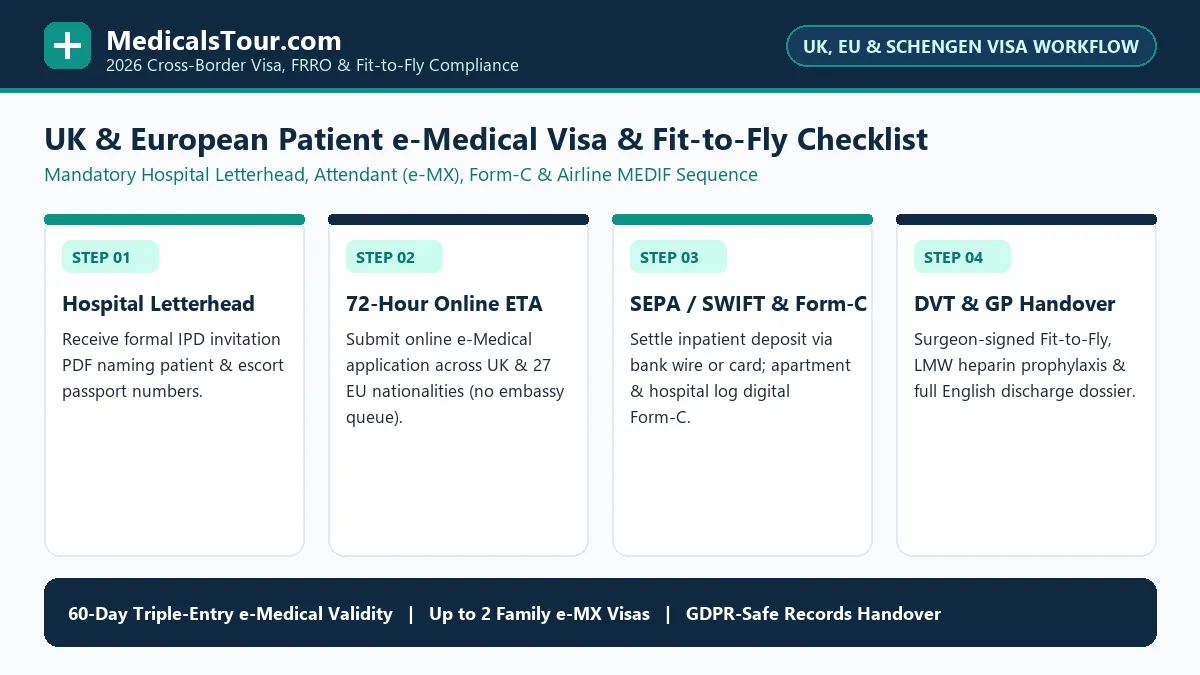
Factoring in every predictable non-hospital expense helps European households compare true bottom-line savings accurately. Alongside a Single Private Da Vinci Xi prostatectomy or partial nephrectomy package ($6,200–$8,900 / £4,890–£7,020 / €5,720–€8,210), budget $450–$650 for Day 1 PSMA PET-CT and cardiac clearance, $750–$1,200 for ten nights in an elevator-accessible four-star hotel near Andheri West or Saket, $220–$340 for 28-day take-home anticoagulants and tadalafil, and $1,350–$2,100 for two return economy tickets (or $3,200–$4,600 if upgrading the patient’s return leg to lie-flat business class). Settling the main hospital invoice via USD or EUR SWIFT wire transfer 5 business days before admission—detailed in our Hospital Wire Transfer & Forex Billing Guide—avoids UK and EU retail card markups. Full visa steps sit in our UK & Western Citizens e-Medical Visa Guide, and you can build a custom GBP or EUR cost sheet using Medical Tour’s interactive Medical Trip Budget Planner.