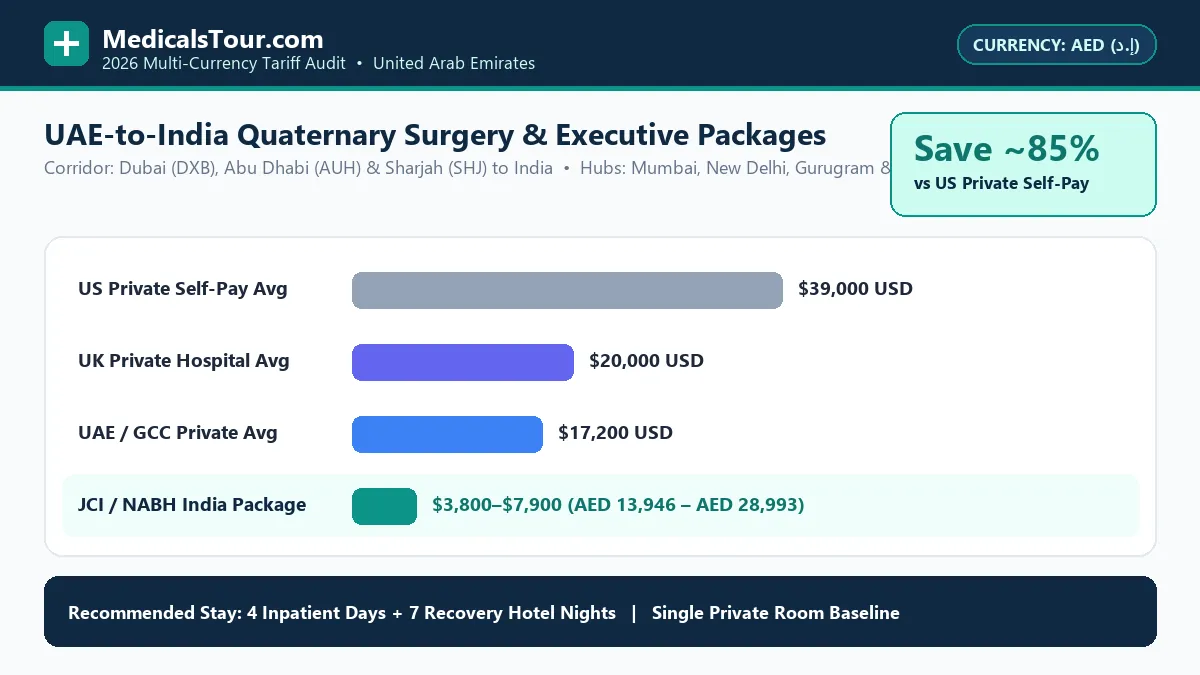
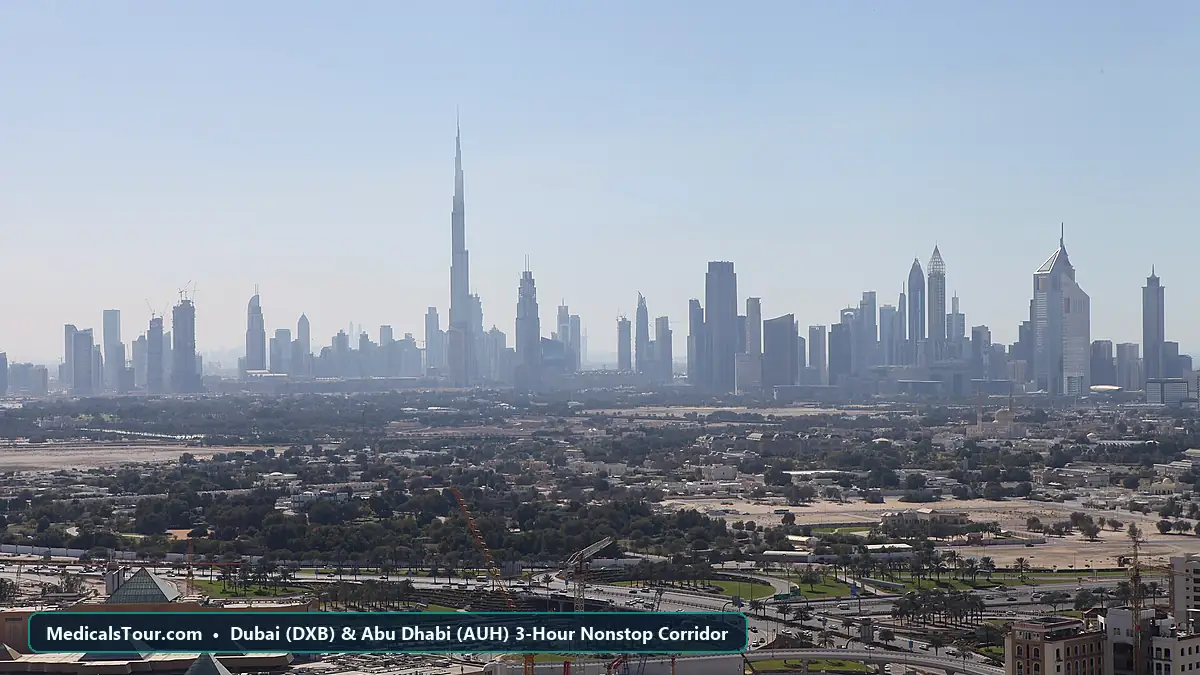
Boarding Emirates EK504 at Dubai International Terminal 3 or Etihad EY204 at Zayed International Airport in Abu Dhabi after morning coffee puts a patient inside a JCI-accredited consulting suite in Mumbai or Gurugram before mid-afternoon—shorter door-to-door than driving from Fujairah to Al Dhafra in weekend highway traffic. Across that three-hour Arabian Sea crossing, however, hospital billing architecture changes completely. When a private facility in Dubai Healthcare City, Jumeirah, or Al Maryah Island quotes AED 78,000 to AED 115,000 for robotic knee arthroplasty, spinal fusion, or oncological resection, families paying out of pocket—or hitting sub-limits on UAE corporate health policies—face steep capital outlays.
Audited across Medical Tour’s 2026 Gulf corridor tariff desk using the UAE Dirham’s fixed US dollar peg (1 USD = 3.6725 AED), identical Single Private Room surgical bundles inside flagship Mumbai, Gurugram, New Delhi, and Chennai quaternary hospitals run $3,800 to $7,900 (AED 13,955 to AED 29,015). Those packages pair high-volume surgeons who perform hundreds of complex cases annually with FDA- and CE-approved Stryker, Medtronic, Edwards, and Intuitive Da Vinci hardware.
Because the UAE hosts over two hundred resident nationalities alongside Emirati citizens, planning a medical trip from Dubai, Abu Dhabi, Sharjah, or Ras Al Khaimah requires getting two corridor details right before booking flights: verifying whether your specific passport qualifies for India’s 72-hour online e-Medical Visa or requires a stamped visa via BLS International in Dubai/Abu Dhabi, and understanding how hospital room tiers govern final Dirham invoices.
2026 Surgical Tariff Audit in UAE Dirhams (AED): Dubai & Abu Dhabi Private Quotes vs India
Private healthcare across Dubai (regulated by the Dubai Health Authority, DHA) and Abu Dhabi (regulated by the Department of Health, DOH) features modern hospital towers and international clinicians, yet carries high real-estate, imported-consumable, and fee-for-service DRG markups. Whenever a procedure falls outside mandatory insurance coverage, triggers a 20% co-pay ceiling, or exceeds an Essential Benefits Plan (EBP) annual AED 150,000 limit, self-pay bills escalate rapidly.
Indian JCI hospitals issue fixed Single Private Room Proforma Invoices prior to departure—bundling surgeon fees, anaesthesia, operating theatre hours, standard consumables, nursing, and fixed ICU/ward days. You can benchmark procedure-specific inclusions in our Robotic Knee Replacement Cost Guide, Heart Bypass (CABG) Cost Guide, and Gastric Sleeve Surgery Cost Comparison.
| Tertiary Procedure (Single Private Room) | UAE Private Hospital (AED) | India JCI Package ($ USD) | India Equivalent in AED (1$ = 3.67) |
|---|---|---|---|
| Stryker Mako / Robotic Knee Replacement (Unilateral) | AED 64,000 – 88,000 | $4,600 – $6,400 | AED 16,895 – 23,505 |
| Off-Pump Beating-Heart CABG Bypass | AED 95,000 – 145,000 | $5,400 – $7,800 | AED 19,830 – 28,645 |
| O-Arm Navigation Lumbar Spine Fusion (1-Level TLIF) | AED 76,000 – 112,000 | $5,200 – $7,400 | AED 19,095 – 27,175 |
| Laparoscopic Gastric Sleeve (FDA Tri-Stapler) | AED 42,000 – 62,000 | $4,500 – $6,100 | AED 16,525 – 22,400 |
| Whole-Body PET-CT + Major Onco-Surgical Resection | AED 88,000 – 155,000 | $5,100 – $7,900 | AED 18,730 – 29,015 |
| All-on-4 Straumann/Nobel Zirconia Dental Arch | AED 46,000 – 66,000 | $4,200 – $6,200 | AED 15,425 – 22,770 |
Outpatient Pre-Evaluation Costs Outside Your Surgical Package
Even when an Indian hospital emails a firm surgical package quote, keep AED 1,400 to AED 2,600 ($380 to $710) budgeted separately for Day 1 outpatient pre-anaesthesia clearance—covering consultant registration, 2D echocardiography, viral serology, pulmonary spirometry, and any updated 3T MRI or CT angiogram—plus AED 600 to AED 1,500 for 30-to-60-day discharge medications carried back to the Emirates.
When UAE Residents & Emirati Families Self-Pay in India vs Using DHA/DOH Insurance
Roughly four distinct patient profiles fly every week from DXB, AUH, and Sharjah to Indian tertiary centres, each navigating UAE health insurance rules differently:
- Self-Sponsored Golden Visa Retirees & Investors: Long-term Dubai and Abu Dhabi property investors, retirees over 60, and free-zone entrepreneurs frequently carry high-deductible plans or face AED 35,000+ annual premiums with six-to-twelve-month pre-existing condition exclusions on orthopaedic joints, spinal stenosis, or benign prostate disease. Self-paying AED 18,000 in Mumbai or Gurugram bypasses policy waiting periods immediately.
- Employees & Dependents on Essential Benefits Plans (EBP): Across Dubai and the Northern Emirates, workers and sponsored parents on EBP policies face an annual AED 150,000 aggregate cap and 20% inpatient co-insurance. Major oncology, multi-vessel cardiac, or neurosurgical admissions inside private Dubai hospitals can exhaust that cap within four ICU days.
- Excluded Elective Specialties (Bariatric, IVF & Full-Arch Prosthodontics): Standard corporate group policies from Sukoon, Daman, Orient, and NextCare frequently exclude metabolic weight-loss surgery below BMI 40, homologous IVF/ICSI cycles, and zirconia implant rehabilitation—segments detailed further in our UAE & Saudi to Delhi Dental & IVF Travel Guide inside our International Medical Corridors Hub.
- Emirati Families & Comprehensive Expats Seeking Quaternary Volume: Even when domestic coverage exists, Emirati families and senior expats holding Cigna Global, Bupa Global, Allianz Care, or Sukoon regional network plans choose India for high-volume subspecialties—such as living-donor liver transplantation, Pencil-Beam Proton Therapy, or pediatric congenital heart repair—requesting either pre-authorized Guarantee of Payment (GOP) direct billing or itemized stamped claim dossiers for out-of-network South Asia reimbursement.
How Direct Billing GOP vs Post-Discharge Reimbursement Works for UAE Policies
If your employer-issued Dubai or Abu Dhabi policy includes ”Elective South Asia / India Network“ benefits (common on senior regional tiers from Cigna, Bupa, GIG Gulf, and Sukoon), email the hospital’s insurance TPA desk your Emirates ID, insurance card front/back, and home specialist referral seven to ten working days before flying. Once the insurer issues a written Guarantee of Payment (GOP), you settle only non-medical items or policy deductibles at discharge. Conversely, when paying self-pay rates upfront and claiming retrospective out-of-network reimbursement back in the UAE, request three stamped documents before leaving the hospital: an ICD-10 and CPT-coded itemized final invoice, operative notes signed by the lead consultant, and official histopathology or implant-sticker sheets.
3-Hour Aviation Matrix: DXB, AUH & Sharjah (SHJ) Nonstop Schedules into BOM, DEL & MAA
No long-haul medical corridor anywhere in the world matches the frequency of commercial widebody and narrowbody flights linking the UAE to India’s four primary hospital hubs. Over seventy nonstop departures cross the Arabian Sea daily, eliminating connecting-hub fatigue for post-operative spine, cardiac, and elderly orthopaedic travelers.
| UAE Origin Airport | Indian Hospital Gateway | Nonstop Airlines Operating | Block Flight Time |
|---|---|---|---|
| Dubai (DXB T1 / T2 / T3) | Mumbai CSMIA (BOM T2) | Emirates (A380/B777), Air India, IndiGo, Flydubai | 3 hrs 05 mins |
| Dubai (DXB T1 / T3) | New Delhi IGI (DEL T3) | Emirates, Air India, IndiGo, SpiceJet, Flydubai | 3 hrs 35 mins |
| Dubai (DXB T3 / T1) | Chennai Intl (MAA T4) | Emirates (B777), Air India, IndiGo | 4 hrs 10 mins |
| Abu Dhabi (AUH Terminal A) | Mumbai (BOM) & New Delhi (DEL) | Etihad Airways, Air India, Air India Express, IndiGo | 3 hrs 10m – 3 hrs 40m |
| Abu Dhabi (AUH Terminal A) | Chennai Intl (MAA) | Etihad Airways, IndiGo | 4 hrs 15 mins |
| Sharjah (SHJ) | Mumbai, Delhi & Chennai | Air Arabia, Air India Express | 3 hrs 10m – 4 hrs 15m |
Stretcher, Wheelchair & MEDIF Clearance on Emirates and Etihad
Patients flying with impaired mobility—or returning ten days after joint replacement or cardiac surgery—benefit from widebody Boeing 777 and Airbus A380 cabins on Emirates and Etihad. Standard airport wheelchair assistance (WCHR/WCHS) requires zero medical forms when requested 48 hours ahead. However, any traveler needing supplemental in-flight therapeutic oxygen, a commercial economy-cabin stretcher installation, or flying within ten days of thoraco-abdominal surgery must have their Indian surgeon sign an IATA MEDIF (Medical Information Form) 48 to 72 hours prior to departure so Emirates or Etihad Aviation Medical Services issues formal boarding clearance.
Visa Split-Track: Emirati Citizens vs UAE Expatriate Passport Holders (e-Medical vs BLS Dubai)
The single most common visa mistake made by Dubai and Abu Dhabi residents is assuming that holding a valid UAE Residency Visa and Emirates ID automatically qualifies every traveler for an Indian e-Visa. Indian Bureau of Immigration rules determine electronic visa eligibility strictly by passport nationality, never by country of residence.
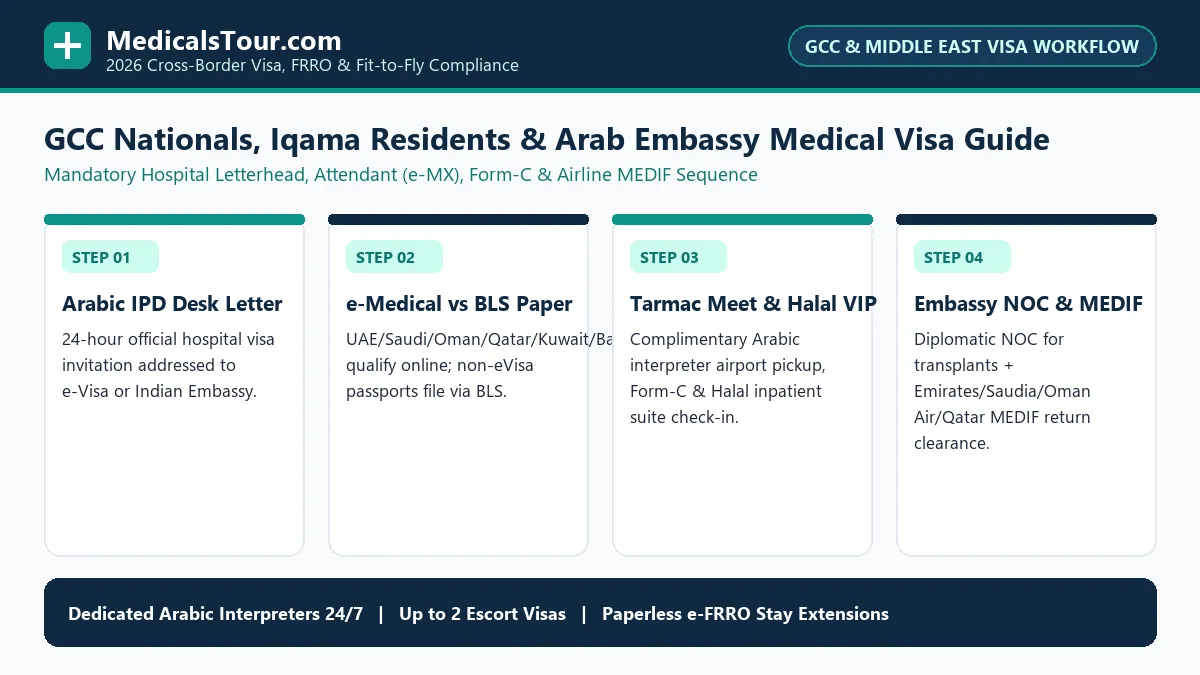
Track A — Online Indian e-Medical Visa (72-Hour Approval): UAE nationals (Emirati passport holders) as well as UAE residents holding passports from over 165 eligible countries—including the UK, USA, Canada, EU states, Philippines, Jordan, Oman, Saudi Arabia, South Africa, Kenya, Russia, and Mauritius—apply online for the 60-day triple-entry e-Medical Visa plus up to two e-Medical Attendant Visas for accompanying relatives, uploading a hospital Visa Invitation Letter (VIL) on letterhead. Full filing instructions sit in our India e-Medical Visa Guide for UAE & Oman Travelers.
Track B — Stamped Paper Medical Visa via BLS International (Dubai & Abu Dhabi): UAE residents holding passports not listed on India’s electronic portal—including Syrian, Yemeni, Sudanese, Egyptian, Iraqi, Somali, Nigerian (regular paper track checks), or Pakistani nationals—must submit physical passports, Emirates ID copies, six-month UAE residence validity proof, and an official hospital VIL electronically echoed to the Consulate General of India (Dubai) or Embassy of India (Abu Dhabi) through BLS International Services in BurJuman / Al Khaleej Center (Dubai), Khalidiya (Abu Dhabi), or Sharjah. Apply 10 to 15 working days ahead for standard Arab/African passports (and longer statutory clearance windows for Pakistani-origin passports). Indian NRI/OCI residents in the UAE need no visa at all—valid Indian passport or OCI card grants immediate domestic entry.
UAE Residence Visa Validity & e-FRRO Rules for Expatriate Patients
Two practical immigration checkpoints protect expatriate families residing in Dubai, Abu Dhabi, or Ajman from return-flight boarding surprises. First, confirm before flying that your UAE Residency Visa (checked via the ICP Smart Services app) holds at least ninety days of remaining validity and that you will not stay outside the Emirates past the standard 180-day continuous absence threshold (unless holding a UAE Golden Visa, which is exempt from the six-month outside-country rule). Second, if you enter India on a 6-month stamped BLS paper Medical Visa rather than a 60-day online e-Medical Visa, remember that Indian law requires online e-FRRO registration within 14 calendar days of arrival. Hospital international patient coordinators upload your passport, visa stamp, doctor’s letter, and hotel Form-C certificate on the e-FRRO portal free of brokerage charges so your departure clearance at Mumbai or Delhi immigration remains completely smooth.
Families traveling with infants or elderly wheel-bound parents from Ras Al Khaimah, Umm Al Quwain, or Fujairah should also note that up to two blood relatives qualify for linked Medical Attendant Visas per patient file—allowing both a spouse and an adult son or daughter to share inpatient companion shifts comfortably.
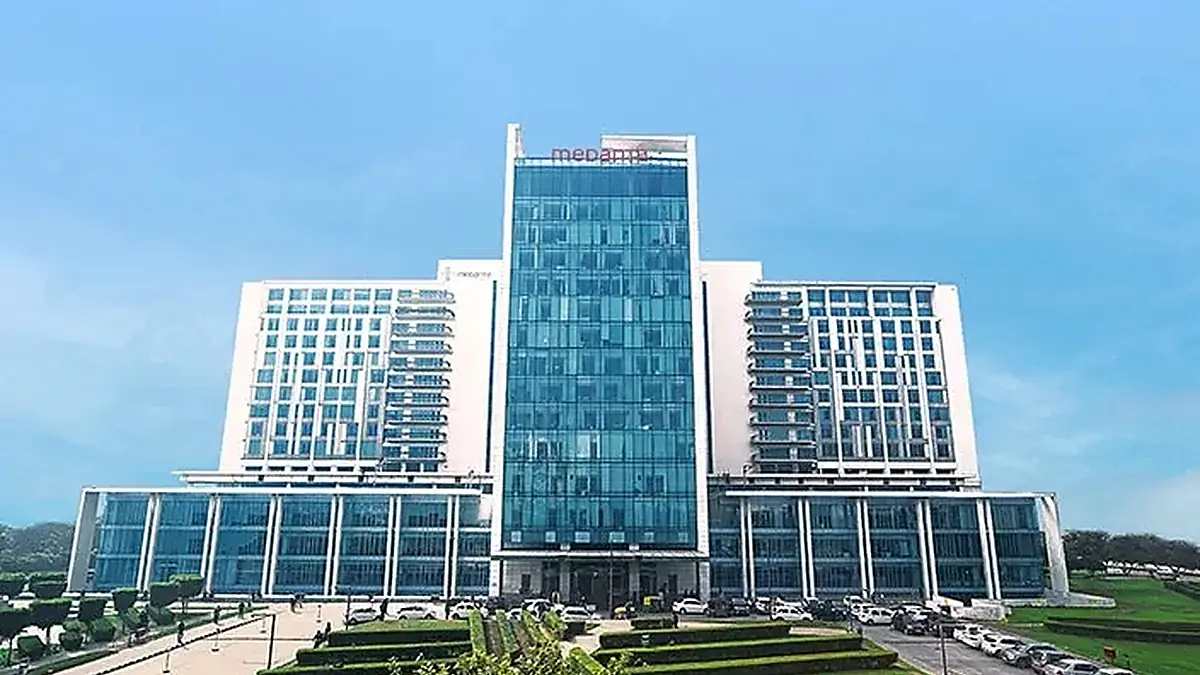
Comparing Kokilaben Hospital Mumbai & Medanta—The Medicity Gurugram for Gulf Guests
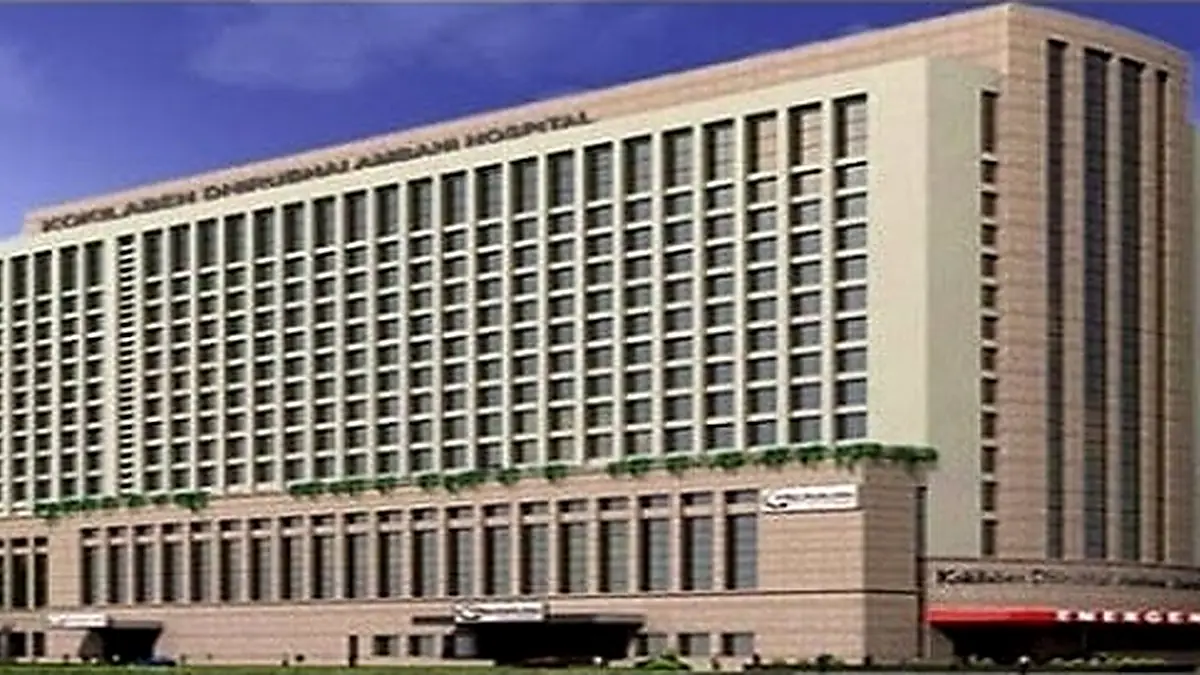
Two quaternary JCI campuses illustrate the choice between Mumbai’s coastal proximity and Delhi NCR’s massive multi-building medical townships. Twenty-eight minutes south of Mumbai Airport Terminal 2, Kokilaben Dhirubhai Ambani Hospital in Four Bungalows, Andheri West operates 750 beds staffed exclusively by full-time salaried specialists—ideal for Dubai and Sharjah families seeking fast-turnaround robotic joint replacement, Da Vinci urology/oncology, complex spine microsurgery, or pediatric cardiac care with familiar urban convenience.
Twenty-five minutes down National Highway 48 from New Delhi IGI Terminal 3, Medanta—The Medicity in Sector 38, Gurugram spans 43 landscaped acres housing 1,390+ beds, 40+ modular laminar-flow operating rooms, CyberKnife radiosurgery, robotic cardiac and liver transplant institutes, and an entire dedicated International Patient Floor. Both hospitals enforce transparent room-tier indexing: booking a Single Private Room ($165–$220 / AED 605–810/night) preserves base package tariffs, whereas upgrading to a Deluxe Suite or Presidential VIP Suite ($380–$750 / AED 1,395–2,755/night) adds a 20% to 35% billing multiplier onto non-implant professional and theatre fees.
Why Mumbai Suits Short Diagnostics While Gurugram & Chennai Lead Multi-Organ Referrals
UAE travelers often match city selection to trip length. For a three-day executive 3T MRI longevity checkup, sapphire FUE hair restoration, day-case vitreoretinal eye surgery, or first-stage Straumann dental implant placement, Mumbai’s 3-hour flight from DXB or SHJ lets working professionals fly out Thursday evening after work and return to Dubai by Monday or Tuesday morning. For multi-disciplinary solid-organ transplantation, deep brain stimulation, robotic Whipple surgery, or proton beam radiation, families from Abu Dhabi and Dubai frequently prefer Gurugram’s wide campus avenues or Chennai’s specialized oncology corridors where spacious multi-week serviced apartments sit five minutes from ward gates.
Before flying back to DXB or AUH after inpatient orthopaedic, spinal, or cardiac surgery, your attending consultant issues an official aviation clearance—detailed in our Fit-to-Fly Certificate After Surgery Guide—verifying stable haemoglobin, dry surgical dressings, normal oxygen saturation on room air, and a written DVT prophylaxis schedule covering your three-hour cabin leg.
Arabic International Lounges, Halal Inpatient Kitchens & Family Serviced Apartments
Hospitality workflows inside India’s top corporate hospitals have been shaped directly around Gulf family expectations over three decades. Upon landing at BOM or DEL, uniformed international desk drivers meet Emirati and Arab families outside customs with placard signage, assisting directly into the hospital’s International Patient Lounge where check-in, currency guidance, and local Airtel/Jio SIM activation occur away from crowded domestic outpatient queues.
Certified native and fluent Arabic medical interpreters accompany patients during pre-surgical anaesthesia briefings, daily consultant ward rounds, and discharge pharmacy counselling at zero extra interpreter charge. Inpatient dietary departments operate certified Halal kitchens supervised by clinical nutritionists—preparing lightly spiced grilled chicken, lamb stews, lentil soups, fresh flatbreads, labneh-style yoghurts, and low-sodium diabetic or cardiac menus—while every private inpatient room marks the Qibla direction clearly and provides dedicated multi-faith prayer rooms on campus. Female patients from Abu Dhabi, Sharjah, or Al Ain can request female gynaecologists, female breast oncologists, and all-female inpatient nursing shifts prior to admission.
For the seven-to-ten-day post-discharge hotel recovery window before Fit-to-Fly sign-off, families routinely book 1BHK or 2BHK elevator-equipped serviced apartments in Andheri West, Juhu, or Bandra West (Mumbai, AED 260–480/night) or in Gurugram Sector 38, Sector 39, and Sushant Lok (AED 220–420/night), surrounded by Arabic Shawarma/Mandi eateries, 24-hour pharmacies, and Form-C immigration registration support.
Pre-Travel DICOM Cloud Review & Continuity With Your UAE Specialist
Because DHA- and DOH-licensed hospitals in Dubai and Abu Dhabi use modern PACS portals (such as Nabidh in Dubai and Malaffi in Abu Dhabi), exporting your home MRI, CT angiogram, PET-CT, and lab trends before travel takes minutes. Uploading those raw DICOM studies 7 days pre-flight allows the Indian department head to confirm surgical candidacy over Zoom, issue an accurate AED-equivalent Proforma Invoice, and list exact medication washout dates. On discharge day in India, insist on receiving printed implant bar-code stickers (for Stryker/Zimmer joints, Medtronic spinal screws, or Abbott coronary stents) alongside a digital USB of post-op radiographs so your orthopaedist or cardiologist in Dubai Healthcare City or Cleveland Clinic Abu Dhabi has full hardware traceability for routine six-month follow-ups.
Paying Hospital Bills from the UAE: Al Ansari / Lulu Exchange SWIFT vs International Cards
Because the UAE Dirham and US Dollar share a rock-steady peg, UAE residents can avoid 3.25% to 3.75% credit-card foreign-exchange and Dynamic Currency Conversion (DCC) surcharges by initiating a corporate USD SWIFT wire transfer four to five banking days before admission. Present the hospital’s signed Proforma Invoice and passport/visa copy at Emirates NBD, First Abu Dhabi Bank (FAB), ADCB, Dubai Islamic Bank, or major licensed remittance desks such as Al Ansari Exchange or Lulu Exchange to wire funds directly to the hospital’s Nostro beneficiary account; detailed reconciliation tips appear in our Hospital Wire Transfer & Forex Billing Guide.
Sample 11-Day Dubai-to-Mumbai Robotic Knee or Spine Total Budget in AED
- Single Private Room JCI Surgery Package: AED 16,900 – AED 24,500 ($4,600 – $6,670)
- Day 1 Pre-Op Cardiology, Serology & 3T MRI + Discharge Meds: AED 1,850 – AED 3,100 ($505 – $845)
- 7 Post-Discharge Hotel / Serviced Apartment Nights + Local Transfers: AED 2,100 – AED 3,400 ($570 – $925)
- Two Nonstop Return Economy Tickets (DXB/AUH–BOM or DEL): AED 2,200 – AED 3,500 ($600 – $955)
All-in—flights, companion accommodation, diagnostics, and FDA-cleared implants included—a UAE household spends roughly AED 23,050 to AED 34,500 compared against AED 75,000+ for hospital surgery alone at home. Run your own procedure, city, and room-tier math inside Medical Tour’s interactive Medical Trip Budget Planner.
When carrying thirty to ninety days of discharge medications back into Dubai International or Abu Dhabi Zayed International Airport, pack all blister strips inside original pharmacy boxes accompanied by a stamped hospital prescription signed by your consultant, generic chemical names, and itemized pharmacy invoices. Keep routine antihypertensives, statins, and anticoagulants in cabin hand baggage, and verify UAE Ministry of Health and Prevention (MOHAP) online personal-medication import permit rules beforehand whenever your post-operative pain regimen includes controlled neuropathic or opioid analgesics such as pregabalin, gabapentin, or tramadol.