Every autumn across the Randstad, Noord-Brabant, Twente, and Gelderland, thousands of Dutch patients collide with the most frustrating structural bottleneck of the Zorgverzekeringswet (Zvw): the annual contracted hospital turnover ceiling known as a zorgplafond. Even though the Dutch Healthcare Authority (NZa) sets clear maximum acceptable waiting standards—the Treeknormen of four weeks for an outpatient specialist consultation and seven weeks for inpatient hospital treatment—orthopedic, neurosurgical, and metabolic departments at regional topklinische ziekenhuizen (such as St. Antonius, Rijnstate, or OLVG) and independent clinics (ZBCs) routinely stretch elective queues across four to nine months once OR nursing rosters prioritize acute trauma and oncology or annual insurer budgets tighten at Zilveren Kruis, VGZ, CZ, and Menzis.
In past years, Dutch residents holding unrestricted restitutiepolissen occasionally claimed partial foreign reimbursement up to the Dutch DBC/DOT market rate. Across recent policy cycles, virtually all major Dutch insurers phased out uncontracted non-EU elective hospital coverage unless explicit prior authorization (voorafgaande toestemming / machtiging) is granted—an approval rarely issued outside neighbouring Flanders or North Rhine-Westphalia. Yet waiting eight months on tramadol or oxycodone with bone-on-bone hip osteoarthritis, a compressed L5 nerve root, or progressive Type 2 diabetes carries a punishing toll, particularly for Dutch ZZP’ers (independent contractors) and MKB owners without paid disability cover.
Backed by daily nonstop KLM Royal Dutch Airlines and Air India Dreamliners out of Amsterdam Airport Schiphol (AMS) into Mumbai and New Delhi—and effortless English communication between Dutch patients and Indian surgical teams—JCI-accredited hospitals in India provide a fast, transparent EUR self-pay solution. Using Medical Tour’s 2026 Dutch corridor benchmarks, here is how clinical quality, landed Euro budgets, and Dutch MRSA hospital-return rules work in practice.
Treeknorm Breaches, Zorgplafonds and Non-EU Zvw Policy Changes
Before planning surgery abroad from Amsterdam, Rotterdam, The Hague, Utrecht, or Eindhoven, every Dutch patient should take one sensible domestic step first: telephone your health insurer’s zorgbemiddeling (waiting-list mediation team) and ask whether another contracted Dutch ZBC or border clinic in Antwerp or Kleve can operate within the seven-week NZa Treeknorm. Outbound self-pay travel to India becomes the logical choice when three domestic roadblocks appear:
- Nationwide Specialty Queues & Strict Gatekeeping: Revision joint arthroplasty, multi-level lumbar spinal stenosis, and laparoscopic bariatric surgery (where Dutch obesity centers such as the Nederlandse Obesitas Kliniek enforce rigid BMI ≥40 thresholds or mandatory multi-year group tracks that exclude BMI 33–38 metabolic patients with sleep apnea or insulin resistance) routinely stall for half a year or more.
- 100% Transparent Self-Pay vs Zvw Article 13 Friction: Rather than fighting months of retroactive Zvw Article 13 reimbursement rejections over non-EEA uncontracted care—or worrying about your €385–€885 eigen risico—booking a fixed €4,230–€6,530 Single Private surgical bundle in Mumbai or Gurugram gives complete upfront price certainty with surgical dates confirmed inside 10 to 14 days.
- Immediate Uptime Math for ZZP’ers: Nearly 1.3 million self-employed Dutch zelfstandigen zonder personeel lack automatic employer wage continuation (loondoorbetaling bij ziekte). For a contractor billing €650–€950 per day, eliminating a 22-week spinal or knee queue protects €35,000+ in earned income—paying for an entire Indian surgical trip five times over.
- Zero Cultural Puffery: Dutch patients famously dislike hierarchical medical paternalism and glossy sales pitches. Senior Indian orthopedic, neuro-spine, and bariatric consultants conduct pre-travel video consultations directly from your uploaded Dutch hospital DICOM files, giving blunt, evidence-based risk-benefit assessments in clear English.
Before wiring any deposit, request your existing Dutch radiology CD or download your raw MRI/CT study via your regional hospital’s online patient portal (such as MijnUMC, Mijnantonius, or MijnOLVG). Sending uncompressed DICOM slices lets the Mumbai or Gurugram surgical board measure exact femoral canal geometry, intervertebral disc height, or hepatic steatosis prior to issuing a binding written package quote—preventing surprise Day-2 scope changes after you land in India.
EUR Cost Breakdown: Dutch Self-Pay ZBC Tariffs vs Mumbai and Gurugram
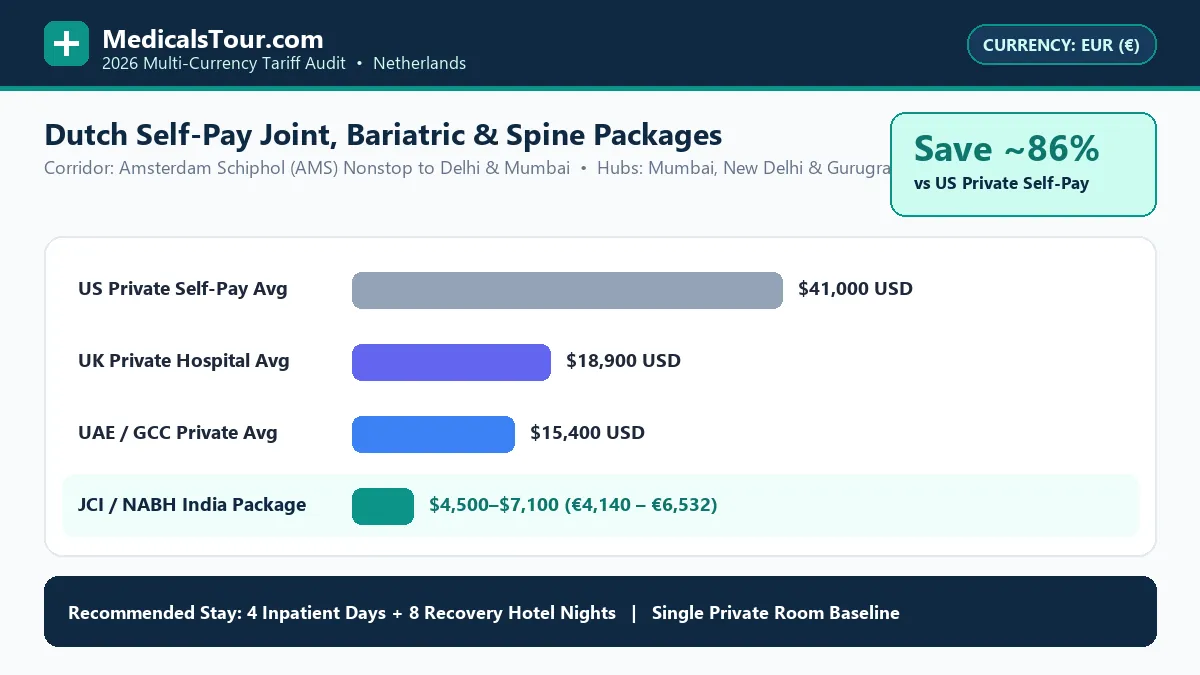
Paying privately outside insurance at a Dutch clinic or academic hospital means absorbing published Dutch DBC passantentarieven that easily exceed €13,000–€22,000. Flagship JCI hospitals in Mumbai and Gurugram quote bundled Single Private Room packages in USD that convert cleanly into Euros (1 USD ≈ €0.92 EUR). Model your exact stay length, companion KLM ticket, and hotel tier inside our Medical Trip Total Budget Planner.
| Surgical Procedure | NL Private Passantentarief (€) | India JCI Package (USD) | India Equivalent in EUR (€) |
|---|---|---|---|
| Stryker Mako Robotic Unilateral Knee Replacement | €13,500 – €17,900 | $4,600 – $6,200 | €4,230 – €5,700 |
| Uncemented Ceramic Total Hip Replacement | €12,800 – €16,800 | $4,800 – $6,600 | €4,420 – €6,070 |
| Laparoscopic Gastric Sleeve (FDA Tri-Staple Cartridges) | €10,900 – €14,200 | $4,700 – $6,100 | €4,320 – €5,610 |
| Roux-en-Y / Mini Gastric Bypass (3 Hosp Nights) | €12,200 – €15,600 | $5,200 – $6,800 | €4,780 – €6,260 |
| Endoscopic Lumbar Microdiscectomy / Stenosis Decompression | €8,900 – €13,400 | $4,500 – $5,800 | €4,140 – €5,340 |
| 1-Level Navigated Spinal Fusion (TLIF) | €17,500 – €24,500 | $5,700 – $7,100 | €5,240 – €6,530 |
All-In Landed EUR Trip Math from Schiphol
To calculate realistic total landed spend, add €280 to €560 ($300–$610) for Day-1 outpatient pre-anesthesia cardiac echo, NABL hematology/viral screening, and 30-day take-home thromboprophylaxis, plus €750 to €1,350 for 8 post-discharge nights in an elevator-equipped four-star recovery hotel (€90–€140/night in Gurugram Sector 44; €120–€175/night in South Mumbai) and KLM nonstop airfare (€780–€1,450 in Economy Comfort). Even fully loaded, a single-traveler robotic knee or hip trip lands around €6,400–€8,800—saving €7,000 to €11,000 below Dutch self-pay rates with zero queue. Just as critically, insist on booking a Standard Single Private Room rather than a luxury Presidential Suite inside the hospital: Indian corporate hospital billing software ties surgeon, anesthesiologist, and operating-room tariffs directly to your chosen ward room tier, so keeping a Standard Single Private Room avoids 25%–35% automatic professional-fee markups while still giving you private en-suite climate control and an attendant sofa-bed.
Why Dutch Patients Pick H.N. Reliance Mumbai and Fortis Gurugram
Because KLM operates daily nonstop widebodies into both Mumbai (BOM) and New Delhi (DEL), Dutch travelers—including tens of thousands of Hindustani Surinamese-Dutch families in The Hague, Rotterdam, and Almere who know Indian metro areas well—can choose between coastal Mumbai and modern Gurugram based on surgical sub-specialty and winter weather.
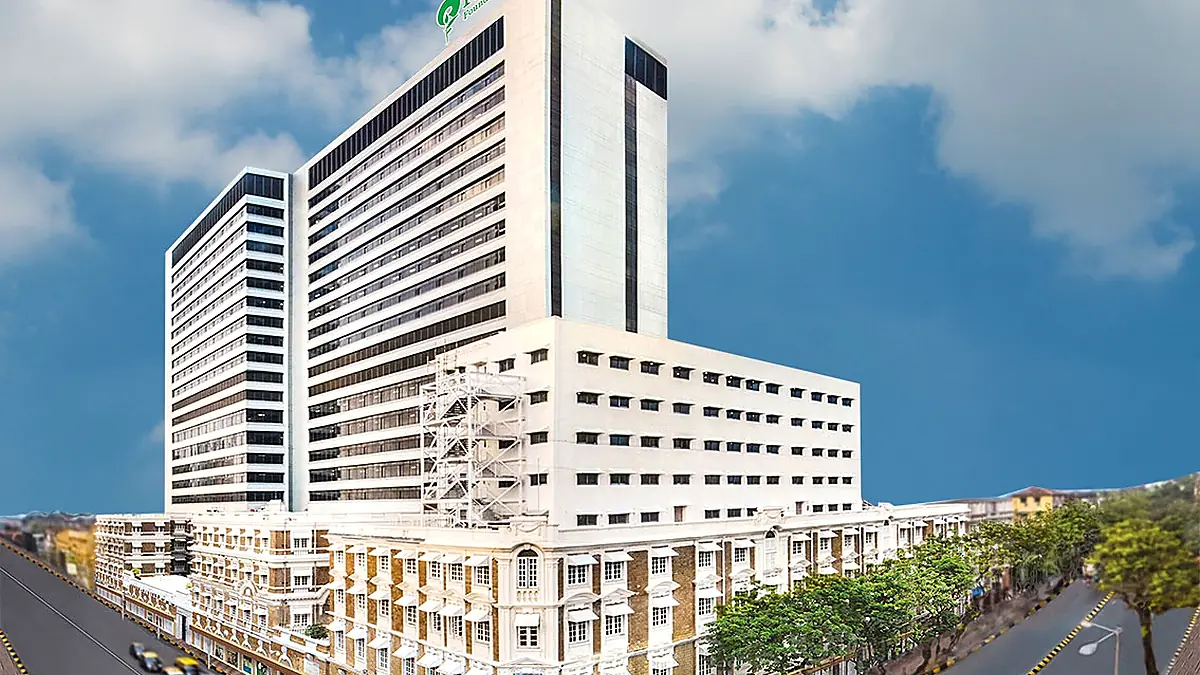
In South Mumbai’s Girgaon district—now a smooth 30-to-40-minute drive from CSMIA Terminal 2 across the Bandra-Worli Sea Link and the signal-free Mumbai Coastal Road—Sir H. N. Reliance Foundation Hospital operates one of Asia’s cleanest LEED-Gold and JCI-accredited quaternary towers. Equipped with ultra-clean laminar-airflow modular operating suites, Mako and Da Vinci robotic platforms, and calm sea-view Single Private rooms ($215–$285/night baseline), Reliance suits Dutch orthopedic and metabolic travelers who appreciate compact vertical hospital navigation, quiet private nursing floors, and dry 27°C–29°C coastal winter sunshine along Marine Drive between November and March. Post-discharge hotels around Nariman Point, Cuffe Parade, and Worli offer step-free lobbies, walk-in shower grab bars, and mild Continental dining within fifteen minutes of outpatient physiotherapy, making daily wound-check visits calm and predictable for older Dutch couples.
For patients landing on KLM KL871 or Air India AI156 at New Delhi IGI Terminal 3, Fortis Memorial Research Institute (FMRI) in Sector 44, Gurugram sits just 17 kilometers southwest down NH-48 (22–30 minutes off-peak), opposite Millennium City Centre Metro Station. Set across an 11-acre landscaped campus surrounded by wide, wheelchair-accessible Sector 44 and Sushant Lok avenues, FMRI excels at bilateral robotic joint arthroplasty, O-Arm navigated spine decompression, and high-acuity bariatric revision surgery backed by 24/7 intensivist-staffed ICUs and international serviced apartments five minutes from the main gate. Accompanying Dutch partners find clean, walkable cafes, Western supermarkets at Galleria Market, high-speed fiber Wi-Fi for remote work in European CET hours (India sits just 3.5 hours ahead of Amsterdam during Dutch summer time and 4.5 hours ahead in winter), and English-speaking concierge pharmacies right across the boulevard.
Robotic Joint Replacement and Bariatric Stapler Standards Audited
Dutch orthopedic and surgical guidelines are anchored by rigorous national registries—most notably the LROI (Landelijke Registratie Orthopedische Interventies), which tracks 10- and 15-year survivorship of every hip and knee prosthesis implanted in the Netherlands. When reviewing Indian surgical quotes through Medical Tour’s hardware audit checklist, verify that your written Proforma Invoice specifies an LROI-documented Class 10A/ODEP-rated Western implant rather than vague “standard imported implant” wording.
LROI-Tracked Implants and Fast-Track ERAS Joint Recovery
Both Sir H.N. Reliance and Fortis Gurugram implant the exact prosthesis families used at Sint Maartenskliniek or Bergman Clinics: Stryker Triathlon (paired with Mako 3D CT haptic robotics), Zimmer Biomet Persona, DePuy Synthes Attune, and uncemented titanium stems with Biolox Delta fourth-generation ceramic femoral heads. Enhanced Recovery After Surgery (ERAS) anesthesia—combining low-dose spinal block, ultrasound-guided adductor-canal sensory nerve block, and intravenous tranexamic acid—gets joint patients standing with a physiotherapist within six hours of theatre without groggy morphine pumps; compare itemized inclusions in our Robotic Knee Replacement Cost Guide and ceramic hip specifications in our Total Hip Replacement Cost Guide. Every surgical theatre runs ISO Class 5 HEPA positive-pressure filtration with SpaceSuit helmet exhaust systems worn by the entire arthroplasty team—matching the strict prosthetic joint infection (under 0.4%) prevention protocols mandated across Dutch orthopedic teaching centers.
Bariatric Stapler Integrity and Long-Term Micronutrient Labs
Metabolic travelers choosing laparoscopic sleeve gastrectomy or mini-gastric bypass in India receive single-patient Medtronic Signia / Tri-Staple or Ethicon Echelon titanium staple cartridges, mandatory intraoperative methylene-blue and endoscopic leak testing, overnight sleep-apnea oximetry, and an English bariatric lab schedule (vitamine B12, foliumzuur, ferritine, vitamine D3, PTH) so your Dutch GP can run routine Month-3, Month-6, and Month-12 blood checks; review full surgical specs in our Gastric Sleeve Surgery Cost Comparison. For lumbar stenosis and herniated disc patients, full-endoscopic transforaminal decompression through an 8-millimeter keyhole preserves paraspinal muscle attachments and posterior ligament complexes, cutting inpatient ward stays to two nights and allowing comfortable upright sitting before the return flight to Amsterdam.
Flying KLM KL871, KL877 and Air India AI156 Direct from Schiphol
Amsterdam Airport Schiphol (AMS) offers Continental Europe’s easiest rail-to-gate medical departure experience: NS Intercity and Intercity Direct trains from Rotterdam Centraal (26 minutes), Utrecht Centraal (30 minutes), The Hague, Eindhoven, and Zwolle pull directly beneath Schiphol Plaza, steps from Departures 2 and 3 check-in desks and Non-Schengen Lounge 52.
| Nonstop Corridor | Flight Codes | Eastbound Duration | Aircraft & Post-Op Seating Notes |
|---|---|---|---|
| Amsterdam (AMS) → Delhi (DEL T3) | KLM KL871 / Air India AI156 | ~7h 50m – 8h 05m | Boeing 787 Dreamliner; 6,000-ft cabin pressure & higher cabin humidity. |
| Amsterdam (AMS) → Mumbai (BOM T2) | KLM KL877 (Daily) | ~8h 15m | Boeing 777/787; late-evening arrival skips daytime Mumbai highway congestion. |
| Return DEL/BOM → Amsterdam (AMS) | KLM KL872 (DEL) / KL878 (BOM) | ~8h 55m – 9h 20m | Pre-book Axxicom Airport Caddy wheelchair escort from aircraft door to NS train/taxi. |
For hip, knee, and lumbar spine patients boarding the 9-hour westbound return flight 10 to 14 days post-surgery, KLM’s separate Premium Comfort Class cabin (38-inch pitch, 7-inch recline, articulated calf/footrest) or World Business Class flat-bed suites dramatically reduce posterior knee swelling and sitting sciatic pressure compared with standard Economy rows. Request free WCHR or WCHS mobility assistance in MijnKLM at least 48 hours prior to departure, wear graduated compression stockings, and walk the Dreamliner aisle every 90 minutes while awake. Keep low-molecular-weight heparin syringes (Fraxiparine or Clexane) and surgical staple-remover clearance notes inside your cabin backpack alongside an original hospital prescription stamped with your surgeon’s registration number so Schiphol and Indian CISF airport security screeners clear medical sharps in seconds. Travelers connecting homeward from Schiphol Plaza onto NS Intercity trains toward Eindhoven, Arnhem, Breda, or Leeuwarden should book NS Reisassistentie at least one hour in advance so station staff bridge the platform-to-train step with a portable ramp for wheeled luggage and crutches.
Huisarts Handover, MRSA Screening Rules in Dutch Ziekenhuizen and Rehab
One clinical compliance rule unique to the Netherlands and Nordic countries surprises unprepared medical travelers every week: strict Dutch national infection-prevention law (SRI / WIP BRMO and MRSA hospital guidelines). Under mandatory Dutch hospital hygiene rules, any person who was admitted overnight (over 24 hours) or underwent an invasive surgical procedure in a hospital outside the Netherlands within the preceding two months is automatically flagged as MRSA / BRMO Category 2 upon entering any Dutch ziekenhuis or hospital-based outpatient clinic.
Navigating this protocol smoothly with your Dutch huisarts (GP) and neighborhood physical therapist requires zero stress if you follow a simple three-step checklist:
- Brief Your Huisarts & Apotheek Before Leaving: Pick up a printed English Actueel Medicatie Overzicht (AMO) from your local Dutch pharmacy before flying so Indian anesthetists see exact blood-thinner or blood-pressure doses, and let your GP know your planned return date so the doktersassistente can book a painless throat/nasal/rectal MRSA & BRMO PCR swab 48 hours after you land back at Schiphol.
- Pre-Book Eerstelijns Fysiotherapie in Your Neighbourhood: Independent community physiotherapy practices (eerstelijns fysiotherapiepraktijken) do not require hospital isolation rooms; handing your local physiotherapist your Indian surgeon’s English week-by-week rehab protocol and cloud DICOM post-op X-rays lets outpatient strengthening start immediately without waiting on hospital polyclinics. (Note: if you hold an aanvullende verzekering covering 12–36 physio sessions, bring your surgical discharge summary so chronic lijst Borst coding after joint arthroplasty is registered properly from session 21 onward under basic Zvw rules.)
- Keep Original Implant Barcodes & NABL Culture Reports: Store your signed operative note, peel-off LROI-compatible implant LOT stickers, and pre-discharge wound inspection sheet in both PDF and paper folders.
Dutch bariatric patients returning to Rotterdam, Utrecht, or Groningen should similarly share their English surgical gastric-volume note and daily proton-pump inhibitor (omeprazol or pantoprazol for 90 days) prescription with their huisarts so lifelong annual metabolic blood panels are logged in their local GP portal (MijnGezondheid.net or Uw Zorg Online). Salaried employees covered by Dutch Arbowet occupational health rules can also forward the typed English hospital surgical certificate directly to their company bedrijfsarts so phased return-to-work milestones (re-integratieplan) align smoothly with orthopedic weight-bearing or post-laparoscopic lifting limits.
Dutch Passport e-Medical Visas, ING/Rabobank SWIFT Wires and Box 1 Tax Rules
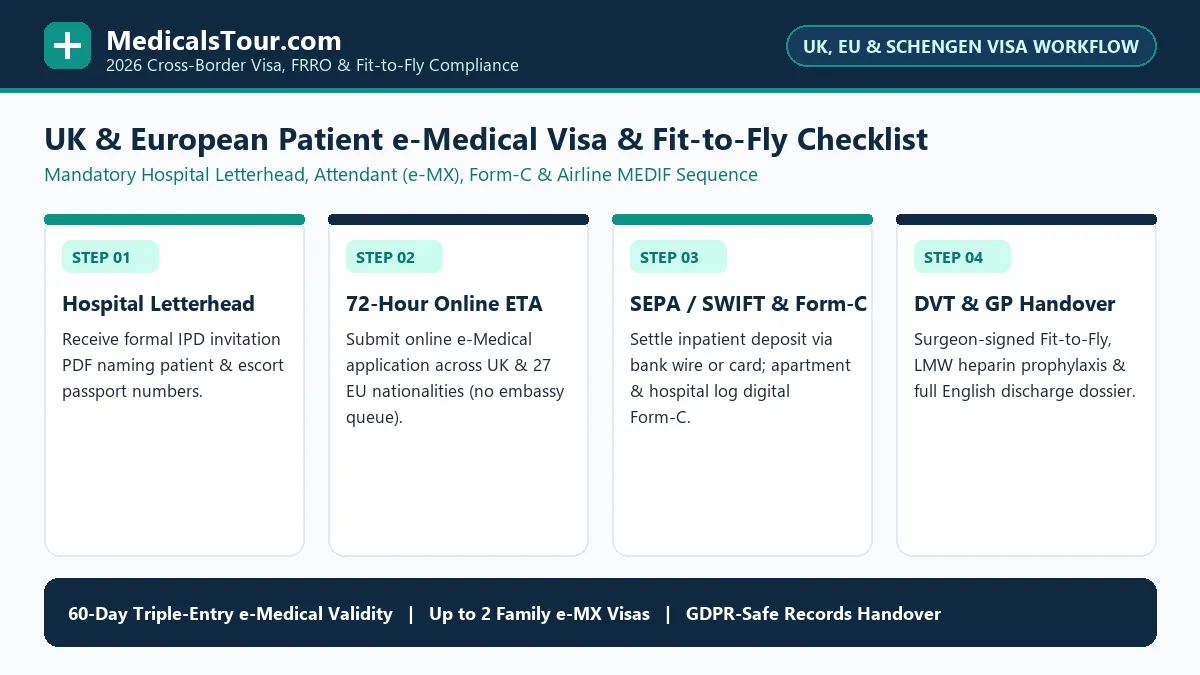
Dutch passport holders apply online for India’s 60-day triple-entry e-Medical Visa (indianvisaonline.gov.in) once Sir H.N. Reliance or Fortis Gurugram emails an official stamped Visa Invitation Letter, with approval typically landing in 48 to 72 hours. Hindustani Surinamese-Dutch travelers holding a valid OCI (Overseas Citizen of India) booklet can travel directly on their lifelong OCI card without filing an e-Medical Visa, while still pre-registering with the hospital’s International Patient Desk to lock in bundled USD/EUR tariffs; browse European comparison guides on our International Medical Corridors Hub.
ING, Rabobank & ABN AMRO Banking Settings Plus Belastingdienst Tax Rules
- Switch On Betalen Buiten Europa: Mobile banking apps at ING, Rabobank, ABN AMRO, andASN Bank block non-European debit/credit POS transactions by default (Werelddekking uit). Activate Asia/Worldwide card usage before boarding at Schiphol, and send your main surgical deposit via SWIFT international transfer (Wereldbetaling) 4 business days ahead of admission using OUR charge coding—or compare multi-currency Wise FX spreads against traditional bank 1.8% exchange markups using our Hospital Forex, SWIFT Wire & Billing Guide.
- Belastingdienst Box 1 Specifieke Zorgkosten: Un-reimbursed surgery and hospital care prescribed on medical grounds and performed by a qualified physician abroad can be entered under specifieke zorgkosten on your annual Dutch income tax return (aangifte inkomstenbelasting) above your income-dependent threshold (drempelbedrag). Keep itemized English hospital invoices and bank wire proofs; note that Dutch tax law excludes companion travel, tourist dining, and hotel accommodation from deduction.
- Pre-Flight Discharge Clearance & Complication Cover: Collect your signed Fit-to-Fly Medical Certificate during your final outpatient review 48 hours before KLM check-in. Also remember that standard Dutch annual continuous holiday policies (doorlopende reisverzekering from ANWB, Univé, Interpolis, or Centraal Beheer) cover lost baggage or unforeseen accidents—not elective medical trips—so purchase a dedicated medical-travel surgical complication policy if you want extra post-op hotel-extension protection.
Finally, if your recovery stay in South Mumbai or Gurugram uses a private serviced apartment rather than a commercial hotel chain, verify before check-in that the property manager submits your digital Bureau of Immigration Form-C arrival record within 24 hours. Keeping a screenshot of that Form-C confirmation alongside your zero-balance hospital receipt ensures frictionless exit immigration at Mumbai Terminal 2 or New Delhi Terminal 3 when boarding your KLM flight back to Schiphol.