On weekday mornings along Chandragupta Marg and Shantipath in Chanakyapuri—New Delhi’s leafy diplomatic enclave—hospital liaison cars pull up outside the embassies of Saudi Arabia, the United Arab Emirates, the Sultanate of Oman, Kuwait, and Qatar carrying thick leather-bound folders of notarized Arabic civil registries. Inside each folder sits the legal key to a life-saving solid-organ transplant: original birth records, marriage deeds, four-generation family trees, and HLA kinship reports waiting for diplomatic attestation under India’s statutory Form-21 protocol. For families across the Gulf facing end-stage liver cirrhosis, hepatocellular carcinoma within transplant criteria, or dialysis-dependent renal failure, understanding that diplomatic paperwork is every bit as decisive as choosing the right microsurgical team.
Gulf medical boards and private households refer hundreds of living-donor liver and kidney cases to Gurugram, New Delhi, and Chennai each year for a straightforward clinical reason: high-volume Indian transplant institutes perform 200 to 350 living-related hepatectomies and nephrectomies per center annually, posting >92% one-year graft survival while charging $14,500 to $35,500 USD—compared with $90,000 to $320,000 across Western self-pay programs where deceased-donor waitlists remain closed to non-residents. Yet Medical Tour’s 2026 transplant audit shows that nearly one in three Arab families loses ten unnecessary hotel days after landing simply because Arabic-to-English passport name transliterations or missing Ministry of Foreign Affairs stamps stall Authorization Committee clearance.
This step-by-step legal, clinical, and financial playbook explains India’s Transplantation of Human Organs and Tissues Act (THOA) rules for GCC nationals and expatriates, Chanakyapuri Embassy NOC procedures, donor fatty-liver screening traps, and full six-to-eight-week apartment recovery budgets.
India’s THOA Law Explained: Who Can Legally Donate to a GCC or Arab Patient?
Before booking flights from Riyadh, Jeddah, Dubai, Abu Dhabi, Muscat, Doha, Kuwait City, or Manama, every family must understand two non-negotiable pillars of Indian federal law under the Transplantation of Human Organs and Tissues Act (THOA, 1994, amended 2011 and Rules 2014). First, foreign nationals visiting on a Medical Visa are functionally ineligible to receive deceased-donor (cadaveric brain-dead) organs ahead of waitlisted Indian citizens; waiting months in an Indian apartment hoping for a cadaveric liver or kidney allocation is practically futile. Second, bringing an unrelated paid donor—such as a domestic worker, driver, distant acquaintance, or broker-recruited stranger—is a serious criminal felony under Indian law that triggers immediate hospital rejection and deportation.
Every lawful international liver or kidney transplant in India operates strictly on a Living-Related Donor basis. Indian transplant rules divide eligible family donors into two scrutiny tiers:
- Tier 1 — “Near Relatives” (Fastest Statutory Path): Biological mother, father, adult son, adult daughter, brother, sister, spouse, grandmother, grandfather, or adult grandchild aged between 18 and 50–55 years. Near-relative files backed by unimpeachable civil records, NABL-accredited DNA STR profiling, and an Embassy Form-21 NOC move smoothly through the hospital or state Authorization Committee within 7 to 12 working days.
- Tier 2 — Second-Degree Blood Relatives (Enhanced Committee Scrutiny): Biological uncle, aunt, nephew, niece, or first cousin. While legally permissible when no Tier-1 relative is medically fit or ABO-compatible, second-degree donors undergo far deeper financial, historical, and photographic scrutiny by the Government Authorization Committee to verify genuine lifelong family affection and zero commercial inducement—adding 5 to 10 extra administrative days.
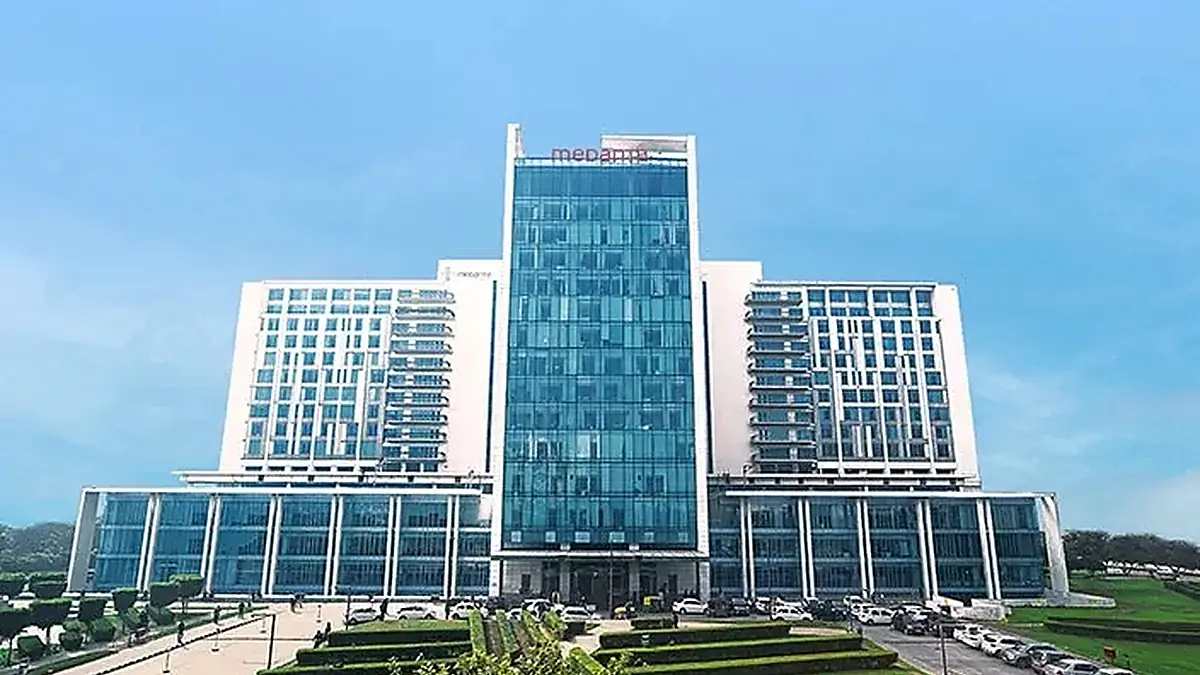
What if a willing son, wife, or brother has an incompatible blood group (for example, Donor A+ into Recipient O+)? Both Medanta – The Medicity in Sector 38, Gurugram and Gleneagles HealthCity on OMR in Perumbakkam, Chennai run specialized ABO-Incompatible (ABOi) Kidney and Liver Transplant protocols using pre-transplant rituximab B-cell depletion and immunoadsorption/plasmapheresis columns—or lawful Paired Kidney Exchange (Swap Transplant) between two approved near-relative pairs.
Equally important for high-acuity hepatic referrals arriving from Riyadh, Jeddah, Muscat, or Kuwait City is simultaneous dual-organ capability. Patients whose long-standing diabetic nephropathy and MASH cirrhosis have destroyed both liver and renal filtration—or children with primary hyperoxaluria type 1—require Combined Liver-Kidney Transplantation (CLKT) under a single surgical session, a benchmark restricted to high-volume quaternary campuses where dedicated hepatobiliary and renal microsurgical teams operate in adjacent twin rooms.
Donor surgical comfort has advanced dramatically as well. Across leading Chennai and Gurugram centers, nearly all living kidney donor nephrectomies and an expanding share of right-lobe donor hepatectomies utilize 3D-laparoscopic or robotic-assisted minimal-access incisions rather than traditional wide subcostal cuts, reducing post-operative analgesic requirements and getting healthy family donors walking unassisted by the following afternoon.

Chanakyapuri Embassy NOC & THOA Form-21: Fixing Arabic Patronymic Name Mismatches
Under Rule 20 of the THOA Rules, no Indian hospital may wheel a foreign donor and foreign recipient into the operating room without an original Form-21 Certificate signed and sealed by a senior diplomat at the patient’s home embassy or high commission in India. That certificate attests two facts on official diplomatic stationery: that the civil relationship between donor and recipient is authentic under home-country records, and that the embassy has no objection to the surgery taking place in India.
Notice the geographic detail that catches Chennai- and Mumbai-bound Gulf families off guard: while several GCC states maintain consulates in Mumbai, many embassies issue statutory THOA Form-21 clearances exclusively through their federal diplomatic missions or Health Attaché offices in Chanakyapuri, New Delhi (including the Royal Embassy of Saudi Arabia, UAE Embassy, Embassy of the Sultanate of Oman, Kuwait Embassy, and Embassy of Qatar). Experienced transplant coordinators in Chennai and Gurugram manage courier or in-person verification workflows directly with New Delhi diplomatic desks, provided your pre-departure paperwork from home is airtight.
Pre-Departure Attestation Checklist Before Leaving the Gulf
- Official Family Registry Extract: Obtain your Saudi Absher / Ahwal Madaniya family print, Emirati Khulasat Al-Qaid, Omani Royal Oman Police civil birth/marriage extract, Kuwaiti PACI family record, or Qatari/Bahraini civil certificate—plus notarized English translations attested by your home Ministry of Foreign Affairs (MOFA).
- Resolving Four-Part Arabic Name Transliteration Gaps: Arabic passports frequently spell the same grandfather or tribal surname three different ways in English across siblings (for instance, Sulaiman vs Suleiman, or Al-Balushi vs Alblooshi). Before flying, obtain a notarized MOFA-attested “One and the Same Person / Lineage Affidavit” linking exact National ID numbers across donor and recipient passports so the Authorization Committee never questions paternity.
- Spousal Donors & Historical Family Proof: When a wife donates to her husband (or vice versa), pack your original attested marriage contract, wedding photographs, and birth certificates of shared children—committees routinely inspect multi-year proof of marriage to rule out sham marriages arranged for organ procurement.
Expatriate residents living in Dubai, Abu Dhabi, Riyadh, Jeddah, Doha, or Muscat on work residencies (for example, a Jordanian, Egyptian, Pakistani, Lebanese, or Sudanese family holding UAE Residence Visas or Saudi Iqamas) must note which embassy issues their Form-21 NOC in New Delhi: the certificate always comes from the embassy of the patient’s and donor’s passport nationality in Chanakyapuri, not the embassy of the GCC host country where you work. Have civil birth and marriage certificates attested by your passport country’s Ministry of Foreign Affairs ahead of travel so your national embassy in New Delhi stamps Form-21 inside 48 to 72 hours.
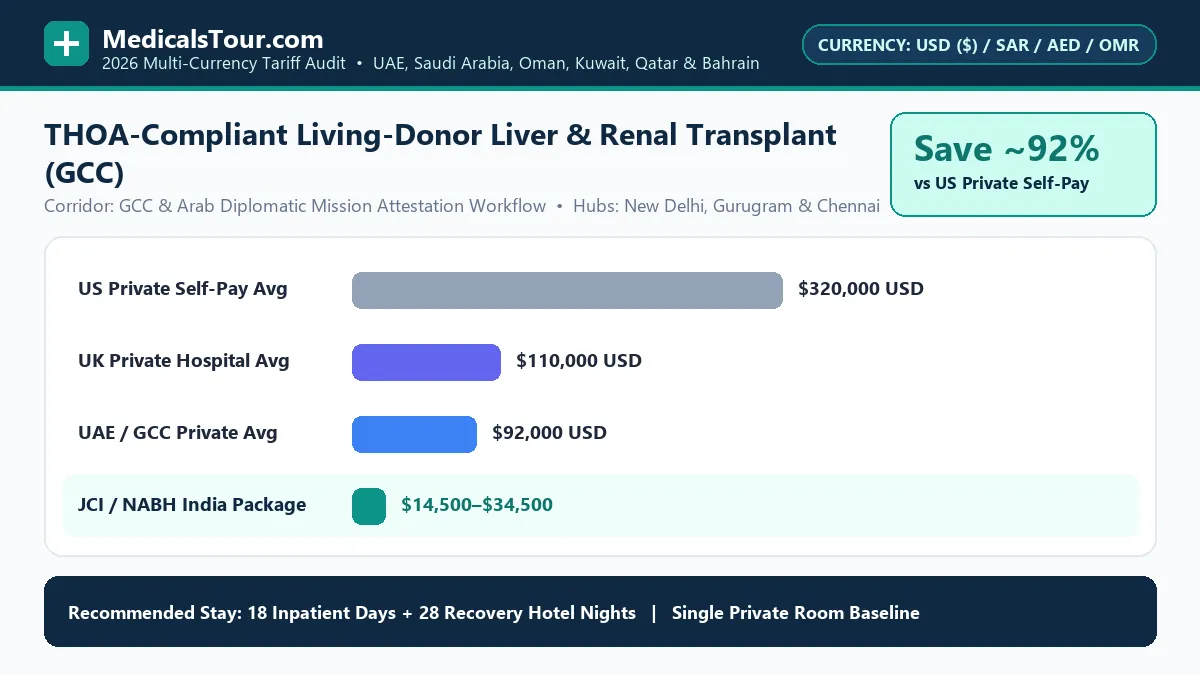
2026 Living-Donor Liver & Kidney Package Tariffs in USD, SAR, AED & OMR
Transplant billing in India splits cleanly into Stage 1 (Outpatient Pre-Transplant Recipient & Donor Evaluation) and Stage 2 (Inpatient Dual-Team Surgical Transplant Package). Separating the two protects your wallet: you never pay the surgical transplant deposit until your donor clears CT volumetry, cardiac stress testing, viral serology, and Authorization Committee approval.
| Transplant Stage / Clinical Bundle | India JCI Tariff (USD) | Approx. Gulf Equivalent (SAR / AED / OMR) | Included Inpatient & Clinical Scope |
|---|---|---|---|
| Stage 1: Kidney Recipient + Donor Workup & HLA/DNA | $1,400 – $2,200 | 5,250 SAR / 5,140 AED / 540 OMR | CT renal angiogram, DTPA nuclear GFR, Luminex DSA/HLA cross-match, NABL DNA kinship & notary file prep. |
| Stage 2: Living-Donor Kidney Transplant (ABO-Compatible) | $13,800 – $17,200 | 51,750 SAR / 50,680 AED / 5,310 OMR | 3D laparoscopic donor nephrectomy (4–5 days) + recipient renal ICU/ward (10–12 days), surgeon & OR charges. |
| ABO-Incompatible Kidney Desensitization Add-On | +$4,800 – $7,200 | +18,000 SAR / 17,630 AED / 1,850 OMR | Rituximab infusion, 2–4 plasmapheresis / Glycosorb immunoadsorption sessions & anti-A/B titer monitoring. |
| Stage 1: Liver Recipient + Donor Workup (CT Volumetry/MRCP) | $2,200 – $3,400 | 8,250 SAR / 8,080 AED / 845 OMR | Triphasic liver CT graft-to-recipient weight ratio, biliary MRCP, FibroScan, cardio-pulmonary & DNA tests. |
| Stage 2: Adult Living-Donor Right-Lobe Liver Transplant | $28,500 – $35,500 | 106,875 SAR / 104,680 AED / 10,970 OMR | Dual-OR simultaneous donor hepatectomy (7–9 days) + recipient Liver ICU & Single Private stay (18–21 days). |
| Pediatric Living-Donor Left-Lateral Liver Transplant | $29,000 – $36,500 | 108,750 SAR / 106,500 AED / 11,160 OMR | Microsurgical biliary/arterial reconstruction for biliary atresia or metabolic liver failure; dedicated PICU. |
Account explicitly for three non-package medications and diagnostics when building your family wire amount: Induction Immunosuppression on Day 0/Day 4 for renal transplants (Basiliximab Simulect or Rabbit ATG Thymoglobulin adds $1,500–$2,800), pre-transplant oncology or cardiac clearance scans such as whole-body FDG PET-CT for hepatocellular carcinoma staging (see our PET-CT & Oncology Cost Guide) or coronary angiography/dobutamine echo (compare baselines in our Cardiac Care Cost Guide), and a $3,500–$6,000 ICU contingency buffer for high-MELD (>25) liver patients who may require continuous renal replacement therapy (CRRT), high-dose human albumin, or Hepatitis B immunoglobulin (HBIG).
Why 1 in 5 Prospective Gulf Liver Donors Gets Rejected on Day 3 (And How to Pre-Screen)
Ask any senior hepatobiliary surgeon in Gurugram or Chennai what derails Middle East transplant timelines fastest, and the answer is never surgical technique—it is unsuspected donor fatty liver (hepatic steatosis) discovered after the family has already landed in India. Across the GCC, sedentary office lifestyles and insulin resistance mean that seemingly healthy 29-year-old sons or brothers with a BMI of 29 frequently harbor 25% to 35% macrovesicular fat inside their liver parenchyma.
Transplanting a fatty right lobe endangers both lives: the donor’s remaining 35% left-liver remnant regenerates sluggishly, while the recipient risks catastrophic primary non-function. Ethical JCI transplant boards in India enforce an ironclad safety rule—donors must typically demonstrate less than 10% to 15% hepatic steatosis, normal liver enzymes, a remnant liver volume strictly above 30%–35% on 3D CT volumetry, and a Graft-to-Recipient Weight Ratio (GRWR) of at least 0.8%.
Protect your schedule before buying business-class tickets from Riyadh, Dubai, or Muscat by running a simple $250 Home Pre-Screening on your intended donor (and ideally one backup sibling or adult child):
- ABO Blood Group + Fasting Metabolic Panel: HbA1c, lipid profile, AST/ALT/GGT/bilirubin, serum creatinine, and viral serology (HBsAg, Anti-HCV, HIV).
- FibroScan with CAP Score + Non-Contrast Liver-Spleen CT Attenuation Ratio: A Controlled Attenuation Parameter (CAP) score under 248 dB/m and a liver-minus-spleen CT Hounsfield index confirming crisp, fat-free parenchyma give 90% confidence that your donor will pass Stage-1 workup in India—or allow 4 to 6 weeks of supervised high-protein weight loss before flying if borderline mild steatosis (15%–20%) is spotted early.
Prospective kidney donors undergo a parallel anatomical reality check before travel. In addition to clean blood pressure (<130/80 mmHg without multiple antihypertensives), normal HbA1c (<6.0%—active diabetes permanently disqualifies living renal donation), and zero proteinuria on a 24-hour urine collection, CT renal angiography in India maps whether the donor’s left and right kidneys carry single or multiple renal arteries and evaluates split glomerular filtration rate via nuclear DTPA scan so the healthier kidney always remains inside the donor.
Week-by-Week 45-to-60-Day Timeline: Visa Class, Donor Recovery & Committee Video
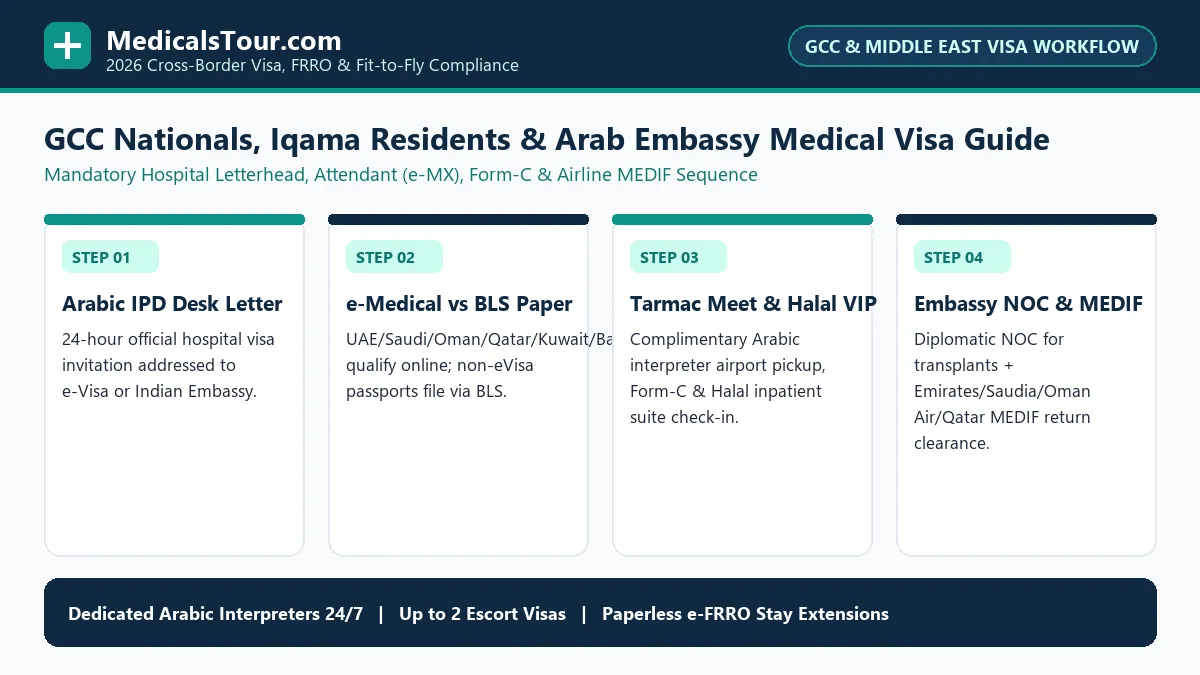
Never attempt to squeeze a solid-organ transplant into a 30-day schedule. Just as important, ensure the primary patient, the living donor, and one non-surgical family caregiver (vital because during Surgery Week both patient and donor are hospitalized simultaneously!) travel on proper Medical / Medical Attendant Visas—Indian hospitals are legally barred from performing organ transplants on Tourist Visas. If your initial e-Medical Visa carries 60-day validity, your hospital desk initiates timely online extension paperwork around Day 42; review exact portal steps in our FRRO Medical Visa Extension & Registration Guide.
| Transplant Phase | Calendar Window | Key Clinical, Legal & Family Caregiver Milestones |
|---|---|---|
| Outpatient Evaluation & Legal File | Days 1 – 12 | Donor/recipient CT, MRCP, cardiac/psychiatry sign-offs, NABL DNA kinship test, Chanakyapuri Embassy Form-21 NOC & video-recorded Authorization Committee approval. |
| Dual Surgery & Transplant ICU | Days 13 – 22 | 10–14 hour synchronized liver transplant (or 4-hour laparoscopic renal transplant); donor discharged around Day 18 (kidney) or Day 21 (liver) to nearby sanitized apartment. |
| Recipient Step-Down & Discharge | Days 23 – 32 | Surgical drains & Foley/stent checks; daily tacrolimus FK506 blood trough calibration, steroid taper & inpatient spirometry/physiotherapy. |
| Sanitized Apartment Outpatient Phase | Days 33 – 52 | Twice-weekly clinic labs (CBC, LFT/RFT, CMV PCR, tacrolimus trough), DJ ureteric stent cystoscopic removal (kidney Week 3–4) & donor regeneration clearance. |
Understanding what happens inside the mandatory Authorization Committee interview removes unnecessary apprehension for Gulf families. Under statutory transparency mandates, the committee session is video-recorded from start to finish in the presence of independent government/medical members and a certified hospital Arabic interpreter. Both donor and recipient are interviewed separately and together to confirm that the donor understands surgical risks, holds verifiable biological or spousal kinship, and acts out of pure familial goodwill without coercion or financial compensation.

Infection-Controlled Apartments in Gurugram & Chennai OMR + SWIFT Escrow Rules
During the three weeks immediately following hospital discharge, high-dose triple immunosuppression (tacrolimus, mycophenolate mofetil, and prednisolone) blunts cellular immunity deliberately to prevent acute rejection. Staying inside a crowded tourist hotel where central buffet dining, damp carpets, or street dust expose the recipient to Aspergillus spores or foodborne Salmonella invites preventable readmission.
Instead, transplant families at Medanta Gurugram or Gleneagles HealthCity on Chennai’s Old Mahabalipuram Road (OMR) rent single-family 2BHK or 3BHK serviced apartments ($55–$120/night) featuring hard vitrified-tile floors (wet-mopped daily with hospital-grade disinfectant), split AC units with freshly washed filters, a private bedroom with attached bathroom reserved exclusively for the transplant recipient, and an induction kitchen where the third family caregiver cooks thoroughly boiled, peeled, piping-hot halal meals using sealed bottled water.
Strict dietary discipline during Days 25 through 60 protects both drug metabolism and mucosal immunity: transplant recipients must completely avoid grapefruit, pomelo, pomegranate, and Seville bitter oranges—all of which inhibit intestinal CYP3A4 enzymes and spike blood tacrolimus levels into acute kidney-toxic ranges overnight—alongside raw salads, unpasteurized dairy, and reheated restaurant rice.
For financial settlement of $18,000 to $40,000 transplant budgets, initiate outbound SWIFT transfers directly from Saudi National Bank, Al Rajhi, Emirates NBD, First Abu Dhabi Bank, Bank Muscat, NBK, or QNB into the hospital’s official corporate account 4 to 5 business days before scheduled surgery once the Authorization Committee signs clearance. Hospitals freeze operating theatre booking slots until cleared funds reflect in their RBI-regulated ledger; inspect wire reference rules in our Hospital Forex & SWIFT Wire Billing Guide.
Tacrolimus Brand Consistency & Handing Care Back to Riyadh, Dubai or Muscat
One pharmacology rule must be tattooed onto every transplant family’s discharge binder: never switch generic or originator brands of Tacrolimus (Prograf / Pangraf / Envarsus) without 72-hour blood-trough re-testing. Because tacrolimus has a narrow therapeutic window (typically 8–10 ng/mL in Month 1–3, avoiding nephrotoxicity above 12 ng/mL and rejection below 6 ng/mL), minor bioavailability shifts between manufacturers can destabilize a fresh graft.
Before flying home from DEL or MAA:
- Stock 90 Days of Exact Hospital-Dispensed Immunosuppressants: Purchase sealed boxes of tacrolimus, mycophenolate, valganciclovir (Valcyte prophylaxis), trimethoprim-sulfamethoxazole, and ursodeoxycholic acid from the hospital pharmacy, accompanied by a stamped customs medical certificate and itemized GST invoice.
- Verify Brand Availability at Home: Ask your home transplant hepatologist or nephrologist at King Faisal Specialist Hospital, Cleveland Clinic Abu Dhabi, Royal Hospital Muscat, or Hamad Medical Corporation which exact tacrolimus formulation their outpatient pharmacy dispenses so transition labs are drawn 4 days after any future brand crossover.
- Donor Post-Return Wellness Check: Living liver donors regenerate roughly 80% to 90% of baseline hepatic volume within 6 to 8 weeks while avoiding heavy lifting (>5 kg) for three months to prevent incisional hernia; living kidney donors check annual serum creatinine, urine microalbumin, and blood pressure back home while living completely normal, unrestricted lifespans.
Using Medical Tour’s cross-border transplant checklist, Arab families routinely maintain 90-day WhatsApp lab-charting links directly with their Indian transplant coordinator at zero extra fee. Compare all Gulf healthcare pathways on our Medical Corridors Hub and calculate multi-week 2BHK apartment, donor flight, and contingency reserves inside our Medical Trip Budget Planner.