Across all 27 European Union Member States, EEA countries, and post-Brexit Britain, patients stuck on nine-month domestic surgical waiting lists almost always start with the same hopeful question: “Doesn’t European cross-border law force my national health fund to pay for immediate private surgery in another EU country?” On paper, two separate European legal instruments govern planned cross-border treatment inside Europe—Regulation (EC) No 883/2004 (Portable Document S2) and Directive 2011/24/EU on Patients’ Rights in Cross-Border Healthcare. In everyday practice across 2026, prior-authorization vetoes, public-sector-only restrictions, and painful reimbursement shortfalls leave thousands of European households holding unexpected five-figure private hospital bills.
When a patient in Ireland, Germany, the Netherlands, Sweden, France, Poland, or Italy discovers that their home insurer either denies overnight cross-border prior authorization or reimburses only €3,800 of an €18,500 intra-European private clinic invoice six months after surgery, a counter-intuitive financial truth emerges: stepping completely outside the EU bureaucratic maze into a JCI-accredited quaternary hospital in Mumbai, Gurugram, New Delhi, or Chennai on a 100% transparent €3,860 to €7,540 ($4,200–$8,200 USD) self-pay package frequently costs less net cash out of pocket—with operating-theatre dates confirmed inside ten days and zero insurer permission slips.
Compiled by Medical Tour’s regulatory and hospital-finance desk, this pan-European reference audit compares EU S2 and Directive 2011/24/EU mechanics line-by-line against Indian self-pay surgical bundles, clarifies lawful GDPR clinical record exports under Articles 15 and 49, explains why European SEPA IBAN wires stop at the Schengen/EEA banking border, and sets out practical protocols for medical-complication insurance and domestic European GP follow-up. Before signing an €18,000 promissory form at a private clinic across a European border hoping your statutory insurer will reimburse most of it later, review every legal threshold and currency safeguard below.
EU Portable Document S2 vs Directive 2011/24/EU vs Self-Pay in India
To make a sound legal and financial decision, European households must first separate the two intra-EU statutory pathways from non-EU private care—because patients routinely conflate them and lose thousands of Euros when claims are rejected retroactively:
- Route A — Portable Document S2 (Regulation 883/2004, EU/EEA + Switzerland + UK reciprocal S2): Covers state-contracted public hospital care only in another European state with direct state-to-state billing settlement. The Catch: Requires mandatory prior authorization before you travel, granted only if your domestic health fund certifies you face “medically unjustifiable delay” based on objective clinical deterioration rather than missed national waiting-time targets—and private clinics, robotic surcharges, and private consultant honoraria are excluded!
- Route B — EU Cross-Border Healthcare Directive (Directive 2011/24/EU, EU/EEA only — UK excluded post-Brexit!): Allows treatment at private EU clinics, but you pay 100% of the clinic bill upfront (€14,000–€26,000), almost all EU Member States enforce mandatory prior authorization under Article 8(2) for any surgery requiring at least one overnight hospital stay, and your home insurer reimburses only up to what your domestic public DRG tariff would have cost—never flights, hotels, companion stays, or private surgeon markups!
- Route C — Non-EU Self-Pay at Indian JCI/NABH Quaternary Hospitals: Zero EU statutory reimbursement applies (aside from domestic income-tax deductions available worldwide in Ireland at 20%, Italy at 19%, Germany/Austria under § 33/34 EStG, Netherlands Box 1, Switzerland, and Portugal), yet the entire Single Private surgical package costs €3,860–€7,540 upfront with 10-day scheduling and zero prior-authorization denial risk.
| Decision Factor | EU S2 Form (State Care) | EU Directive 2011/24/EU | India JCI Self-Pay Package |
|---|---|---|---|
| Prior Insurer Authorization Needed? | Mandatory (strictly vetted) | Mandatory if ≥1 hosp night | None — direct surgeon booking |
| Private Hospitals & Robotic Suites Eligible? | No (public/state sector only) | Yes (upfront full self-pay) | Yes — JCI/NABH Single Private |
| Typical Time to Operating Theatre | 3 – 9 months (paperwork + queue) | 6 – 14 weeks (prior auth wait) | 10 – 14 days incl. e-Medical Visa |
| Upfront Cash Outlay (e.g. Robotic Knee/Hip) | Co-pays + travel (€1,500–€2,500) | €14,500 – €21,000 upfront | €4,230 – €6,070 surgical bundle |
| Unreimbursed Net Cost Risk to Patient | Low if approved; high rejection rate | €5,000–€12,000 gap (100% if auth denied!) | Fixed written cap before flying |
2026 Real Out-of-Pocket EUR Math Across Major Surgical Procedures
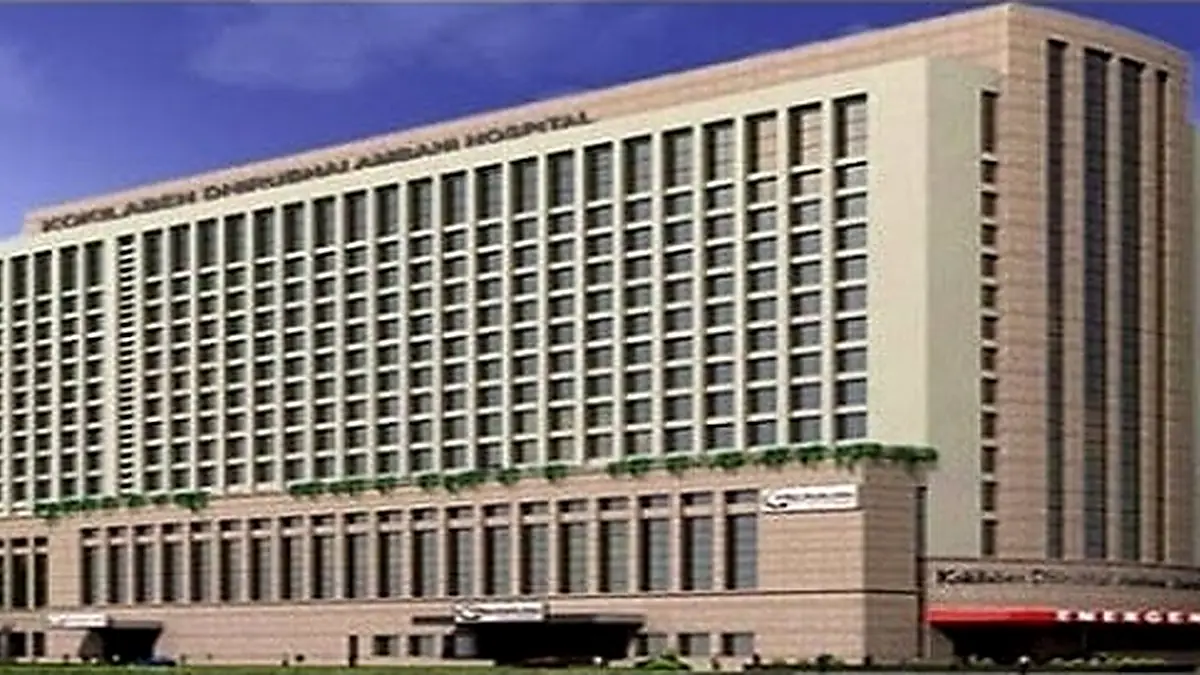
Look closely at why Directive 2011/24/EU catches European self-payers off guard: if a patient from Poland, Hungary, Spain, or France pays €17,500 privately in Munich, Vienna, or Brussels for a navigated spinal fusion whose domestic public DRG tariff back home is only €4,200—or if overnight prior authorization was refused because a local hospital offered a slot eight months away—the patient remains €13,300 to €17,500 out of pocket. Compare true self-pay package benchmarks (1 USD ≈ €0.92 EUR) across India’s flagship hubs and run your own flight-and-hotel numbers inside our Medical Trip Total Budget Planner.
| Quaternary Procedure (Single Private Room) | Western EU Private Clinic (€) | Central EU Private Clinic (€) | India JCI Hospital Bundle (€) |
|---|---|---|---|
| Stryker Mako Robotic Knee / Ceramic Hip | €14,500 – €22,000 | €8,900 – €13,500 | €4,230 – €6,070 ($4,600–$6,600) |
| 1-Level O-Arm Navigated Spinal Fusion (TLIF) | €19,000 – €31,000 | €11,500 – €16,800 | €5,150 – €6,990 ($5,600–$7,600) |
| Off-Pump Beating-Heart CABG Bypass (7 Days) | €25,000 – €42,000 | €16,500 – €24,000 | €4,970 – €6,810 ($5,400–$7,400) |
| Da Vinci Xi Nerve-Sparing Prostatectomy | €19,500 – €29,500 | €13,500 – €18,500 | €5,700 – €7,540 ($6,200–$8,200) |
| All-on-4 Straumann Zirconia Arch (Zero EU S2 Cover) | €13,500 – €24,000 | €7,800 – €11,900 | €3,860 – €5,890 ($4,200–$6,400) |
Cross-check detailed implant and ICU inclusions in our Robotic Knee Replacement Cost Guide and Heart Bypass (CABG) Cost Guide, and always select a Standard Single Private Room rather than a Presidential Suite to avoid 20%–35% hospital room-tier multipliers on surgeon fees. Even when adding €280–€560 for Day-1 outpatient pre-anesthesia diagnostics, €900–€1,450 for 8 to 10 four-star recovery hotel nights in Mumbai or Gurugram, and nonstop widebody airfare from Frankfurt, Paris, Amsterdam, Zurich, Milan, Rome, Warsaw, Copenhagen, or London, total landed cash outlay routinely finishes €6,000 to €18,000 lower than un-reimbursed intra-EU private hospital invoices—with zero six-month bureaucratic wait to learn whether your national health fund rejected a coding line.
Quaternary Governance: Kokilaben Mumbai, Medanta Gurugram and JCI vs EU Standards
European patients comparing intra-EU clinics against India should recognize an overlooked regulatory fact: the European Union has no unified pan-European hospital clinical accreditation seal—each Member State licenses clinics under varying national health-ministry rules, which is why small commercial cosmetic, bariatric, or dental clinics in parts of Europe operate without intensive-care units, on-site blood banks, or 24/7 resident intensivists. By contrast, India’s leading international referral centres submit voluntarily to triennial Joint Commission International (JCI Gold Seal, 8th Edition) audits alongside India’s rigorous NABH and NABL (ISO 15189) laboratory standards; see how each indicator is scored in our JCI vs NABH Hospital Accreditation Guide.
Two benchmark institutions illustrate why European self-payers choose flagship Indian quaternary campuses over smaller intra-EU commercial clinics:
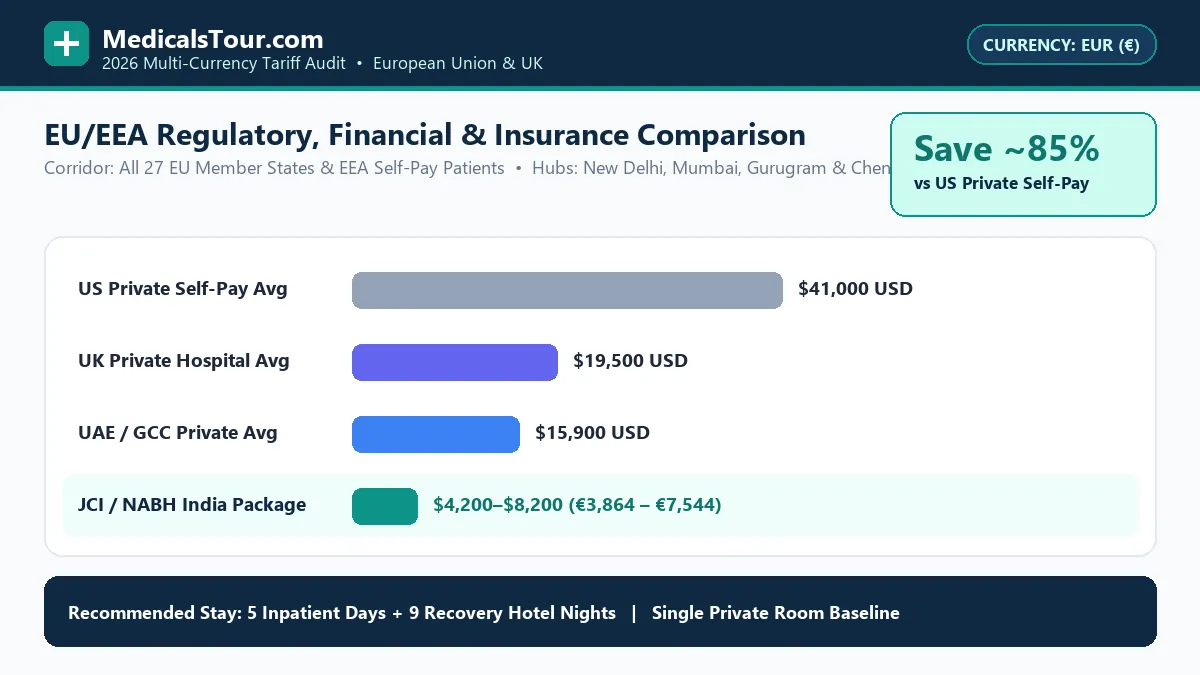
- Western Gateway — Kokilaben Dhirubhai Ambani Hospital, Andheri West, Mumbai: Located 9 kilometers from Mumbai CSMIA Terminal 2 (served nonstop from London, Paris, Frankfurt, Munich, Amsterdam, Zurich, and Warsaw), Kokilaben enforces a 100% salaried Full-Time Specialist System (FTSS) modeled on leading European academic hospitals rather than fee-splitting visiting consultants, paired with 3-room intraoperative MRI neuro-suites (IMRIS), Da Vinci Xi robotics, EDGE radiosurgery, and 180+ critical-care beds.
- Northern Gateway — Medanta – The Medicity, Sector 38, Gurugram: Situated 18 kilometers from New Delhi IGI Terminal 3 via NH-48 (served nonstop from Frankfurt, Munich, Vienna, Paris, Amsterdam, Zurich, Milan, Rome, Copenhagen, Helsinki, Warsaw, and London), Medanta houses 1,350+ beds across 43 landscaped acres, CyberKnife radiosurgery, O-Arm spinal navigation, hybrid cardiac theatres, and dedicated European patient coordinators.
Across both campuses, closed-loop barcode medication administration, WHO Safe Surgery time-outs, antimicrobial stewardship boards, and 1:1 ICU registered-nurse ratios mirror the exact clinical governance European patients expect at Charité Berlin, AP-HP Paris, or Karolinska Stockholm. Equally decisive for surgical outcomes is individual consultant case volume: whereas a small regional European private clinic might perform forty robotic prostatectomies or thirty revision hip replacements a year, department chairs at Kokilaben and Medanta lead sub-specialist surgical units completing hundreds of complex cases annually with dedicated fellowship-trained organ-specific anesthesia teams.
GDPR Medical Record Transfers to India: Busting the ‘Third-Country’ Myth
Occasionally an over-cautious hospital records clerk in Germany, France, Ireland, the Netherlands, or Sweden tells a patient: “We cannot email your MRI or biopsy to India because India is outside the EU under GDPR.” Understanding how Regulation (EU) 2016/679 (GDPR) actually works eliminates that administrative roadblock in ten minutes.
When an EU hospital transmits sensitive Article 9 health data controller-to-controller directly to a non-EEA hospital without an European Commission adequacy decision, the EU hospital’s Data Protection Officer worries about drafting Chapter V Standard Contractual Clauses (SCCs). However, GDPR establishes two clean, unquestionable patient-driven pathways that require zero legal paperwork from your domestic hospital:
- Exercise Your Absolute Right of Access & Portability (GDPR Articles 15 & 20): Every patient in the EU/EEA and UK (UK GDPR) holds a statutory, free-of-charge legal right to obtain an uncompressed electronic copy of their own medical dossier, histopathology reports, operative notes, and raw DICOM radiology imaging on CD-ROM or secure patient-portal download within 30 calendar days (and most radiology desks hand over the DICOM link or disc within 24–48 hours). Once downloaded onto your own encrypted laptop, you are a private citizen exercising autonomy over your own body and medical records—not a corporate data exporter.
- Explicit Patient Consent & Vital Medical Care (GDPR Article 49(1)(a) & (f)): Uploading your DICOM .zip archive directly into Kokilaben’s or Medanta’s TLS-1.3 encrypted international PACS portal under your explicit informed consent is 100% lawful. Inside India, top JCI hospitals enforce ISO/IEC 27001 information-security controls, role-based PACS access logging, and strict compliance with India’s Digital Personal Data Protection Act (DPDPA)—never selling or sharing foreign clinical records with third parties.
Practical tip before uploading: compress your entire DICOM CD-ROM directory (including the root DICOMDIR index file) into a single password-protected .zip file rather than sending low-resolution smartphone screenshots of a monitor screen, so Indian surgical navigation workstations can reconstruct 1-millimeter 3D slices accurately.

Why SEPA Transfers Stop at Europe’s Border & Mastering SWIFT MT103 Billing
Inside the Eurozone and SEPA zone (36 European countries), patients wire €10,000 by typing a 22-character IBAN with zero fees and same-day SEPA Instant settlement. India is not part of SEPA and Indian banks do not use IBAN numbers. Attempting to paste an Indian corporate account number into your bank app’s standard domestic or SEPA transfer screen will immediately fail format validation. Follow the four-part cross-border payment protocol verified by Medical Tour’s hospital treasury guide (Hospital Forex, SWIFT Wire & Billing Guide):
- Use International SWIFT (Extra-SEPA / Non-EEA Wire): Select “International Transfer outside Europe” in Deutsche Bank, BNP Paribas, ING, Rabobank, UBS, Intesa Sanpaolo, Nordea, CaixaBank, PKO BP, or AIB, entering the hospital’s 8- or 11-character SWIFT/BIC code, corporate Account Number, and 11-character Indian IFSC branch code exactly as printed on your stamped Hospital Proforma Invoice.
- Always Choose OUR Charge Coding Over SHA: Inside SEPA, SHA (shared fees) is mandatory under EU Payment Services Directive (PSD2) law; on non-EEA SWIFT wires to India, SHA allows intermediary correspondent banks in Frankfurt, London, or New York to slice $25–$45 off the principal before it reaches Mumbai or Gurugram. Selecting OUR ensures 100% of the invoiced surgical deposit lands in the hospital’s patient ledger.
- Include RBI Medical Purpose Reference & 4-Day Buffer: Type “Medical Treatment — Patient [Passport Name & Number] — UHID [Number]” in SWIFT Field 70 so the Indian receiving bank tags Reserve Bank of India inward medical remittance code P1101 / S0304 cleanly within 3 to 5 business days—and compare regulated Wise or Revolut interbank FX rates against 1.8%–2.5% legacy retail bank currency spreads.
- Decline POS Dynamic Currency Conversion (DCC) & Cash Traps: When paying Day-1 outpatient tests or hotel bills by Visa or Mastercard in India, always press Charge in INR—never EUR, CHF, or GBP—to avoid a 3.5% merchant terminal FX markup, and remember Indian healthcare tax law caps cash acceptance so traceable SWIFT/card payment is essential.

Medical Travel Complication Insurance vs Standard Schengen & Annual Holiday Policies
A critical consumer warning for every European self-pay patient: your standard annual multi-trip holiday insurance, household contents travel extension, premium credit-card travel cover (Amex Platinum, Visa Infinite, Miles & More), and European Health Insurance Card (EHIC / GHIC) pay €0 if you travel abroad with the pre-planned intention of undergoing medical or dental treatment. Every mainstream European leisure policy contains a strict exclusion for “trips undertaken for the purpose of obtaining medical, dental, or surgical treatment.” Equally important, unlike medical device manufacturers’ global hardware warranties against mechanical fracture, no honest surgeon anywhere in the world—whether in Zurich, London, Paris, or New Delhi—can guarantee zero biological risk of post-op deep-vein thrombosis, seroma, atrial fibrillation, or delayed wound healing.
Smart European travelers close that financial risk gap cleanly before boarding:
- Dedicated Medical Tourism Complication Insurance: Specialist Lloyd’s-backed and international underwriters offer short-term policies specifically underwritten for patients undergoing elective surgery at JCI-accredited hospitals abroad (€180–€480 depending on patient age, ASA physical status grade, and surgical complexity). Good policies cover unexpected inpatient ICU extension, medically indicated revision surgery within 30–180 days, extra hotel and companion rebooking costs if your Fit-to-Fly Medical Certificate is delayed on clinical safety grounds, and air-ambulance or Business Class stretcher repatriation.
- Written Hospital Complication & ICU Per-Diem Clarity: Ask your Indian hospital’s International Desk in writing before admission how unexpected extra ward or ICU days beyond the standard bundled stay are billed (transparent Single Private vs ICU per-diem tariff), keeping a €2,500–€3,500 worldwide-enabled credit-card contingency buffer available just in case.
- Pre-Travel Anesthesia Risk Stratification: Disclosing every chronic condition—sleep apnea CPAP usage, prior coronary stents, Eliquis/Xarelto blood thinners, or HbA1c levels—during your pre-travel video review lets Indian perioperative physicians optimize your risk weeks before you step onto the aircraft.
Always request your complication policy certificate before surgical admission Day 1—underwriters cannot bind surgical complication insurance retroactively once anesthesia has already commenced—and verify that the policy schedule names India (“Worldwide excluding USA/Canada” or “India JCI-Accredited Hospitals”) alongside your exact surgical CPT/ICD procedure description.
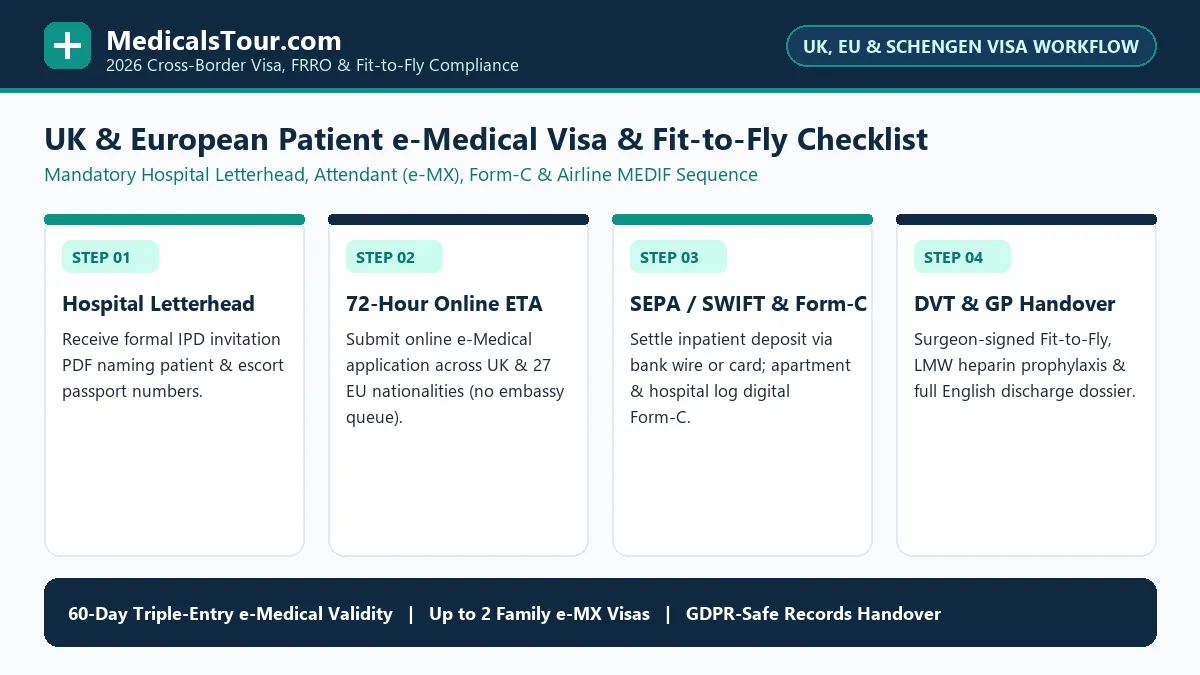
Continuity of Care Back in Europe: GP Sick Notes, Implant Cards & MRSA Rules
Returning smoothly into your national European public healthcare system after private surgery in India is completely lawful across every EU Member State, EEA nation, Switzerland, and the UK: under universal European medical ethics and statutory public-health law, your domestic GP, public hospital emergency department, and outpatient physiotherapist cannot refuse medically necessary aftercare, blood monitoring, or emergency follow-up simply because your primary surgery was self-paid outside Europe.
Eliminate administrative friction during your first two weeks back in Europe by packing five items inside your cabin carry-on folder:
- Typed English Operative & Discharge Summary: Listing ICD-10 diagnostic codes, ASA anesthesia chart, intraoperative findings, estimated blood loss, NABL microbiology clearance, and week-by-week physiotherapy weight-bearing milestones.
- Original Manufacturer Implant Passports & Peel-Off LOT Stickers: Confirming CE-marked and FDA-cleared Western hardware (Stryker, DePuy Synthes, Zimmer Biomet, Medtronic, Abbott, Edwards Lifesciences, Straumann, Nobel Biocare) recognized by European national arthroplasty, cardiac, and dental registries.
- Generic INN Medication Table: Listing active pharmacological molecules (apixaban, enoxaparin, pantoprazole, celecoxib, atorvastatin) rather than Indian commercial brand names so EU and UK community pharmacists dispense follow-up prescriptions immediately.
- Domestic MRSA Swab Awareness (Nordics & Netherlands): If you reside in the Netherlands, Sweden, Denmark, Norway, or Finland, book a quick outpatient MRSA/BRMO screening swab with your GP upon landing so domestic hospital infection flags clear before routine clinic visits.
- Domestic Tax & Sick-Leave Conversion: Visit your local European family doctor within 48 hours of return to convert surgical convalescence into official domestic sick-pay certificates (Arbeitsunfähigkeitsbescheinigung, arrêt de travail, certificato INPS, läkarintyg, baja médica, or Irish DSP MED1) and archive traceable SWIFT receipts for national income-tax relief where eligible. Explore all country-by-country guides on our International Medical Corridors Hub.
For smooth six-week and six-month surgical continuity, Indian quaternary departments also schedule complimentary post-return video follow-ups timed around European morning or afternoon hours—allowing your operating surgeon in Mumbai, Gurugram, New Delhi, or Chennai to review fresh domestic radiographs, PSA curves, echocardiograms, or wound photographs alongside your local European GP’s ongoing clinical care.