Late at night inside Terminal 3 at Cairo International Airport (CAI), boarding gates for EgyptAir’s eastbound widebody departures to Mumbai and New Delhi carry a noticeably different passenger mix than leisure flights headed to Sharm El-Sheikh or Milan. Alongside pharmaceutical executives and maritime engineers sit families from Heliopolis, Maadi, Mohandessin, Smouha in Alexandria, and Mansoura clutching rigid hand-luggage folders filled with triphasic liver CT discs, pediatric echocardiograms, and stamped Visa Invitation Letters. When EgyptAir restored and expanded direct six-hour corridors linking Cairo nonstop to both Mumbai (BOM) and New Delhi (DEL), it quietly reshaped North African quaternary healthcare referrals—eliminating Schengen transit-visa rejections in Frankfurt or Paris and pricing surgeries 75% below London’s Harley Street.
Egypt possesses deeply respected university professors and major domestic centers in hepatology and oncology, yet three structural pressures push complex cases across the Arabian Sea: severe waiting lists or donor-matching hurdles for haploidentical bone marrow transplantation, pediatric and adult redo cardiac valve/aortic reconstructions requiring mechanical circulatory backup, and living-related hepatobiliary or robotic cancer surgeries where imported consumables face erratic local supply chains. In Medical Tour’s 2026 North Africa corridor review, Egyptian households choosing JCI-accredited Indian centers saved $35,000 to $90,000 USD against European self-pay quotes while completing admission workups within 48 hours of landing.
This guide walks Egyptian patients and referring doctors through the exact Zamalek consular visa process, Central Bank of Egypt (CBE) outbound USD hospital wire documentation, nonstop EgyptAir versus Addis Ababa transit vaccination traps, and itemized Mumbai and New Delhi package tariffs.
Why Cairo and Alexandria Specialists Refer Quaternary Cases to Mumbai & Delhi
Understanding when an Egyptian patient genuinely benefits from flying to India starts with honest clinical triage. Primary coronary stenting, straightforward mitral valve replacements, routine breast lumpectomies, and standard laparoscopic bariatric procedures are performed every day in New Cairo, Sheikh Zayed City, and Alexandria at competitive Egyptian Pound (EGP) rates. Crossing six time zones makes clinical and financial sense only when institutional sub-specialty volume, imported device availability, or positive-pressure isolation infrastructure alters survival odds.
On India’s western coast—the closest nonstop widebody arrival point from Cairo—Apollo Hospitals in CBD Belapur, Navi Mumbai has emerged as a preferred landing hub for Egyptian hematology-oncology, bone marrow transplant, living-donor liver transplant, and robotic surgical oncology referrals. Planned from the ground up with wide infection-controlled corridors, HEPA-filtered BMT suites, TrueBeam STx stereotactic radiation, and Da Vinci robotic operating rooms, the Navi Mumbai campus sits away from South Mumbai’s congested peninsula real estate, allowing accompanying Egyptian relatives to rent spacious, modern apartments in Belapur, Seawoods, and Vashi at half the nightly cost of Bandra or Colaba.
For high-risk cardiovascular referrals—such as infants born with transposition of the great arteries, adults requiring third-time redo sternotomy after calcified rheumatic valve prostheses fail, or ischemic cardiomyopathy patients needing complex Dor ventricular restoration—families fly nonstop into New Delhi for Fortis Escorts Heart Institute on Okhla Road. Performing thousands of open-heart and structural catheter interventions annually, dedicated cardiac intensivists there maintain continuous bedside transesophageal echo, inhaled nitric oxide, intra-aortic balloon pumps, and adult/pediatric ECMO without relying on external equipment rentals.
Supply-chain certainty also plays a quiet, decisive role in 2026. Because major Indian corporate hospital chains purchase FDA- and CE-approved titanium implants, Abbott/Edwards heart valves, Medtronic neuro-navigation hardware, and targeted immunotherapy vials under nationwide annual dollar-hedged contracts, Egyptian families never have to hunt down scarce imported stents, vascular grafts, or liposomal antifungal vials through private distributors before an operation can start.
Equally decisive is rapid diagnostic turnaround inside a single campus. An oncology or hepatobiliary patient arriving from Heliopolis, Zamalek, or Tanta does not bounce across three separate imaging laboratories in Cairo traffic waiting ten days for molecular immunohistochemistry results; liquid biopsy NGS panels, 3-Tesla multiparametric MRI, whole-body FDG or Ga-68 DOTATATE PET-CT, and endoscopic ultrasound-guided fine-needle biopsies take place under one roof inside 48 hours of registration.

2026 Quaternary Surgical & Transplant Packages in USD ($) and EGP Context
Because the Egyptian Pound (EGP) operates under a flexible exchange regime (~48–51 EGP per USD in commercial bank trading), Indian international hospital desks quote and lock all Proforma Invoices strictly in US Dollars ($ USD). Locking your surgical estimate in USD protects both hospital and patient: your Single Private Room package price stays fixed for 30 to 60 days from quotation date regardless of EGP fluctuations back home.
| Quaternary Procedure (Mumbai & New Delhi JCI Centers) | Single Private Package (USD) | Private UK / Germany Self-Pay (USD) | Typical Hospital + Apartment Stay |
|---|---|---|---|
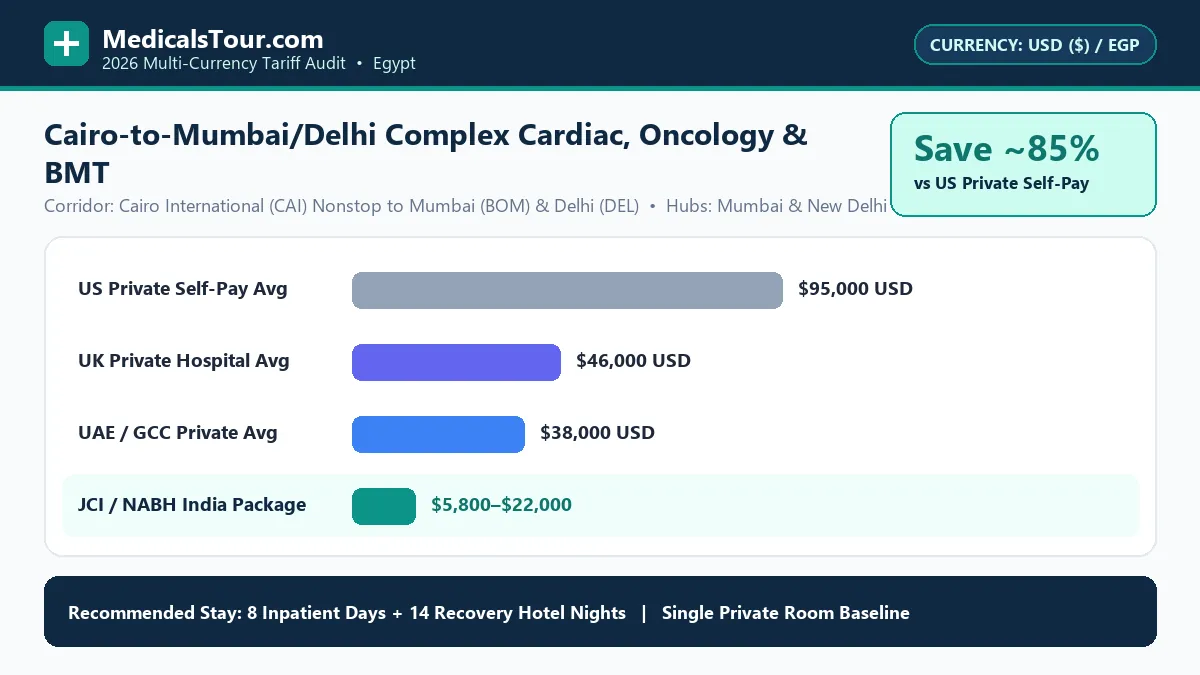
| Complex Redo Cardiac Valve / Double Valve + Maze | $7,400 – $10,800 | $48,000 – $95,000 | 7–8 Hosp + 10–12 Hotel Days |
| Pediatric Congenital Heart Surgery (TOF / VSD / Switch) | $5,900 – $10,500 | $52,000 – $120,000 | 8–10 Hosp + 10–12 Hotel Days |
| Da Vinci Robotic Radical Oncology Resection + PET-CT | $6,400 – $9,800 | $38,000 – $72,000 | 5–6 Hosp + 9–12 Hotel Days |
| Living-Related Kidney Transplant (Recipient + Donor) | $13,800 – $17,000 | $75,000 – $135,000 | 11 Hosp + 20–24 Apartment Days |
| Matched-Sibling / Haploidentical Bone Marrow Transplant | $20,500 – $36,500 | $145,000 – $310,000 | 25–30 Hosp + 30–35 Apartment Days |
| Living-Related Adult Liver Transplant (HCC / Cirrhosis) | $28,000 – $35,000 | $170,000 – $325,000 | 18–21 Hosp + 24–28 Apartment Days |
Review granular line-item inclusions inside our Heart Bypass & Cardiac Surgery Cost Guide and PET-CT, Radiation & Oncology Cost Guide. Remember that hepatocellular carcinoma (HCC) liver transplant candidates arriving from Cairo or Mansoura often require pre-transplant whole-body FDG PET-CT ($360–$460) to rule out extrahepatic spread, plus donor CT liver volumetry and MRCP ($650–$950) during outpatient Week 1 before the inpatient surgical package is triggered.
Patients arriving from Tanta, Assiut, or Zagazig with post-hepatitic portal hypertension and extensive portosystemic collateral varices should also budget $1,800 to $3,200 USD as a refundable ICU contingency reserve. Complex portal-vein thrombectomy, jump grafts using donor iliac conduits, or continuous renal replacement therapy (CRRT) during the first 72 hours post-reperfusion are billed strictly on actual consumable consumption rather than bundled into routine uncomplicated transplant rates.
Medical Visa Protocol in Zamalek, Cairo: Consular Checklist & Polio/YFV Rules
Egyptian passport holders should plan their visa pathway carefully depending on urgency and length of stay. While India periodically updates electronic visa eligibility tiers, Egyptian patients traveling for major inpatient surgery, organ transplantation, or multi-month hematology care overwhelmingly rely on the regular Paper Medical Visa (MED) and Medical Attendant Visa (MED-X) processed through the Embassy of India in Cairo (5 Aziz Abaza Street, Zamalek) and its authorized application center.
Documents Required for Cairo Medical Visa Submission
- Official Stamped Hospital Visa Invitation Letter (VIL): Issued directly by Apollo Navi Mumbai, Fortis Escorts Delhi, or another NABH/JCI hospital, addressed explicitly to the Consular Section, Embassy of India, Cairo. The hospital emails an identical copy directly from its institutional server to the Embassy’s verification inbox—consular staff will hold any application whose VIL has not arrived from an official hospital domain.
- Egyptian Local Medical Diagnosis & Passports: Original passports valid for at least 6 months with two blank pages, Egyptian National ID copies translated or matched to English passport names, recent diagnostic summaries (pathology, echo, or MRI), and completed online regular visa forms printed with barcoded reference numbers.
- Bank Solvency & Kinship Proof for MED-X Attendants: Six months of stamped bank statements (EGP or USD account at NBE, CIB, QNB Alahli, or Banque Misr) demonstrating ability to cover the Proforma Invoice, plus birth or marriage certificates proving relationship for up to two accompanying attendants (plus a separate living donor if applicable).
- Oral Polio / IPV Vaccination Certificate: Under standing Indian Ministry of Health port-health advisories covering travelers resident in listed countries, carry a stamped official vaccination certificate received at least four weeks prior to departure from an Egyptian Ministry of Health international vaccination office.
Verified urgent pediatric cardiac, acute leukemia, and decompensated liver referrals flagged by the Indian hospital’s international director typically receive consular clearance in Zamalek within 3 to 6 working days. Male Egyptian applicants and accompanying brothers or adult sons aged 18 to 40—including prospective living liver or kidney donors—must also remember domestic Egyptian departure clearance rules: obtain your valid military exemption, postponement, or travel permit certificate (Tasreeh Al-Safar) from the Ministry of Defense mobilization administration in Cairo before heading to Terminal 3, as Egyptian airport emigration officers inspect military travel permits independent of your Indian Medical Visa.
EgyptAir Nonstop (CAI–BOM & CAI–DEL) vs Yellow Fever Transit Pitfalls
One aviation detail saves Egyptian medical travelers from a devastating six-day airport quarantine in Mumbai or New Delhi: how you route your flight out of Cairo. Egypt itself is classified by international health authorities as free of endemic Yellow Fever transmission when flying nonstop or transiting through the Arabian Gulf. However, bargain flight search engines frequently tempt Cairo travelers with cheap one-stop fares via Addis Ababa (ADD) on Ethiopian Airlines or Nairobi (NBO).
Under strict Government of India Port Health Organisation (APHO) rules, any passenger—including an unwell cancer or liver patient—who transits an airport inside a Yellow Fever endemic country (even airside without leaving the terminal in Addis Ababa!) must present a valid Yellow Fever Vaccination Certificate issued at least 10 full days prior to arrival, or face mandatory isolation at an airport quarantine hospital! Worse still, live-attenuated Yellow Fever vaccine is medically contraindicated in immunocompromised oncology, BMT, steroid-dependent, and infant patients under nine months old.
The solution is simple and categorical: fly either EgyptAir nonstop from Cairo Terminal 3 (`MS 968` to Mumbai BOM in ~5 hours 45 minutes, or `MS 973` to New Delhi DEL in ~6 hours) or connect exclusively via Yellow-Fever-exempt Gulf hubs—Dubai (Emirates), Abu Dhabi (Etihad), Doha (Qatar Airways), Muscat (Oman Air), Kuwait, or Bahrain (Gulf Air). Booking EgyptAir nonstop also allows 48-hour pre-clearance of cabin medical oxygen or commercial economy stretchers directly through EgyptAir’s Cairo Medical Centre near the airport complex.
Families traveling from Alexandria (Borg El Arab Airport, HBE), Luxor, or Assiut who do not wish to drive three hours along the Cairo–Alexandria Desert Road with a fragile spine or cardiac patient can book single-ticket Flydubai, Qatar Airways, Air Arabia, or Saudia departures straight from Borg El Arab via Gulf hubs into Mumbai T2 or New Delhi T3, keeping baggage checked all the way through to India while maintaining complete Yellow Fever exemption.

Central Bank of Egypt (CBE) USD Hospital Wires, Card Caps & Customs Rules
Navigating Egyptian foreign-currency controls legally and calmly is half the battle when funding a $9,000 cardiac surgery or a $31,000 transplant. Over the past three years, Egyptian banks have maintained strict monthly foreign-currency spending caps on standard EGP debit and credit cards used overseas, meaning a family cannot simply swipe a domestic EGP Visa card for $15,000 at an Indian hospital cashier.
Three Safe, Compliant Payment Routes from Egypt
- Direct Bank-to-Hospital USD Medical Wire (Recommended): Egyptian banking regulations explicitly permit outbound foreign-exchange transfers for verified overseas medical treatment. Present your stamped Indian hospital Proforma Invoice (showing corporate beneficiary bank details, IBAN/account number, and SWIFT code), your stamped Indian Medical Visa, passport, and local medical referral report to your relationship manager at Commercial International Bank (CIB), National Bank of Egypt (NBE), Banque Misr, or HSBC Egypt. When wired directly to the hospital’s corporate account—never to a personal broker’s account—compliance teams approve and transmit USD funds within 3 to 5 business days. See our Hospital Forex & SWIFT Wire Transfer Guide for exact MT103 tracking steps.
- Existing USD Foreign-Currency Accounts & USD Debit Cards: Patients holding personal USD accounts in Cairo can wire directly or swipe USD-denominated international cards after notifying bank fraud desks 48 hours ahead to lift daily Point-of-Sale healthcare ceilings.
- Declared Physical USD Cash Within Airport Limits: Observe Cairo Airport outbound cash regulations strictly (Egyptian customs caps physical foreign-currency cash carried out per passenger—verify current $10,000 USD traveler thresholds before departure) and declare sums above $5,000 USD banknotes at Indian Customs Red Channel upon landing at BOM or DEL to receive a stamped Currency Declaration Form (CDF).
Egyptian expatriates working in Riyadh, Jeddah, Dubai, Kuwait City, or Doha who are sponsoring surgery in India for elderly parents flying out of Cairo enjoy an even simpler settlement route: the Gulf-based son or daughter can wire the surgical deposit directly in USD, SAR, AED, or KWD from Al Rajhi Bank, Emirates NBD, NBK, or QNB straight into the Indian hospital’s corporate account while quoting the parent’s Egyptian passport number and UHID, bypassing Egyptian domestic FX paperwork altogether.
Living-Donor Transplant Attestation at the Egyptian Embassy & Halal Recovery Stays
Because hepatitis-related cirrhosis and hepatocellular carcinoma have historically driven significant hepatobiliary demand along the Nile Valley, Egyptian families frequently ask whether they can travel to Mumbai or New Delhi for living-donor liver transplantation. Yes—provided every statutory step of India’s Transplantation of Human Organs Act (THOA) is respected to the letter. Donors must be first-degree blood relatives (son, daughter, brother, sister, parent) or a legally wedded spouse aged 18 to 50 with compatible blood group, BMI typically below 28, and zero hepatic steatosis or viral hepatitis.
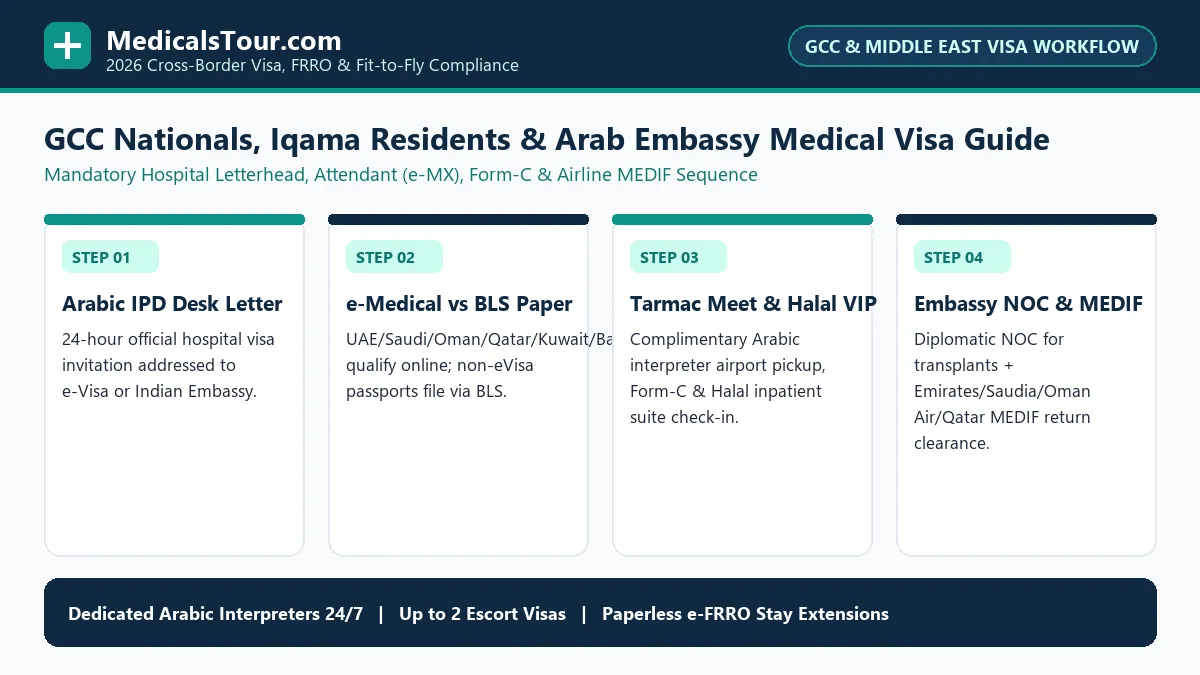
Before leaving Cairo, obtain official computerized civil family records (Qaid Aily) and birth/marriage certificates from the Egyptian Civil Status Organization (Al-Segel Al-Madani), have them translated into English, and get them attested by the Egyptian Ministry of Foreign Affairs ratification offices. Once in India, your hospital transplant coordinator submits those attested civil proofs alongside HLA/DNA kinship reports to the Embassy of the Arab Republic of Egypt in Chanakyapuri, New Delhi (or the Egyptian Consulate General in Mumbai where applicable for preliminary verification before diplomatic Form-21 issuance) to obtain the statutory No Objection Certificate required by the Authorization Committee.
| Hospital Hub | Preferred Egyptian Family Neighbourhoods | Nightly Serviced Flat / Hotel (USD) | Kitchen, Halal Food & Commute Advantages |
|---|---|---|---|
| Apollo Navi Mumbai (CBD Belapur) | CBD Belapur Sector 15, Seawoods Grand Central & Vashi | $42 – $95 / night | Wide palm-lined avenues, Courtyard by Marriott & Park Hotel nearby, elevator 1BHK/2BHK flats, abundant halal meat & fish markets within 10 mins. |
| Fortis Escorts (Okhla Road, South Delhi) | New Friends Colony, Sukhdev Vihar & Crowne Plaza Okhla | $45 – $125 / night | 5–10 min cab to hospital gates; walkable Arabic/Mughlai halal bakeries, 24-hour chemists, and Violet/Magenta Metro connectivity. |
Both Belapur in Navi Mumbai and Okhla/New Friends Colony in South Delhi host longstanding Muslim residential communities with mosques within five minutes’ walk of inpatient gates, certified halal poultry and mutton shops, and Arabic-speaking hospital guest-relations officers who assist Egyptian families with local SIM activation, laundry, and online FRRO registration.
Post-Discharge Fit-to-Fly Timing & Continuity of Care Back in Cairo
Rushing onto an EgyptAir return flight 48 hours after inpatient discharge is the most common mistake families try to make when hotel budgets tighten. After open-heart surgery, craniotomy, robotic oncological resection, or renal transplantation, cabin pressure equivalent to 6,000–8,000 feet expands trapped post-operative air pockets and elevates deep-vein thrombosis risk. Budget at least 8 to 12 post-discharge apartment days for cardiac and major oncology surgeries—and 3 to 4 post-discharge weeks for liver or bone marrow recipients—so your primary surgeon can remove skin staples, verify chest X-ray Pleural clearance, and titrate oral anticoagulants or tacrolimus doses accurately.
During your final outpatient clinic visit in Navi Mumbai or South Delhi, obtain a stamped Fit-to-Fly Medical Certificate issued within 48 to 72 hours of your scheduled flight, and submit EgyptAir’s MEDA/MEDIF form early if you require airport wheelchair lift (`WCHC`) or extra legroom Bulkhead seating.
According to Medical Tour’s post-discharge follow-up checks, Egyptian patients transition smoothest back to consultants at Kasr Al-Ainy, Ain Shams University Specialized Hospital, or private Cairo clinics when they hand-carry three items: sealed 90-day manufacturer boxes of prescribed immunosuppressants or targeted therapies with stamped hospital tax receipts for Cairo Airport customs, a cloud-linked archive of pre- and post-operative DICOM imaging, and a direct WhatsApp/tele-medicine escalation contact with their Indian surgical registrar. Explore neighboring routes on our Medical Corridors Hub and map out flights, visas, and apartment nights inside our Medical Trip Budget Planner.