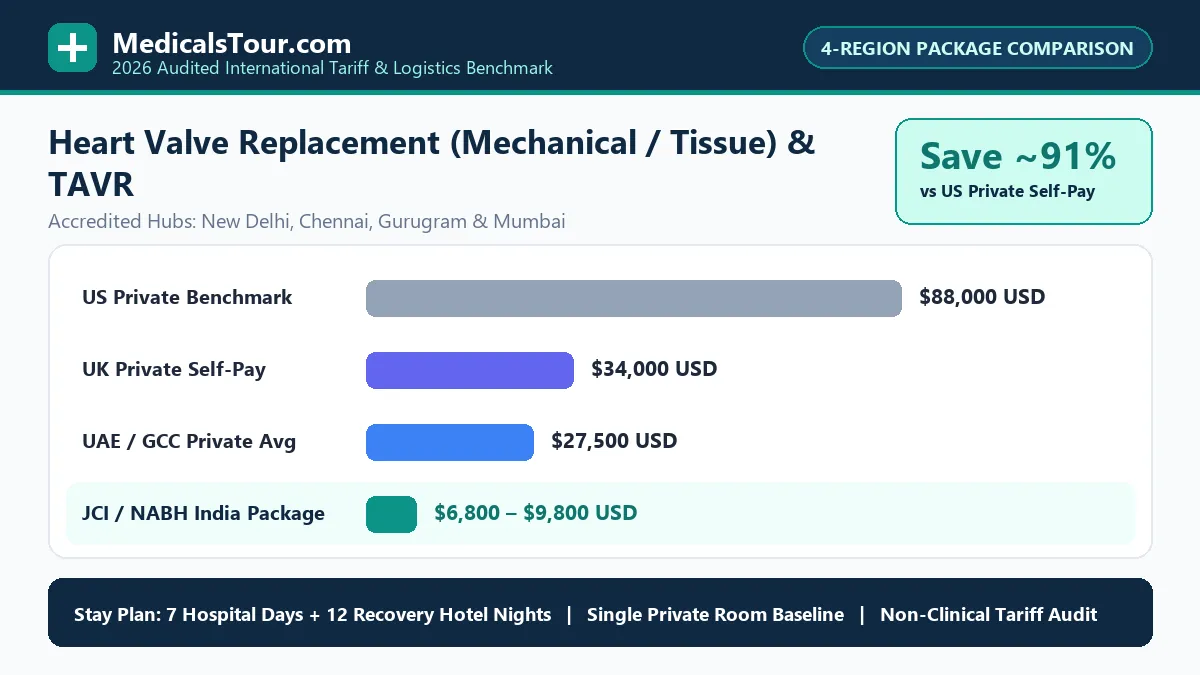
Self-paying international patients researching Heart Valve Replacement (Mechanical / Tissue) & TAVR regularly encounter a wide gap between headline clinic advertisements and the actual door-to-door invoice settled at hospital discharge. Across JCI and NABH accredited centres in New Delhi, Chennai, Gurugram & Mumbai, verified 2026 package tariffs range between $6,800 and $9,800 USD in a standard Single Private Room, compared with private self-pay averages of $88,000 in the United States, $34,000 in the United Kingdom, and $27,500 across UAE and GCC private hospitals. Even after factoring round-trip airfare for the patient and an accompanying family member, statutory e-Medical Visa fees, and 12 post-discharge recovery nights in a nearby serviced apartment, international families from Africa, GCC, CIS & UK routinely retain 60% to 80% in net audited savings.
This independent non-clinical cost guide dissects every billing line item behind Heart Valve Replacement (Mechanical / Tissue) & TAVR—separating fixed inpatient operating theatre bundles from variable room-category multipliers, imported implant or consumable tiers (Edwards Lifesciences Inspiris/Magna Bioprosthetic, Abbott St. Jude Mechanical, Meril Myval / Edwards SAPIEN TAVR), pre-admission outpatient diagnostics, and airline Fit-to-Fly buffer days. Every figure is calibrated for financial planning so families can request an apples-to-apples written Proforma Estimate from an accredited hospital’s International Patient Desk before booking flights.
Key Financial & Logistics Takeaways Before You Book
Our quarterly audit of published international patient desk schedules highlights three high-impact rules specific to Heart Valve Replacement (Mechanical / Tissue) & TAVR:
- Separate open surgical valve replacement ($6,800–$9,800 total) clearly from Transcatheter Aortic Valve Replacement (TAVR/TAVI): catheter-delivered TAVR costs $18,500–$24,000 with CE-approved Indian Meril Myval valves or $27,000–$34,000 with imported Edwards SAPIEN / Medtronic Evolut valves—still 65%+ below US $110,000+ TAVR charges.
- Before traveling for elective heart valve replacement, complete any pending dental extractions or root canals 3 weeks earlier if medically safe, as untreated oral infection delays cardiac theatre clearance due to endocarditis precautions.
- Patients receiving mechanical valves need 7–10 post-discharge days for stable INR anticoagulation target calibration before boarding long-haul flights.
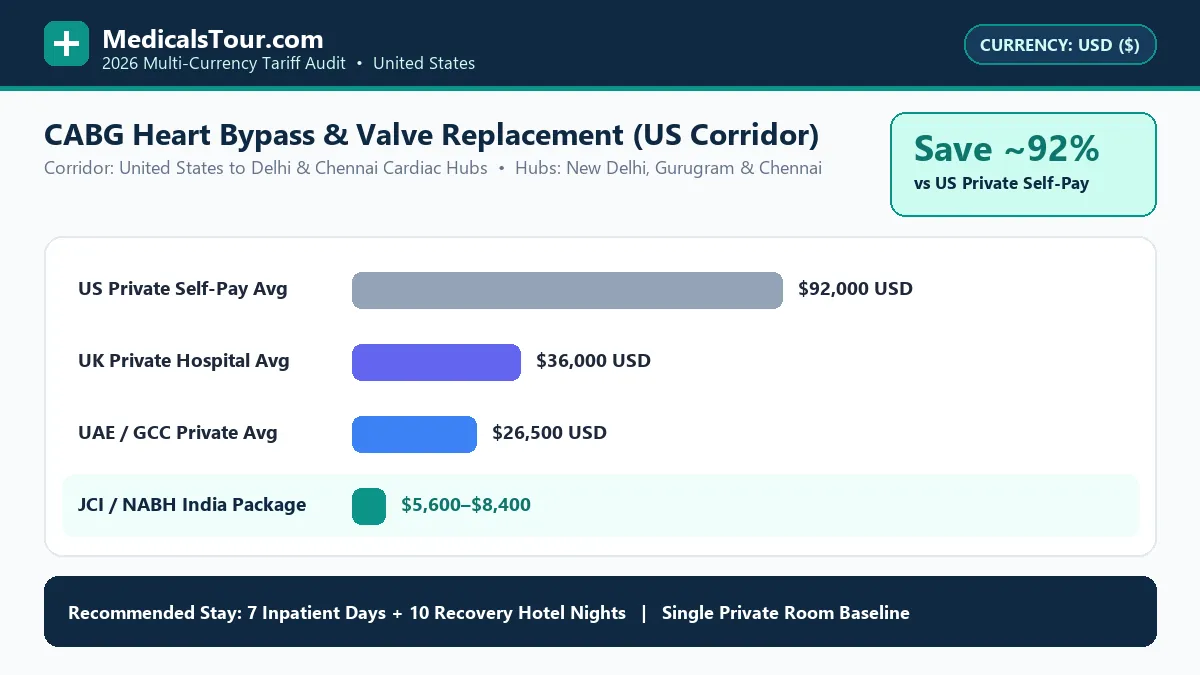
Before wiring any admission deposit or locking non-refundable airfare, cross-check your complete trip numbers inside our Medical Trip Total Budget Planner and compare related benchmarks across the Treatment Costs Silo Hub, including Coronary Artery Bypass Grafting (Off-Pump / Beating-Heart CABG) and Oncology Diagnostics, Robotic Tumor Resection & IMRT Radiation.
Itemized Cost & Logistics Breakdown (2026 Audited Schedule)
When requesting a formal Proforma Invoice from an accredited hospital’s International Patient Department (IPD), ask the coordinator to unbundle every clinical, hardware, and stay component rather than quoting a single lump-sum figure. The itemized schedule below reflects 2026 international self-pay benchmarks for Heart Valve Replacement (Mechanical / Tissue) & TAVR across New Delhi, Chennai, Gurugram & Mumbai:
| Cost / Logistics Component | Audited Scope & Billing Notes | 2026 Benchmark (USD) |
|---|---|---|
| 3D Transesophageal Echo (TEE), Cardiac CT & Dental Clearance | Annulus sizing CT, coronary angiogram & infection-focus check | $380 – $620 |
| Surgical Valve Prosthesis (St. Jude Mechanical vs Edwards Tissue) | Imported mechanical ($1,300–$1,800) or bovine pericardial ($2,100–$3,200) | $1,300 – $3,200 |
| Open / Mini-Sternotomy Cardiopulmonary Bypass Theatre & ICU | Heart-lung machine, 3 days CTVS-ICU + 4–5 days Single Private Room | $4,800 – $6,200 |
| Alternative: Transcatheter Aortic Valve (TAVR/TAVI) Total Range | Catheter valve deployment without open surgery ($18,500–$29,000) | Separate Cath-Lab Tier |
| Anticoagulation INR Stabilization & Warfarin/ Medication Kit | Titration visits prior to discharge & outpatient lab check | $95 – $180 |
| 12 Nights Recovery Apartment Near Cardiac Outpatient Desk | Follow-up echo & airline MEDIF Fit-to-Fly paperwork | $780 – $1,020 |
Important Currency & Tax Note: Indian tertiary hospitals issue official tax invoices denominated in Indian Rupees (INR), converting USD, GBP, EUR, AED, OMR, or SAR benchmark quotes at the hospital’s published daily RBI-authorized bank exchange rate on admission day. Under current healthcare tax rules, core inpatient clinical surgical packages are exempt from GST, whereas standalone luxury room rentals exceeding ₹5,000 INR per night (~$60 USD/night) attract a statutory 5% hospital room GST component without input credit—typically adding $35 to $95 total across a standard inpatient stay.
Room Category Multipliers, Hardware Tiers & Out-of-Pocket Buffers
The #1 surprise for first-time medical travelers is how Indian private hospital tariff books link surgeon fees, nursing charges, and operating theatre consumables directly to the inpatient room category you select at check-in. Moving up one room tier does not merely add the nightly hotel-style room differential; it applies a structured percentage multiplier across the entire clinical package:
| Inpatient Room Tier | Companion & Amenity Standard | Indicative Tariff Impact |
|---|---|---|
| Economy Twin-Sharing Room | 2-bed air-conditioned ward separated by privacy screen; shared visitor hours; standard dietitian meals. | $5,984 – $8,624 (10%–14% below Private base) |
| Standard Single Private Room | Private room + en-suite washroom, 1 dedicated companion sofa-cum-bed, Wi-Fi & patient/attendant breakfast. | $6,800 – $9,800 (Recommended International Baseline) |
| Deluxe / VIP International Suite | Two-bay suite with separate family lounge, microwave/fridge, priority lounge check-in & concierge nursing. | $8,568 – $12,936 (+22% to +35% linked package uplift) |
In addition to room-tier selection, verify exact device, laboratory, or technical specifications written on your estimate—specifically Edwards Lifesciences Inspiris/Magna Bioprosthetic, Abbott St. Jude Mechanical, Meril Myval / Edwards SAPIEN TAVR. Accredited International Patient Desks willingly state the exact FDA-cleared or CE-marked implant family, diagnostic protocol, or documentation standard on your written pre-arrival confirmation. Finally, set aside a dedicated 10% to 15% contingency reserve in an accessible multi-currency card or bank account to cover unbundled outpatient take-home medications ($65–$190), extra diagnostic imaging if pre-existing conditions (such as uncontrolled blood sugar, hypertension, or anemia) require pre-op stabilization, or 2–3 extra apartment buffer nights.
Customize Your Heart Valve Replacement (Mechanical / Tissue) & TAVR Trip Budget
Toggle your preferred currency, medical companion count, and nearby recovery hotel tier in New Delhi, Chennai, Gurugram & Mumbai (7 hospital days + 12 hotel recovery nights).
Accredited Hub Comparison: Airport Proximity, Apartments & Patient Desks
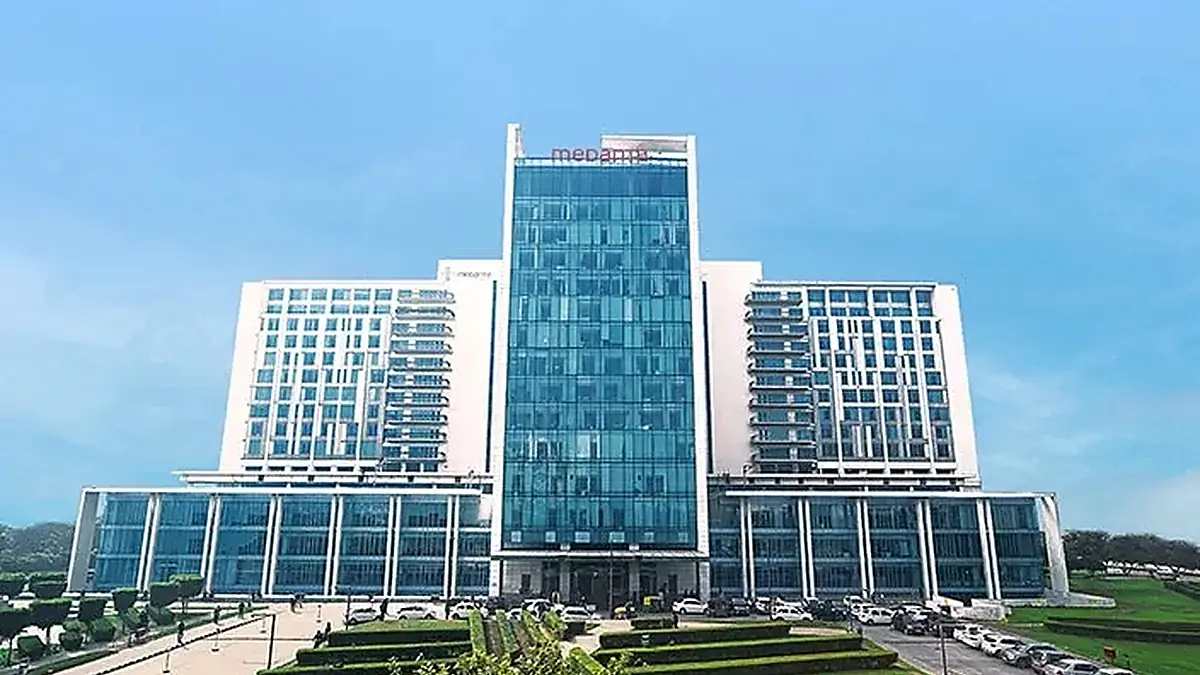
International families traveling from Africa, GCC, CIS & UK typically shortlist four primary JCI and NABH healthcare corridors depending on nonstop flight availability, weather preferences, and post-discharge apartment budgets. All four hubs maintain dedicated International Patient Lounges offering complimentary airport transfers, foreign-exchange counters, Form-C registration, and medical interpreters:
| Healthcare Hub & Campus Cluster | Accreditation Ecosystem | Serviced Apartment Rate | Airport Transit & Corridor Advantage |
|---|---|---|---|
| New Delhi (Sarita Vihar & Saket) | JCI + NABH + NABL Flagships | $50 – $90 / night | DEL T3 (25–40 min) — Nonstop UK, US, EU & GCC |
| Gurugram (Sector 38 & Sector 44) | JCI + NABH Quaternary Campuses | $42 – $82 / night | DEL T3 (20–30 min) — Walkable patient guest houses |
| Mumbai (Andheri West & Navi Mumbai) | JCI + NABH + CAP Full-Time Specialist | $65 – $115 / night | BOM T2 (20–35 min) — Shortest Muscat/Dubai/Nairobi hop |
| Chennai (Greams Road & OMR) | JCI + NABH + Proton Oncology Hub | $40 – $75 / night | MAA (30–40 min) — 10%–18% lower room & stay tariffs |
Before confirming any hospital or standalone clinic, verify its active 3-year accreditation cycle independently using our JCI vs NABH Hospital Accreditation Verification Guide. Selecting a facility with active JCI Gold Seal or Full 5th-Edition NABH accreditation ensures documented HEPA-filtered modular operating theatres, NABL/CAP cross-matched blood banks, clinical pharmacist medication reconciliation, and standardized English operative and discharge records accepted by doctors in your home country.
Step-by-Step Visa, Arrival & Fit-to-Fly Schedule (21-Day Planning Window)
Rushing return flights immediately after hospital discharge is both medically unsafe and financially costly if an airline denies boarding at the check-in counter. Based on a benchmark allocation of 7 inpatient hospital days and 12 nearby hotel or serviced apartment recovery nights, experienced medical travel coordinators structure the journey across five predictable stages:
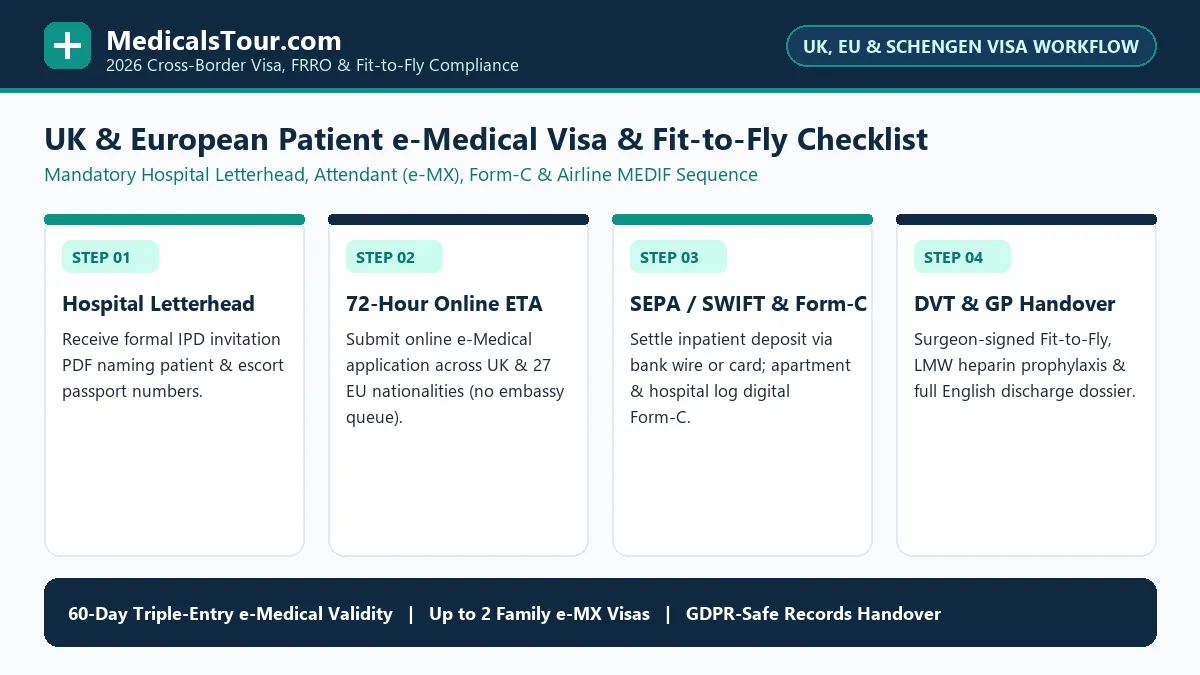
- Pre-Departure Records & Proforma Lock-In (Days -21 to -10): Upload existing DICOM scans (MRI, CT, CBCT, angiogram, or lab panels) to two accredited International Patient Desks to compare written Single Private Room estimates side by side. Once you choose a hospital, email passport bio-page scans for the patient and up to two family escorts to receive the official letterhead Visa Invitation Letter within 24 hours.
- Visa Approval & Semi-Flex Flight Booking (Days -10 to -3): Apply online under Indian e-Medical Visa + Companion e-MX Visa via the official government portal (review our e-Medical Visa Checklist and Medical Attendant e-MX Guide). Book changeable/semi-flexible return airfare rather than rigid non-refundable saver tickets, and notify your home bank prior to initiating any SWIFT deposit wire (Hospital SWIFT & Forex Billing Rules).
- Arrival, Outpatient Workup & Admission (Days 1 to 2): Land at the hub airport, meet the hospital’s international arrival coordinator, activate a local passport-verified 5G SIM/eSIM, and complete pre-admission outpatient blood panels, imaging verification, anesthesia fitness review, and face-to-face surgeon consultation before signing the informed consent and room-tier tariff sheet.
- Procedure & Monitored Inpatient Care (7 Hospital Days): Undergo the scheduled procedure or clinical protocol with daily international coordinator updates, clinical nutrition support, and early inpatient mobilization. One adult companion typically stays in-room inside a Single Private Room while daily interim billing statements remain available on request.
- Apartment Recovery, Suture Review & Aviation Clearance (12 Recovery Nights): Transition to a Form-C registered serviced apartment or hotel within 5–15 minutes of the hospital for follow-up outpatient dressing/lab checks. Observed clearance benchmark: 18–21 days after open surgical AVR/MVR; 7–10 days after transfemoral catheter TAVR/TAVI. Collect your surgeon-signed Fit-to-Fly Certificate (plus airline MEDIF approval 48–72 hours prior to departure if required), laminated implant/device ID cards, and complete English discharge dossier in cabin baggage.
Pre-Departure Financial & Paperwork Audit Checklist
Use this final six-point verification checklist before paying any deposit or departing for New Delhi, Chennai, Gurugram & Mumbai:
- Written Package Inclusions & Exclusions: Confirm in writing how many ICU and ward bed days, implant/consumable units, pre-op scans, and post-discharge OPD follow-up visits are bundled inside the quoted $6,800–$9,800 range—and ask for the per-day overstay tariff if an extra observation day is needed.
- Form-C Accommodation Compliance: Book only licensed hotels, hospital guest houses, or serviced apartments that explicitly issue digital Bureau of Immigration Form-C receipts on check-in; you will need Form-C immediately if treatment requires an online e-FRRO Medical Visa Extension.
- Customs Currency Declaration (>$5,000 Cash Rule): Prefer direct corporate SWIFT bank wires against an official Hospital Proforma Invoice or limit-raised Visa/Mastercard payments; if carrying over $5,000 USD in notes, obtain a stamped Airport Customs Currency Declaration Form (CDF) on arrival.
- Home-Country Continuity Records: Before leaving the hospital on discharge day, verify that you hold digital DICOM links/USBs of pre- and post-procedure imaging, batch/serial stickers for any implanted hardware, histopathological block/slide summaries where relevant, and generic chemical names (not only Indian brand names) for all discharge medications.
Ready to personalize these numbers for your exact departure airport, preferred currency (USD, GBP, EUR, AUD, AED, OMR, SAR, or INR), and hotel star rating? Open our interactive Medical Trip Total Budget Planner or browse all verified guides under Treatment Costs.
Comparing flights, currency rules, and companion visas from North America, Europe, or the Gulf? Review Medical Tour’s country-specific travel dossiers—including our Germany & Austria (DACH) to India Accredited Hospital Guide and full 99-guide International Patient Blog Index.